
Festival snackers keeping an eye on portions
You want to know how much energy is in your portion. A salty or sweet flavour and a light, airy texture don’t, in themselves, tell you whether a snack is right for you.


First, choose between ready-to-eat popcorn and popcorn that needs to be prepared. Then compare the energy content for the same quantity and preparation basis. According to the European Commission, solid foods can only be described as ‘low energy’ if they contain no more than 40 kcal per 100 g. A smaller portion may provide less energy, but that doesn’t automatically make popcorn low in calories.
You want to know how much energy is in your portion. A salty or sweet flavour and a light, airy texture don’t, in themselves, tell you whether a snack is right for you.
You can prepare and portion popcorn at home, but want to know which preparation method and storage instructions apply to the product.
You consider ingredients and allergens as well as energy content, whether you’re choosing packaged popcorn or buying it from a festival stall.
A good fit if: you want a savoury snack that needs no preparation.
What to consider: Jumbo Popcorn Salted lists 481 kcal per 100 g, while AH Salted popcorn lists 543 kcal per 100 g. Both are above the threshold for a ‘low energy’ claim, so compare the amount you actually eat. The label values are from Jumbo and Albert Heijn.
A good fit if: you want a sweet snack and plan your portion in advance.
What to consider: Jumbo Popcorn Sweet lists 406 kcal and 48.6 g of sugars per 100 g; AH Sweet popcorn lists 419 kcal and 45 g of sugars; and AH Caramel popcorn lists 435 kcal and 57 g of sugars. The AH caramel variety contains milk and lactose. These are label details for the varieties mentioned, not a general comparison of the brands.
A good fit if: you can use a microwave before setting off and want to portion it yourself.
What to consider: Jumbo Microwave Popcorn Salted lists 391 kcal per 100 g, while AH Microwave Popcorn Salted lists 435 kcal per 100 g. The label values describe the product as sold; don’t compare them directly with the same weight of popped popcorn. The product information is from Jumbo and Albert Heijn.
A good fit if: you want to decide how much oil, sugar or salt to add.
What to consider: AH Organic Popcorn Kernels lists 374 kcal per 100 g for the unprepared product; the pan method uses oil. The same quantity of kernels is not directly comparable with popped popcorn. The label notes that the product may contain cereals containing gluten, soya and wheat.
| What to consider | What should you check? | Who may find this important? |
|---|---|---|
| Energy per portion | Compare kcal per 100 g on the same preparation basis, then calculate: kcal per 100 g × grams eaten / 100. | I want to know how much energy is in my festival portion, so I compare labels on the same basis. Around 36% of consumers prioritise energy per portion. |
| Preparation and convenience | Check whether the popcorn is ready to eat, needs a microwave or has to be prepared at home. Also check the storage instructions. | If I want to snack straight away at the festival, I prefer something that doesn’t need preparing. Around 29% of consumers give convenience top priority. |
| Flavour and ingredients | For the exact variety, read the nutrition information, ingredients and allergen details. If buying loose popcorn, ask for allergen information. | If flavour or a particular ingredient matters most to me, I look beyond kcal alone. An estimated 21% of consumers prioritise ingredients and dietary requirements. |
| Cost for the quantity you need | Compare the current price for the same quantity. For unprepared kernels, remember to factor in oil and any other additions. | I want to know what the quantity of snacks I need will cost, not just the price of one pack. Around 14% of consumers prioritise the overall cost of their snacks. |
The threshold for a claim on solid foods applies per 100 g, not per bag or portion.
Describe the energy content of the amount you eat, and assess any calorie claim separately. According to the European Commission, a ‘low energy’ claim is permitted only for products containing no more than 40 kcal per 100 g.
AH Salted popcorn lists four 25 g portions in a 100 g bag. The energy in one label portion is therefore not the same as the energy in the whole bag.
Decide in advance how much you want to take and divide up the bag if you want to limit your portion.
The label value for AH Organic Popcorn Kernels applies to the unprepared product. The pan instructions use oil, so the complete preparation is different from the kernels alone.
Compare products on the same preparation basis and take oil and any other additions into account.
Preparing it yourself takes planning; oil and flavourings are also part of the preparation.
Sugars and allergens answer different questions from energy content. For example, AH Caramel popcorn lists milk and lactose, and sweet varieties can contain relatively high amounts of sugar per 100 g.
Check the nutrition information and ingredients for the exact variety. If buying loose popcorn, ask about relevant allergens before you buy.
The own-brand range includes ready-to-eat salted, sweet and caramel popcorn, microwave popcorn and organic popcorn kernels.
The varieties mentioned include ready-to-eat sweet and salted popcorn, as well as salted microwave popcorn.
Snack Day includes a 200 g ready-to-eat sea salt variety and salted microwave popcorn in a pack of 3 × 100 g.
Sun Snacks Salted popcorn is listed as a ready-to-eat variety in a 100 g bag.
This selection includes ready-to-eat salted popcorn, microwave popcorn and loose popcorn kernels to prepare at home.
 No image available
A good fit if you want ready-to-eat salted popcorn and prefer to decide how much to take with you.
Pack size: 100 g.
 No image available
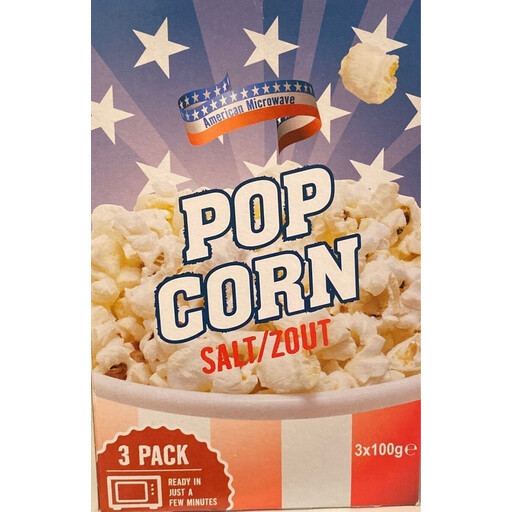
A good fit if you can prepare the popcorn before setting off; this variety needs a microwave.
Pack size: 3 × 100 g.
 No image available
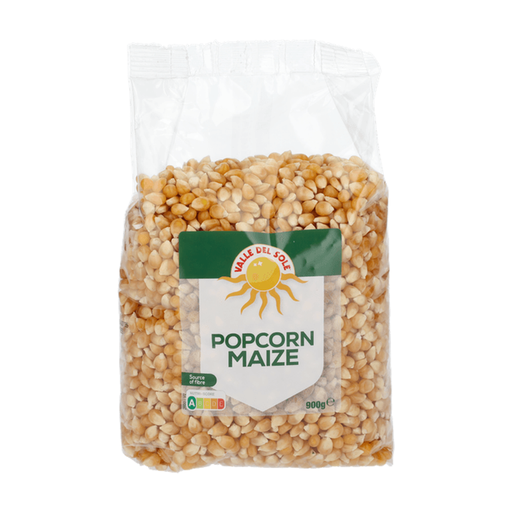
A good fit if you want to prepare loose popcorn kernels at home instead of buying ready-to-eat popcorn.
Pack size: 900 g. The preparation described requires a pan and vegetable oil; prepare the kernels before setting off.
Not simply because the bag is small. According to the European Commission, the ‘low energy’ claim for solid foods is limited to a maximum of 40 kcal (170 kJ) per 100 g. It’s better to describe the energy in your own portion than to call a product low calorie based on the size of the bag.
Multiply the kcal per 100 g for the exact product by the number of grams eaten, then divide by 100. For 25 g of AH Salted popcorn, that’s: 543 × 25 / 100 = 135.75 kcal, rounded to 136 kcal. This is a calculation example, not a recommended portion or personal limit.
Only if the values are based on the same preparation method. The Dutch product information for the microwave varieties mentioned gives values per 100 g of the product as sold; don’t assume these are values per 100 g of prepared popcorn without checking. Your Europe explains that nutrition values refer to the food as sold.
Follow the instructions for the exact variety and take care around heat and steam. Albert Heijn advises staying nearby while the popcorn is popping and opening the bag carefully for the microwave popcorn mentioned. Jumbo warns that children need adult supervision and that you shouldn’t restart the preparation after interrupting it.
Before buying, ask about allergens in the popcorn and any toppings. According to the Netherlands Food and Consumer Product Safety Authority, information about allergens present must be available for non-prepacked foods. In certain circumstances, this information can be given verbally, provided there’s a visible notice telling you that you can ask for it.