
Shoppers comparing labels with fat in mind
You want to choose popcorn based on its total and saturated fat content, without treating a small portion or the word ‘popcorn’ as proof that it is a low-fat product.


First, choose between microwave bags to prepare at home, ready-to-eat popcorn that you portion yourself, or loose popping corn that you prepare yourself. Then compare the fat per 100 g and match your portion to the nutrition information. A multipack or small portion does not automatically mean the popcorn meets the European threshold for a ‘low fat’ claim.
You want to choose popcorn based on its total and saturated fat content, without treating a small portion or the word ‘popcorn’ as proof that it is a low-fat product.
You want to take popcorn with you without having to prepare it on the go. Distinguish between ready-to-eat popcorn that you portion yourself and microwave bags that need to be cooked first.
You want to prepare a separate bag at home for each snack occasion, then share out the popcorn. The weight of a bag for preparation is not the same as a planned serving.
First choose the format that suits how you’ll use it, then compare the nutrition information with the amount you actually eat.
| What to consider | What to look for when buying | Who should pay particular attention? |
|---|---|---|
| Total fat and saturated fat | Compare fat and saturated fat per 100 g on the same product basis. Then work out how much is in your own portion. | If you’re mainly watching your fat intake, compare the figures per 100 g rather than looking only at a small portion. Around 36% of consumers prioritise total fat and saturated fat. |
| Lunchbox portions | Check how many individual bags there are and the weight of each one. Also see whether the popcorn is ready to eat or needs preparing. | For your lunchbox, you’ll want popcorn you can eat without preparing it; a serving size shown on the label doesn’t automatically mean it comes in a separate bag. Around 29% of consumers prefer a convenient portion to take with them. |
| Preparing and sharing at home | Check whether the product is ready to eat or needs to be microwaved, and follow the preparation instructions on the packaging. | If you want to serve popcorn at home, it’s useful to know whether you need to prepare a bag or can portion it straight away. Around 21% of consumers focus mainly on convenience when choosing a snack for home. |
| Sugar, salt and cost | As well as fat, check sugar, salt and energy. Compare the cost for the same amount and factor in portioning it yourself. | If you’re considering the overall nutritional profile and practical cost as well as fat, you’ll want to look beyond a single nutrient. Around 14% of consumers make this their first consideration. |
A serving size of, for example, 30 g does not mean a multipack contains individual 30 g bags. Jumbo lists 90 g preparation bags for its salted microwave popcorn.
Check the number of individual bags and their weight separately from the serving size shown in the nutrition information.
Weighing and packing portions yourself takes extra effort and may require packaging materials.
For solid foods, the European Commission sets a limit of no more than 3 g of fat per 100 g for a ‘low fat’ claim. A smaller portion does not change the fat content per 100 g.
Read the nutrition information per 100 g, then work out how much fat is in the amount you actually eat.
The AH and Jumbo sweet popcorn products checked list 45 g and 48.6 g of sugars per 100 g respectively. A lower fat content alone says nothing about the overall nutritional profile.
Also check sugar, salt and energy if they matter to your choice.
General nutrition information for popcorn does not automatically describe the composition of a specific product sold in a shop.
Use general information as background only, and check the label of the exact product you’re buying.
The own-brand range includes ready-to-eat sweet and salted popcorn, as well as a salted microwave version. These formats suit portioning yourself or preparing at home.
The range includes salted microwave popcorn in 3 x 90 g, 175 g of ready-to-eat sweet popcorn and 500 g of loose popping corn.
The product information describes salted microwave popcorn in 3 x 100 g and 200 g of ready-to-eat sweet popcorn.
The salted popcorn is described as a 100 g pack, a size you can portion yourself.
These products suit either microwave popcorn to prepare at home or loose popcorn that you can portion yourself.
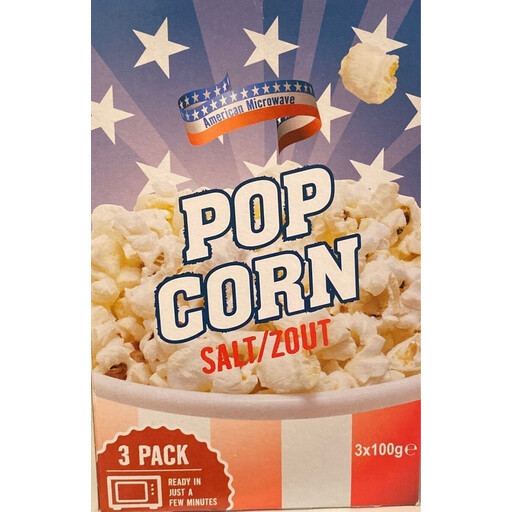 No image available
Suitable if you want to prepare individual microwave bags at home; this is not a ready-to-eat lunchbox portion.
Listed per 100 g: 23 g of fat and 16 g of saturated fat. For solid foods, the European Commission sets a maximum of 3 g of fat per 100 g for a ‘low fat’ claim; the listed amount is above this limit.
 No image available
Suitable if you want to buy a single bag and weigh out your own portion; this is not a multipack.
Listed per 100 g: 29.2 g of fat and 3.9 g of saturated fat. For solid foods, the European Commission sets a maximum of 3 g of fat per 100 g for a ‘low fat’ claim; the listed amount is above this limit.
For solid foods, the European Commission sets a maximum of 3 g of fat per 100 g for the ‘low fat’ nutrition claim. This is a condition for making a product claim, not a personal dietary limit; a small portion does not change the value per 100 g.
Multiply the fat per 100 g by the weight of your portion, then divide by 100. Based on Jumbo’s declared 12.4 g of fat per 100 g, a 30 g portion contains 3.72 g of fat; Jumbo rounds this to 3.7 g. Use a portion weight that matches the product’s nutrition information.
No. A serving size on the label does not automatically mean there is an individual pack inside. For its salted microwave popcorn, Jumbo lists 3 x 90 g; check the number of bags and the weight of each one for every product.
Albert Heijn recommends 2–3 minutes at 800 watts or 3–4 minutes at 600 watts, and advises stopping when there are 1–2 seconds between pops. Stay by the microwave and open the hot bag carefully because of the steam. Follow these instructions only for the AH variety mentioned, and follow the packaging if its instructions differ.
According to the European Commission, the vast majority of prepacked foods list energy, fat, saturated fat, carbohydrates, sugars, protein and salt per 100 g or 100 ml. Values per portion may also be provided.