Who is this guide for?

Shopping for guests with a food allergy

You’re looking for popcorn for someone who needs to avoid a specific allergen. Ingredients and cross-contamination information are important, and the Netherlands Food and Consumer Product Safety Authority explains how allergen information is shown on labels.

Shopping to meet a specific dietary need

For example, you may want to choose gluten-free or lactose-free popcorn and understand what the claim means. Lactose intolerance is different from cow’s milk allergy, and specific EU requirements apply to gluten-free claims.

Hosts who want to choose the ingredients themselves

You want to choose the oil, seasonings and toppings yourself. Even then, check the labels of every ingredient. The Netherlands Nutrition Centre warns that it cannot guarantee the ingredients used in its popcorn recipe are allergen-free.

What should you look for when buying?

Ready-to-eat popcorn

Choose this option: if you want to serve popcorn without popping it yourself and the label meets the dietary requirement.

Keep in mind: you can’t change the existing recipe, so check the ingredients and cross-contamination information.

Microwave popcorn

Choose this option: if microwave popcorn fits your serving plans and the label is suitable for the dietary requirement in question.

Keep in mind: follow the cooking instructions. For the variant reviewed, Jumbo says not to restart cooking if it has been interrupted.

Pop it yourself

Choose this option: if you want to choose the oil, seasonings and toppings yourself, and have time to prepare the popcorn.

Keep in mind: you’ll need to check each ingredient individually. Making it yourself doesn’t guarantee allergen-free popcorn.

What to consider What should you check? Who is this important for?
Avoiding the right allergen Read the full ingredients list and allergen information. Also check the packaging for warnings about possible cross-contamination. When I’m buying for a guest with a food allergy, I want to be able to check both types of information. Avoiding a specific allergen is the top priority for around 36% of consumers.
Understanding a dietary claim Check what the claim describes, and also review the allergen information. For example, if I’m looking for lactose-free or gluten-free food, I want to know what the claim does and doesn’t mean. This is the main concern for around 29% of consumers.
Preparation and packaging Check whether the popcorn is ready to eat or needs to be prepared, how many packs you get and which instructions apply. If I want to spend as little time as possible preparing food during the celebrations, I want to know in advance what’s involved. Ease of preparation is the top priority for around 21% of consumers.
Oil, seasonings and toppings Check the popcorn kernels, oil, seasoning mixes and toppings individually, and review the complete snack as you plan to serve it. If I want to decide on the flavour myself, I also want to be able to choose and check the added ingredients. Choosing your own recipe is the main concern for around 14% of consumers.

Common pitfalls

  • Assuming ‘vegan’, ‘lactose-free’ and ‘free from’ all offer the same guarantee

    Lactose intolerance and cow’s milk allergy relate to different components. A vegan product may also carry a warning about possible traces of milk.

    Start by identifying the substance that needs to be avoided, then check the relevant ingredients and cross-contamination information.

  • Checking only the plain popcorn

    Seasonings and toppings change the final recipe. For example, the Albert Heijn Allerhande caramel popcorn recipe reviewed contains butter.

    Check every added ingredient and assess the popcorn as you’ll actually serve it.

  • Relying on a product page you viewed earlier instead of checking the label

    For the salted popcorn reviewed, Albert Heijn advises reading the packaging before eating the product.

    Check the packaging of the product you actually buy, even if you’ve previously looked at a product with the same name.

Brands to consider

Albert Heijn

The range includes salted popcorn, among other options, and Allerhande also offers recipes for homemade popcorn.

  • Official information clearly identifies the product types and recipe options.
  • The product name doesn’t confirm that the popcorn is suitable for a specific allergy. Check the packaging.

Jumbo

Official product information distinguishes between salted popcorn and microwave popcorn, including a pack of 3 x 90 g.

  • The product types and pack sizes can be identified from the product names.
  • The instruction not to restart cooking if it has been interrupted applies to the microwave variant reviewed. The product name is not an allergen-free claim.

Lidl

Lidl lists popcorn under its own Snack Day brand, including sweet and salted varieties as well as a microwave option.

  • The brand page clearly identifies the popcorn types and flavours mentioned.
  • A flavour or product listing doesn’t confirm that a variety is suitable for a specific allergy.

ALDI

The official product page lists 100 g packs of Sun Snacks Salted Popcorn.

  • The product name gives the brand, flavour and pack size.
  • The word ‘salted’ alone says nothing about whether the product is suitable for a specific dietary requirement or allergy.

Popcorn products on Joybuy

This product selection is for popping your own popcorn from kernels. Always check the current ingredients and cross-contamination information on the packaging before serving it to your guests.
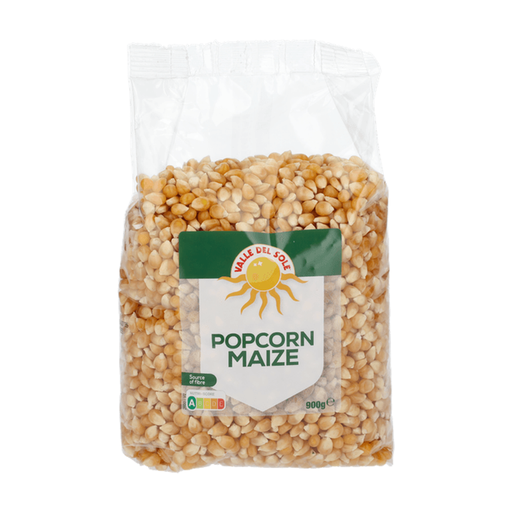
Valle Del Sole Popcorn Maize (Butterfly), 900 g

Valle Del Sole Popcorn Maize (Butterfly), 900 g

For anyone who wants to pop their own popcorn; the product description says to cook it in a pan with oil and a lid.

According to the product description, this product contains none of the 14 major EU allergens. Before serving, check the full ingredients list and any cross-contamination warnings on the packaging.

The product name states 900 g.

Joybuy

Frequently asked questions

Is lactose-free popcorn suitable for someone with a cow’s milk allergy?

A lactose-free claim on its own isn’t enough to establish this. Cow’s milk allergy relates to milk proteins, while lactose intolerance relates to milk sugar. If you have a cow’s milk allergy, check the information about milk ingredients and cross-contamination.

Can a vegan product still carry a warning about milk?

Yes. The Dutch Vegetarian Association explains that vegan products may carry a warning about possible traces of milk. So don’t treat a vegan label as a separate guarantee for people with allergies.

Is ‘gluten-free’ a claim regulated by law?

Yes. Commission Implementing Regulation (EU) No 828/2014 sets requirements for the terms ‘gluten-free’ and ‘very low gluten’. This European framework isn’t a general guarantee about other allergens.

Can I automatically describe homemade popcorn as allergen-free?

No. The Netherlands Nutrition Centre says alongside its popcorn recipe that it cannot guarantee the ingredients used are free from allergens. So check the oil, seasonings and toppings too.

What do the Dutch rules say about cross-contamination warnings?

Since 1 January 2026, new rules have applied in the Netherlands to allergen cross-contamination warnings on labels, as explained by the Netherlands Food and Consumer Product Safety Authority. This information concerns the possible unintentional presence of allergens and is given alongside the ingredients information.
