For polished stones, manageable, diffused light and a suitable white balance are at least as important as the camera body. Nikon describes diffusion as a way to soften light when photographing small, shiny subjects. A compact camera with a close-up mode is a good fit if you want to keep your kit simple, while a mirrorless camera with a suitable macro lens gives you more choice of lens and magnification. If you choose the latter, check the lens mount and what’s included in the kit. The stated magnifications apply to specific lenses, not every camera or kit.
Who are these camera set-ups suitable for?
Seller of shiny stones
You want consistent photos that show the stones’ shape and colour clearly. Start by considering the lighting, reflections and white balance, then choose a camera body. Nikon describes diffusion as a way to soften light when photographing shiny subjects.
Photographer of fine stone details
You want to capture small patterns or inclusions clearly. Check the magnification of the lens or the close-up range of the camera you’ll actually be using. Canon and Nikon publish magnification specifications for individual macro lenses.
Beginner with a compact set-up
You want to keep the number of separate components to a minimum and are comparing a compact camera with a fixed lens against a mirrorless camera for which you’ll need to choose a suitable lens separately. The Consumers’ Association describes the difference between fixed and interchangeable lenses.
What should you look for when photographing under artificial light?
Compact camera with close-up mode
A good fit if: you want to frame small stones close up without choosing a separate macro lens; the OM SYSTEM TG-7 manual describes a mode for shooting as close as 1 cm.
Bear in mind: the lens is fixed, so you can’t choose a different lens later.
Mirrorless camera with a macro lens
A good fit if: you want to match the lens and magnification to the stones you’re photographing; your choice of lens is separate from your choice of camera body.
Bear in mind: the mount, what’s included in the kit and the specifications of the individual lens. Canon states a maximum magnification of 1:2 for the RF 35mm F1.8 MACRO IS STM, while Nikon states 1:1 for the NIKKOR Z MC 50mm f/2.8. These figures apply to the lenses named.
| What to consider |
What to look for |
Who is this important for? |
| Distracting reflections |
See whether you can move or diffuse your lights, and whether there’s enough room for the camera and lighting. Nikon mentions a light tent as one way to make light softer and more consistent, not as a must-have purchase. |
If I’m photographing shiny stones under lights, I want to be able to reduce distracting highlights without losing the lustre. Reflection control is the top priority for around 36% of consumers. |
| Small details |
Compare the camera’s close-up range or the magnification of the specific lens. According to Canon, the Canon RF 35mm F1.8 MACRO IS STM has a maximum magnification of 1:2; Nikon states 1:1 for the NIKKOR Z MC 50mm f/2.8. |
If you want to capture fine patterns or inclusions at a larger scale, consider a separate macro lens. Detail magnification is the main buying concern for around 29% of consumers. |
| Colour under artificial light |
Check whether you can adjust the white balance manually and, if you want to edit your photos, whether the model supports RAW. Sony describes manual white balance as an option when the automatic setting doesn’t give you the colour you want. |
If I want the stone’s colour to look recognisable under my own lights, I want to be able to assess the colour settings and adjust them if necessary. Colour reproduction is the top priority for around 21% of consumers. |
| Simple set-up |
Check what’s included in the kit and whether the lens can frame the details you want. A compact camera has a fixed lens; with a mirrorless camera, you choose a suitable lens. The Consumers’ Association describes this difference. |
If you want to keep your set-up simple, you may prefer to have fewer separate components. Simple equipment is the main buying concern for around 14% of consumers. |
Common buying mistakes
-
Choosing based on the word ‘macro’ alone
A magnification specification applies to a particular lens and doesn’t automatically apply to every camera or kit. For example, Canon states a maximum magnification of 1:2 for the RF 35mm F1.8 MACRO IS STM.
Before buying, check the full lens name, mount, magnification and what’s included in the kit. Canon states that the EOS R50 supports RF and RF-S lenses, but the camera body alone doesn’t determine which macro lens comes with it.
With a mirrorless camera, you may need to buy a separate compatible macro lens, adding extra components to your set-up.
-
Expecting a new camera to solve bright reflections
Reflections and bright spots are a separate lighting challenge, even when photographing small, shiny subjects. Nikon describes diffusion as a way to soften the light.
First try changing the position of your light or diffusing it, then consider which camera feature you still need.
You may need extra equipment to diffuse or direct your existing light.
-
Confusing a short focusing distance with enough working space
The OM SYSTEM TG-7 manual describes shooting as close as 1 cm in a specific mode. For the NIKKOR Z MC 50mm f/2.8, Nikon states that the front of the lens is approximately 5 cm from the subject at the minimum focusing distance. These figures come from different products and measurement contexts, so they aren’t a direct comparison of quality.
Check that the specific camera and lens suit both the framing you want and the space you need for your lighting set-up.
Camera brands to consider
OM SYSTEM
Worth considering if you’re looking for a camera with a fixed lens and a documented close-up mode.
- The OM SYSTEM TG-7 manual describes shooting as close as 1 cm in the relevant mode, as well as focus bracketing.
- The lens is fixed. The 1 cm distance alone doesn’t compare image quality with other cameras.
Canon
Worth considering if you’re looking at the EOS R50 with a suitable RF lens and interchangeable lenses.
- Canon Netherlands states that the EOS R50 supports RF and RF-S lenses. For the RF 35mm F1.8 MACRO IS STM, Canon gives a maximum magnification of 1:2.
- The stated magnification applies to that lens; it isn’t a built-in macro feature of every EOS R50 kit.
Nikon
Worth considering if you’re looking at a compatible Nikon Z camera with the separate NIKKOR Z MC 50mm f/2.8 for close-ups.
- Nikon Netherlands specifies a reproduction ratio of 1:1 for this lens.
- Nikon states that the front of the lens is approximately 5 cm from the subject at the minimum focusing distance. Nikon recommends diffused light as part of the shooting set-up; this isn’t evidence that Nikon cameras handle reflections better.
Fujifilm
Worth considering if you want to take focus bracketing into account with the X-S20, alongside choosing a separate X-mount lens.
- The Fujifilm manual describes focus bracketing and recommends using a tripod for this technique.
- The choice of lens and lens mount are still important considerations when putting your set-up together.
Joybuy product selection
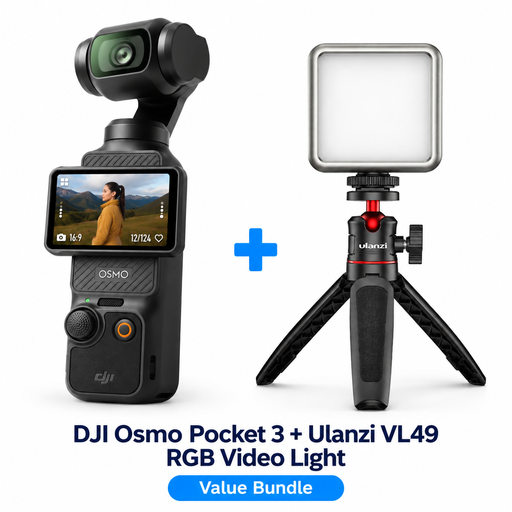
The Joybuy selection below is a camera and RGB LED light bundle described for photography. For polished stones, check that the camera suits your preferred close-up distance and colour settings, and that the lighting is suitable for your set-up.
 No image available
DJI Osmo Pocket 3 + Ulanzi VL49 RGB LED Video Light bundle
The bundle is described as suitable for photography and product photography.
The camera has a 1-inch CMOS sensor.
The product description states that it has mechanical 3-axis stabilisation.
The bundle includes a Ulanzi VL49 RGB LED light.
Joybuy
Frequently asked questions
Does a macro function also help with reflections?
No. A close-up function doesn’t determine how light falls on the stone. Nikon describes light control and diffusion as separate considerations when photographing small, shiny subjects.
How should I start adjusting colour settings under artificial light?
If you like, start with automatic white balance and adjust the setting if the colours don’t look right; Sony Netherlands describes this option. RAW files can give you more scope to adjust settings such as white balance later, but you’ll need to process the files. Check that these features are available on the exact model.
Do I need focus bracketing for stones?
Not for every shot. Focus bracketing captures a series of images, each focused at a different distance; the OM SYSTEM TG-7 and Fujifilm X-S20 manuals describe this feature. Fujifilm recommends using a tripod for the technique described. Check how the feature works on the camera you’re considering.
What if a camera I buy online doesn’t work properly in the Netherlands?
When you buy as a consumer, the seller must provide a product that works properly, and you can contact them if there’s a fault. According to the Dutch government, there’s no fixed statutory guarantee period in the Netherlands; what you can expect from a product depends, among other things, on the product and the information provided. For distance purchases, you’ll also usually have a 14-day cooling-off period, with some exceptions.


