Who will be listening?

Listener with a regular FM traffic station

You want to tune in quickly to a familiar station for traffic updates, and don’t need any additional reception options. Check the FM frequency for your area; ANWB and NPO Radio 1 publish information about traffic stations and frequencies.

Listener who switches between stations

You want to compare national and possibly regional stations. FM and DAB+, along with any presets, can be useful if the broadcasts are available where you’ll be listening. The Dutch Authority for Digital Infrastructure provides information about local DAB+ coverage areas.

Living-room listener who doesn’t use headphones

You listen to spoken updates through the radio itself and prioritise clear sound and easy controls over the smallest possible size. Sony, Sangean and Philips specify built-in speakers on the models discussed here.

What should you look for when buying?

Buying concern What should you check? Who is this important for?
Receiving the right traffic station Find the station you want and check whether it’s available via FM or DAB+ where you’ll be listening. I mainly want to receive the broadcast for my route; this is a priority for around 33% of consumers who put finding the right station first.
Hearing spoken updates without headphones Check that the exact model has a built-in speaker and test reception at home. I want to follow traffic updates through the radio itself in a small living room; around 27% of consumers prioritise clear speech through the speaker.
Tuning in quickly Decide whether you’ll listen to one regular station or switch often, then compare tuning options and presets. I want to play a bulletin without too many steps; quick, straightforward controls are the main buying concern for around 20% of consumers.
Choosing the right power supply Check how each model is powered, what’s included and where you’ll keep the radio. I want changing or charging batteries, or using a mains socket, to fit my routine; around 20% of consumers put the power supply first.

Things to watch out for when buying

  • DAB+ doesn’t automatically mean you’ll receive every local station

    Having a DAB+ tuner doesn’t tell you whether your local station broadcasts on DAB+ or whether it can be received in your living room. The Dutch Authority for Digital Infrastructure provides information about local DAB+ coverage areas.

    Check that the station you want is available and try reception at home. Keep FM as an option if the station is available on it.

  • A pocket radio isn’t necessarily suitable for listening without headphones

    You’ll need a built-in speaker to listen through the radio itself, and this feature varies by model.

    Check the specifications for the exact model to see whether it has a built-in speaker.

  • ‘Portable’ doesn’t always mean ‘pocket-sized’

    A larger portable radio may suit a permanent spot in your living room, but it might not meet your needs if you want a radio that genuinely fits in a coat pocket.

    Compare the dimensions with the space available and how you plan to use the radio.

Brands to consider

Sony

The Sony ICF-P27 is a compact AM/FM radio with a built-in speaker, for anyone wanting to follow an FM traffic station they can receive.

  • Sony specifies two AA batteries and a headphone socket.
  • According to the model specifications, the ICF-P27 doesn’t have a DAB+ tuner; you’ll need to check reception yourself at the specific spot indoors.

Sangean

The DPR-35BT combines FM and DAB+ in a pocket-sized design, with a built-in speaker for listening at home or on the go.

  • Sangean specifies 20 presets and USB-C charging.
  • Having DAB+ on the radio doesn’t guarantee that you’ll be able to receive the local station you want where you’ll be listening.

Philips

The Philips TAR2509/10 is a portable FM/AM radio for the living room, suited to anyone who values easy controls in a fixed spot more than a strictly pocket-sized design.

  • Philips specifies analogue tuning, a large volume knob, a 3.5-inch speaker and mains or battery power.
  • The specifications list FM/AM reception, not DAB+; this isn’t an equivalent choice if you need a radio that fits in a coat pocket.

Joybuy products

These portable radios are designed for listening to bulletins on FM. Check that the station you want is available in your living room and that the model meets your needs for listening through a speaker.
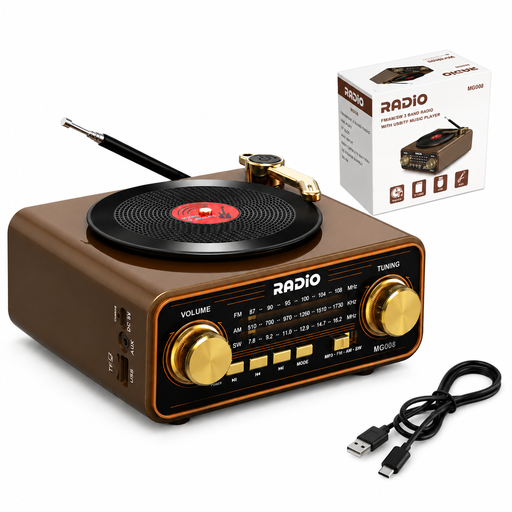
Wood-effect portable radio with AM, FM and shortwave

Wood-effect portable radio with AM, FM and shortwave

The listed FM reception is suitable for a bulletin broadcast on FM; check reception where you plan to listen.

The product name lists Bluetooth 6.0, USB-C, TF card and AUX connections, and a 2000 mAh battery.

Joybuy
Mlove BV800 portable Bluetooth speaker with FM radio

Mlove BV800 portable Bluetooth speaker with FM radio

The product description lists a built-in speaker and FM radio; check at home whether you can receive the station you want.

The product name lists an LCD screen, antenna, AUX input, USB and TF card connections, and MP3 playback.

Joybuy

Frequently asked questions

Which station can I choose for national traffic updates?

ANWB lists NPO Radio 1, NPO Radio 2 and BNR among the stations that provide traffic information. Choose the station and broadcast time that suit your needs; NPO Radio 1 publishes its FM frequencies and states that it’s available on DAB+ in the Netherlands.

Will a DAB+ pocket radio automatically receive my local station indoors?

No, having a DAB+ tuner alone doesn’t confirm that. The Dutch Authority for Digital Infrastructure provides details of separate local DAB+ coverage areas. Check whether your station broadcasts on DAB+ and test reception where you want to listen. NPO Radio 1 reports near-nationwide DAB+ reception, but that doesn’t guarantee reception everywhere in your home.

How do I set up a radio for traffic updates?

First, find the frequency or station name of the broadcaster you want to hear. For an analogue radio, tune in using the dial; if your model has presets, save the stations you want. Check that the signal and spoken broadcast are clear enough where you plan to listen in your living room.

What can I do if a radio I bought online doesn’t receive a signal as expected at home?

For a standard online purchase, ACM ConsuWijzer says you’ll generally have a statutory 14-day cooling-off period from delivery; check the relevant exceptions and returns policy. If the product is faulty, the seller is responsible for providing an appropriate solution, according to the Dutch government. There is no fixed general warranty period in the Netherlands.
