Start with the traffic station and when you want to listen: a basic FM pocket radio may be enough if you can get a good FM signal for that station at home. FM/DAB+ gives you more stations to choose from, but it doesn’t guarantee reception or clear speech at the other end of a large living room. Check reception where you’ll be listening, and try the built-in speaker from your usual listening distance.
Who is this choice relevant to?
Living-room listener who doesn’t use headphones
You want to follow traffic updates through the radio’s speaker while sitting some distance away. In that case, a built-in speaker and a check from your usual listening distance matter more than the smallest size.
Listener with a regular traffic station
You want to tune in quickly to a familiar station, and don’t need another reception option if FM works well at home. The ANWB recommends stations including NPO Radio 1, NPO Radio 2, BNR and Sky Radio for traffic information.
Listener who switches between stations
You want to choose from different traffic programmes, so FM/DAB+ and presets are worth considering. Do check that you can receive your preferred stations where you’ll be listening.
What should you look for when choosing?
First choose the traffic station and the time you want to listen, then check reception where you plan to keep the radio. Next, compare the controls and power options to find what suits the way you’ll use it.
Basic FM pocket radio
A good fit if: you mainly listen to one traffic station and can get a good FM signal for it.
Bear in mind: this type won’t necessarily offer DAB+ or digital presets.
FM and DAB+ pocket radio
A good fit if: you want to switch between different stations you can receive.
Bear in mind: DAB+ requires a compatible receiver and reception where you’ll be listening.
Pocket radio for headphones
A good fit if: private listening matters more than hearing the radio through a speaker in the living room.
Bear in mind: don’t choose this type for listening without headphones unless it’s specifically confirmed to have a speaker.
| What to consider |
What to check before buying |
Who is this important to? |
| Hearing spoken updates in the living room |
Check whether it has a built-in speaker, and try listening from your usual seat. |
If I want to follow spoken updates from my regular seat, clear speech matters more to me than the smallest size. Around 36% of consumers prioritise clear speech at their listening distance. |
| Receiving the right traffic programme |
Choose your preferred station and check FM or DAB+ reception where you’ll be listening. |
I want to hear the programme that suits my station and listening time, so I first check what I can receive there. Around 29% of consumers prioritise getting the right traffic station. |
| Tuning in quickly |
Compare analogue tuning with scanning and presets on the exact model. |
If I want to use several stations, I want to find them again without a long search. Around 21% of consumers give quick tuning and simple operation top priority. |
| Power and portability |
Check the battery type, charging options and what comes with the version you’re buying. |
I want to use the radio in different places, so I look at its power options and how easy it is to move. Around 14% of consumers prioritise power and portability. |
Common buying mistakes
-
Choosing a pocket radio for headphones to listen in a room
The Sangean DPR-39 is designed for listening with headphones, while Sangean says the DPR-35BT has a built-in speaker. Similar model names don’t necessarily tell you what listening options a radio offers.
Check the full model name and look for an explicit mention of a built-in speaker in the specifications.
-
Assuming DAB+ guarantees reception indoors
Digital Radio NL explains that DAB+ networks were initially built for outdoor reception. So, having a DAB+ tuner doesn’t prove that a station will come through clearly everywhere in your home.
Choose based on your preferred station and check reception where you want to listen; don’t rely on general coverage expectations.
-
Mistaking a scheduled radio bulletin for a live route warning
Radio traffic bulletins are broadcast at set times. The ANWB also provides up-to-date traffic information for specific routes through its Onderweg app.
Use the radio for scheduled bulletins, and check a live traffic source just before you set off if a sudden delay would matter.
Brands to consider
Sony
The ICF-P27 is a compact AM/FM pocket radio for anyone who wants to follow one traffic station with good FM reception.
- Sony lists a built-in speaker, a headphone socket and two AA batteries.
- The listed reception bands don’t include DAB+. The stated 100 mW output power doesn’t tell you how it sounds in a large living room.
Sangean
The DPR-35BT combines FM/DAB+, presets, a rechargeable battery and a built-in speaker. The DPR-39 is a different model, designed for listening with headphones.
- Sangean also says the DPR-35BT can stream radio audio over Bluetooth to an external receiver.
- Bluetooth streaming doesn’t tell you how clearly you’ll hear the built-in speaker at the other end of a large room. Check the model number if you want to listen without headphones.
Pure
The Elan Move is an FM/DAB+ radio that Pure describes as pocket-sized. It has a speaker, presets and a rechargeable battery.
- For the black version with article number 255228, Pure lists a 1,5 W mono speaker.
- The listed speaker specifications don’t prove that you’ll be able to hear traffic updates clearly from anywhere in a large living room.
Philips
The TAR1509/00 is an example of an analogue FM/AM pocket radio with simple tuning and two AAA batteries.
- Philips lists analogue tuning and a headphone socket.
- Philips marks this model as no longer available on its Dutch product page, so don’t treat it as a confirmed current buying option.
Radios at Joybuy
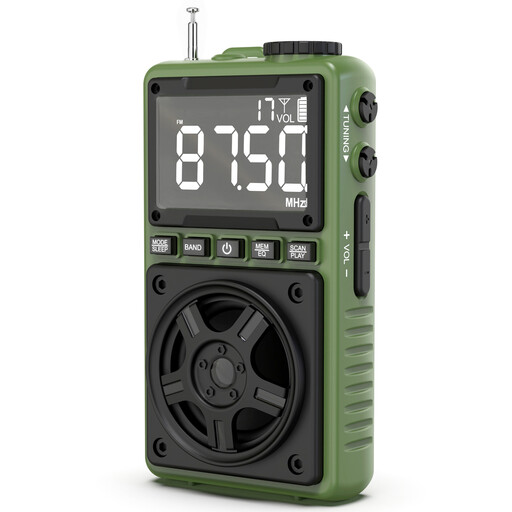
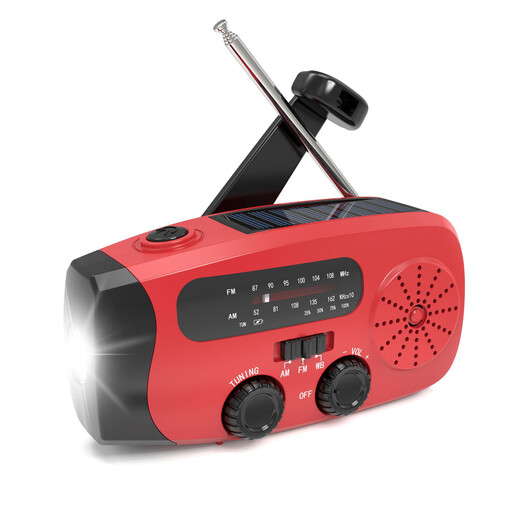
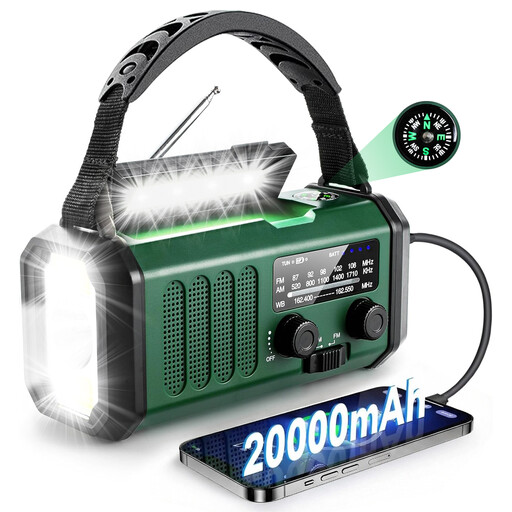
These Joybuy products list FM reception and are designed for anyone who wants to use or move a radio with a speaker. Check reception where you’ll be listening, and check the CE marking on the version being offered.
 No image available
Bluetooth radio with speaker, LED lighting, rechargeable battery and USB-C
Could suit you if you’re looking for a portable radio with FM reception and a speaker; check how clearly you can hear it from where you’ll be listening.
AM, FM and SW reception; rechargeable battery and USB-C charging. The description also mentions a handle, TF card playback and LED lighting.
View at Joybuy
 No image available
Emergency radio with hand crank and solar panel, 2000mAh, AM/FM/WB, IPX-3
Could suit you if you want to take a radio with FM reception with you; the listed emergency features aren’t needed to receive traffic updates over FM.
The title lists AM/FM/WB reception, a 2000mAh battery, a hand crank, solar charging and IPX-3. Also mentioned: an LED torch and power bank function.
View at Joybuy
 No image available
Solar-powered emergency radio with AM/FM, NOAA and 20000mAh battery
Could suit you if you’re looking for a portable radio with FM reception; check that its reception and speaker suit the way you’ll use it in your living room.
The title lists AM/FM and NOAA reception, automatic frequency tuning, a hand crank, a solar panel and a 20000mAh battery. Also mentioned: a 14W LED lamp, SOS alarm and compass. The description lists a weight of 700 g.
View at Joybuy
Frequently asked questions
Which station can I tune in to for ANWB traffic information?
The ANWB recommends stations including NPO Radio 1, NPO Radio 2, BNR and Sky Radio. According to the ANWB overview, NPO Radio 1 and BNR broadcast traffic information every half hour, and every 15 minutes during rush hour. Check the latest schedules and whether you can receive the station at home.
What can I do if DAB+ reception is poor where I listen?
Digital Radio NL recommends running a new station scan first, then checking reception where you want to listen. Digital Radio NL says DAB+ networks were initially built for outdoor reception.
Do I need an internet subscription for DAB+ at home?
No, DAB+ doesn’t require an internet connection or subscription, but you do need a DAB+ receiver. Digital Radio NL describes DAB+ as reception over the air.
What are my rights if a radio I buy online isn’t suitable?
When you buy from a business remotely, you generally have a 14-day cooling-off period. You’re also entitled to a product that meets the terms of the contract in the Netherlands; there’s no fixed statutory guarantee period. According to the Dutch Government, the seller is your point of contact if a product is faulty. Normal wear and tear or damage you cause don’t automatically entitle you to a free repair.
What should I look for in a radio sold in the Netherlands?
Check that the radio being offered has the correct CE marking. The Dutch Authority for Digital Infrastructure says that equipment sold in the EU must meet the applicable requirements; a general product listing doesn’t confirm that an individual item for sale meets them.


