First, decide which broadcast you want to receive: the Netherlands Coastguard lists VHF marine radio channels 23 and 83, and MF frequencies 1890 and 3673 kHz. A standard FM or DAB+ pocket radio will not automatically receive these reports. Then assess reception and speech clarity where you plan to use it, by the wall, and check the relevant Dutch rules if you’re using a transmitting marine radio.
Who is this choice relevant to?
Coastguard weather listener
Wants to receive an announced Dutch maritime weather report directly, so needs to choose the right channel or frequency first. The Netherlands Coastguard lists VHF channels 23 and 83, and MF frequencies 1890 and 3673 kHz for this purpose.
Listener with a fixed spot by the wall
Wants to leave a small device in one place and needs to assess reception, space for the aerial and speech clarity there. Roberts advises moving the radio and rescanning if there’s no DAB signal; this doesn’t guarantee reception of maritime broadcasts.
Listener who takes the radio out and about
Wants suitable reception as well as portability and a practical power supply. If a battery life is specified, check the conditions that apply to the particular model.
What should you look for when buying?
The Netherlands Coastguard broadcasts maritime weather reports on VHF channels 23 and 83, and on MF frequencies 1890 and 3673 kHz. Choose how you’ll receive the report based on what you want to hear, and check that the exact version supports it.
| What to consider |
What to look for |
Who is this important for? |
| Receiving the intended report |
Choose VHF channel 23 or 83, or MF 1890 or 3673 kHz, and check the manual for the exact version. |
If I mainly want to hear the announced Coastguard report, I first check that the receiver supports the right option. Around 36% of consumers prioritise suitable reception. |
| Reception by the wall |
Check reception where you plan to use the radio, and see whether you can move the device and aerial. |
I want to leave the radio in one fixed spot and receive the report there, without the wall or its position getting in the way of reception. Around 29% of consumers prioritise having a fixed listening spot. |
| Speech clarity |
Consider the speaker and volume control; assess spoken audio where you plan to listen. |
When I listen to a spoken weather report, I want to hear the words clearly in my listening spot. Around 21% of consumers prioritise speech clarity. |
| Portability and power |
Compare dimensions, weight and charging options; check the conditions that apply to any stated battery life. |
I want to be able to take the radio with me or use it without a mains connection, but suitable reception is still my first requirement. Around 14% of consumers prioritise portability. |
Common buying mistakes
-
Confusing FM or DAB+ with maritime reception
The Netherlands Coastguard lists VHF channels and MF frequencies for its maritime weather reports. The FM and DAB+ bands on a standard broadcast radio don’t prove that it can receive these reports directly.
Choose VHF or MF first, then check whether the exact version supports the channels or frequencies you need.
-
Treating a transmitting handheld marine radio like a standard pocket radio
A marine radio can also transmit. The Dutch Authority for Digital Infrastructure (RDI) sets out the conditions of use and distinguishes between registration and a licence, depending on the equipment and how it’s used.
Decide whether you only want to receive or also transmit, then check which RDI steps apply before using it.
-
Assuming speaker output means clear sound by the wall
A stated audio output power on its own doesn’t tell you how clearly you’ll hear speech in your planned listening spot.
Assess reception and spoken audio there, and leave room to move the device if necessary.
Brands to compare
Icom
Icom makes handheld marine VHF radios. The IC-M25EURO manual lists Coastguard channels 23 and 83, making this model worth looking into if you want to receive those broadcasts via VHF.
- The IC-M25EURO manual lists channels 23 and 83.
- Check the channel settings on the exact version. This is a transmitting device, so check the relevant Dutch rules for its use. The information listed is from the manufacturer, not from an independent reception test.
Uniden
Uniden describes the BC125AT as a scanner for, among other things, maritime radio bands. This non-transmitting way to receive signals could be worth considering if you want to listen to VHF.
- The manufacturer lists reception of maritime radio bands for the BC125AT.
- Check whether the exact version and settings can receive Dutch channels 23 and 83; the US product description doesn’t confirm this specifically.
Tecsun
Multi-band receivers such as the PL-880 could be one way to explore MF reception. Tecsun lists medium wave, shortwave and SSB, among other features.
- The manufacturer lists multiple reception bands and SSB for the PL-880.
- These specifications don’t confirm that both Coastguard frequencies, 1890 and 3673 kHz, will be usable in the conditions you need. Check the exact tuning range and suitability.
Roberts
According to Roberts, compact radios such as the Revival Petite 2 combine DAB/DAB+, FM, a built-in speaker and a rechargeable battery. This could suit you if you also want to listen to standard radio stations.
- The manufacturer lists DAB/DAB+, FM, a built-in speaker and a rechargeable battery for the Revival Petite 2.
- These bands don’t prove that the radio can receive the maritime VHF channels or MF frequencies listed above. The advice to move the radio and rescan if there’s no DAB signal isn’t a test of maritime reception.
Portable radios at Joybuy
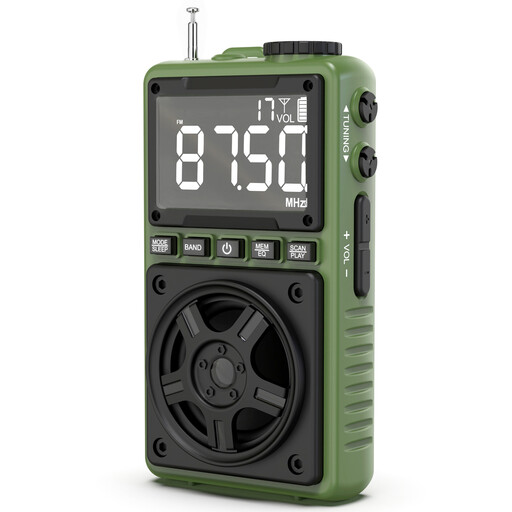
A portable radio for listening through a built-in speaker and rechargeable battery.
 No image available
Bluetooth radio with speaker, LED lighting and USB-C
The built-in speaker and rechargeable battery make it suitable for listening without a mains connection. The bands listed don’t confirm that this radio can receive the Coastguard broadcasts on VHF or MF.
The product description lists AM, FM and SW reception, a carry handle, USB-C charging and playback from a TF card. Before buying, check whether the exact version can tune to 1890 and 3673 kHz if you want to hear the MF broadcasts.
View at Joybuy
Frequently asked questions
Can a standard FM or DAB+ pocket radio receive Coastguard weather reports directly?
Not on the basis of FM or DAB+ support alone. The Netherlands Coastguard lists VHF channels 23 and 83, and MF frequencies 1890 and 3673 kHz. Check whether the exact radio can receive the broadcast you want.
How do I choose between VHF and MF?
Choose the option used for the broadcast you want to hear, and check it on the device itself: VHF on channel 23 or 83, or MF on 1890 or 3673 kHz. For MF, check both frequencies separately if you want to receive both broadcasts.
What can I do if reception is poor by the wall?
Compare reception in another spot and see whether you can reposition the radio or aerial. For the Revival Petite 2, Roberts advises moving the radio and rescanning if there’s no DAB signal. This is model-specific DAB advice and doesn’t prove that a maritime signal will become available.
Can I transmit with a handheld marine radio without taking any further steps?
Don’t assume so. The Dutch Authority for Digital Infrastructure sets out the steps for using a marine radio and lists a separate licensing process for a handheld radio used without a vessel. The requirements depend on the device and how it’s used, so check them before transmitting.
Are maritime weather reports the same as notices about navigation restrictions?
No. The radio broadcasts discussed here are weather and safety reports from the Netherlands Coastguard. Rijkswaterstaat publishes information about matters including navigation restrictions and waterway works; choose the source that matches the information you’re looking for.


