
Private listening in a shared space
You want to follow the discussion without disturbing anyone with a speaker. So check the headphone socket and whether you can comfortably set the volume low.


A basic FM radio is suitable if you can receive the broadcast you want via FM where you plan to listen. Choose a DAB+/FM model if you also want to listen to DAB+ broadcasts. For private listening, a suitable headphone socket and easy-to-adjust volume are important, but no reception band guarantees that speech will be clear at a low volume.
You want to follow the discussion without disturbing anyone with a speaker. So check the headphone socket and whether you can comfortably set the volume low.
You mainly want to know whether you can receive the broadcast where you plan to listen. Find the station and check whether it broadcasts there via FM, DAB+ or both.
You take the radio with you and want a size, controls and power source that suit how you use it. Compare replaceable batteries with a rechargeable battery, and consider which features you really need.
| What to consider | What to look for | Who is this important for? |
|---|---|---|
| Private listening at a low volume | Check the headphone socket, whether earbuds are included and how the volume is controlled. | If I want to follow the discussion in a shared space without disturbing anyone, comfortable private listening is my main consideration. Around 42% of consumers prioritise private listening. |
| Receiving the station you want | Check which band the station broadcasts on and try reception where you usually listen. | If I want to follow a particular broadcast, I need to be able to receive the station where I listen; the listening connection alone isn’t enough. Around 33% of consumers prioritise station reception. |
| Portability and power | Compare the size and controls with the battery type or charging method for the exact model. | If I want to use the radio in different places, portability and a suitable power source matter most to me. Around 25% of consumers focus mainly on portability, controls and power. |
The station you want and reception where you are determine whether you can follow the broadcast. A digital tuner doesn’t prove that speech will be clear at the low volume you choose.
First, find the station and, where possible, try the reception and volume where you plan to listen.
The Sangean DPR-39 is described as having an earphone output; the Roberts SportsDAB 65 and Sharp DR-P520 (GY) are also listed as having a built-in speaker.
Check the listening outputs on the exact model if you sometimes want to listen alone and sometimes with others.
If you also want to listen through a speaker, a model without a built-in speaker may mean you need a different one.
Sharp states that headphones aren’t included with the DR-P520 (GY). According to their manufacturers, the Sony ICF-P27 and Sangean DPR-39 use two AA batteries.
Check what’s in the box and the power source for the model you’re buying.
Sony describes the ICF-P27 as a compact analogue AM/FM radio with a built-in speaker and headphone socket.
Sangean describes the DPR-39 as a portable DAB+/FM radio with an earphone output.
Roberts describes the SportsDAB 65 as a portable DAB+/FM radio with a speaker and supplied in-ear headphones.
Sharp describes the Osaka DR-P520 (GY) as a compact DAB+/FM radio with a speaker, headphone socket and a Dutch-language menu option.
Philips describes the TAR1509/00 as a basic FM/AM pocket radio with a headphone socket.
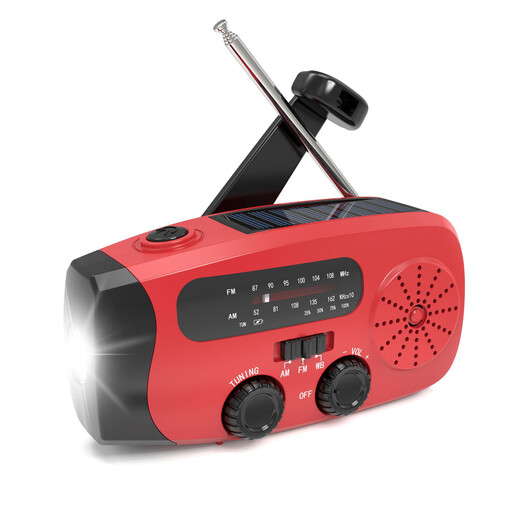
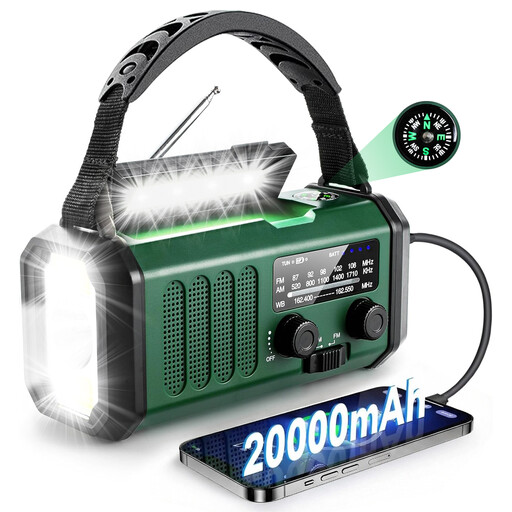
The options shown are portable emergency radios with AM/FM reception. They may suit this listening need if the station you want is available locally via FM. For each model, check that the listening connection and volume control suit private listening at a low volume.
 No image available
The listed AM/FM reception may suit listening to a broadcast available locally via FM; check that the listening output and volume control work for your needs.
The product name lists a 2000mAh battery, manual and solar charging, an LED light, a power bank function and IPX-3.
 No image available
The listed AM/FM reception may be useful if the broadcast you want is available locally via FM; check that the listening output and volume control are suitable for private listening.
The product name lists solar charging and a hand crank. The stated weight is 700 g, which is worth considering if you plan to carry the radio around often.
No, not if you can receive the broadcast you want via FM where you plan to listen. DAB+ is relevant if you want to receive a particular DAB+ broadcast; check the station and reception where you’ll be listening. A digital tuner alone doesn’t tell you whether speech will be clear at the low volume you choose.
Start at a low volume and check that your earbuds fit well. The WHO points out that volume and listening time affect the risk of hearing damage, and that well-fitting earbuds can help you listen at a lower volume.
First, check whether the station you want is available there, then try moving the radio or switching to FM on a combined model. In 2023, NPO reported an expansion of its DAB+ network; that announcement doesn’t guarantee reception in your room or for every station.
For a distance purchase from a business, consumers usually have a 14-day cooling-off period, according to the Government of the Netherlands; check whether an exception applies. You’re also entitled to a product that is fit for purpose. According to the Government of the Netherlands, there is no fixed statutory guarantee period for all products in the Netherlands.
Check the exact model, the user information and whether the radio supports the reception bands you need. According to the European Union, a CE mark indicates that the manufacturer declares the product complies with the relevant EU product rules; it doesn’t tell you whether the radio can receive your station where you plan to listen.