Who is a pocket radio for?

Listening together in the living room

You want to hear the panel without headphones, so you’re looking for a model with a built-in speaker. Sony and Sangean describe models with this feature, but their specifications don’t tell you how clearly you’ll be able to hear speech from your seat.

Station-first listener

You want to check first whether the programme is broadcast on FM or DAB+, and whether the radio supports that band. Digital Radio NL describes DAB+ as a digital radio signal that requires a DAB+ receiver.

Private listener

You’d rather listen through headphones, perhaps so you don’t disturb other people at home, and don’t necessarily need a built-in speaker. Sangean and TechniSat describe specific models that support listening through headphones or a headphone socket.

What should you look for when choosing?

What to consider What should you check? Who is this important for?
Listening to speech through the speaker Check whether the exact model has a built-in speaker. If possible, try it out from the seat where you plan to listen. If I want to listen to the panel with others in the living room, I’m looking for a radio that plays without headphones; around 36% of consumers give clear listening together their top priority.
Receiving the station Find out which band the programme is broadcast on and check whether the radio supports FM or DAB+. Then check reception at home. If I want to make sure I can receive the panel show I’m interested in, I’ll check the broadcast band first; around 29% of consumers prioritise receiving their preferred station.
Easy tuning Compare the controls on the exact model, such as the tuning dial, preset stations and any button lock. If I want to quickly return to the right station during a conversation, easy controls matter; around 21% of consumers give ease of tuning their top priority.
Headphones and power Check for a headphone socket or wireless output, and see whether the model uses a rechargeable battery, charging cable or replaceable batteries. If I want to listen privately and know in advance how to power the radio, this combination matters most; around 14% of consumers prioritise private listening and power.

Things to consider when buying

  • Assuming a headphone radio has a speaker

    The Sangean DPR-39 product specifications describe headphone output; according to Sangean, the DPR-35BT does have a built-in speaker.

    Check explicitly whether the exact model has a built-in speaker.

    For listening together, you may need a different model or a suitable external speaker.

  • Assuming DAB+ guarantees you’ll receive the programme you want

    The radio must support the band the programme is broadcast on, and the signal must be receivable where you’re listening.

    First check the programme, station and broadcast band. Then test reception where you plan to use the radio.

  • Treating an old model listing as proof that it’s available

    Philips lists the TAR1509/00 as discontinued.

    Use specifications for older models to compare features, not to confirm that a model is still available to buy.

Brands and models to compare

Sony

According to Sony Netherlands, the XDR-P1DBP is a pocket radio with DAB+/FM, a mono speaker and a headphone output.

  • Sony lists a speaker output of 1.5 W and USB charging.
  • These specifications don’t measure speech clarity or reception in your living room.

Sangean

The DPR-35BT and DPR-39 offer different ways to listen; check the model number before choosing.

  • According to Sangean, the DPR-35BT has DAB+/FM, a built-in speaker, USB-C charging and Bluetooth streaming to compatible speakers or headphones.
  • The DPR-39 specifications describe headphones and two AA batteries, but not a built-in speaker.

TechniSat

According to TechniSat, the DIGITRADIO mobil 2 is a DAB+/FM pocket radio that you can listen to through a 3.5 mm headphone socket.

  • The socket gives you the option of listening through headphones.
  • Don’t assume it has a built-in speaker for listening together.

Philips

The Philips models illustrate the difference between a simple FM/AM pocket radio and a larger portable radio.

  • Philips describes the TAR2509/10 as having a larger speaker and a News mode, also designed for panel shows.
  • The TAR2509/10 is a portable radio, not necessarily a pocket radio. Philips lists the TAR1509/00 as discontinued.

Joybuy products

These products are suited to FM listening: a portable radio and a portable speaker with FM radio. Check that the design and controls suit your listening space; the speaker isn’t a pocket radio.
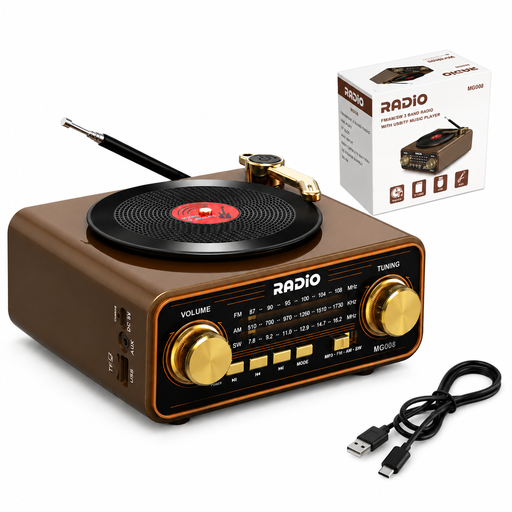
Wood-effect portable radio with Bluetooth 6.0

Wood-effect portable radio with Bluetooth 6.0

An option to consider if your preferred broadcast is available on FM.

The product name lists AM, FM and shortwave, Bluetooth 6.0, USB-C, a TF card, AUX and a 2000 mAh battery.

View at Joybuy
Mlove BV800 portable Bluetooth speaker with FM radio

Mlove BV800 Bluetooth speaker with FM radio

The FM radio and speaker may suit you if you want to listen without headphones to a programme broadcast on FM.

The product description mentions physical tuning and volume buttons and a rechargeable battery. This is a portable speaker, not a pocket radio.

View at Joybuy

Frequently asked questions

What can I do if a station doesn’t appear on my DAB+ pocket radio?

First, run a station scan again. Then check whether the station actually broadcasts the programme on DAB+ and whether you have reception where you’re listening. National availability doesn’t guarantee reception in your living room.

Can I listen to a panel show that’s only available online on an FM or DAB+ pocket radio?

Not with just the FM or DAB+ receiver described here. Check how the specific programme is distributed; if it’s only available online, you’ll need a separate, suitable way to play it.

What if the radio breaks down too soon during normal use?

According to ACM ConsuWijzer, you have a legal guarantee in addition to any manufacturer’s warranty. If the product doesn’t meet what you could reasonably expect, the seller must, depending on the circumstances, repair or replace it free of charge, or refund your money. This doesn’t mean there’s simply one fixed two-year guarantee period.

Can I return a radio I bought online if I’m not happy with it at home?

According to ACM ConsuWijzer, for a standard online purchase you generally have a legal cooling-off period of up to 14 days after delivery, subject to legal exceptions. Check the terms that apply to your purchase and handle the radio carefully while trying it out.
