
Hosts who also want to serve wholemeal rusks
You want to offer a wholemeal variety alongside plain rusks. Compare the ingredients and fibre per 100 g and per rusk; the variety’s name won’t tell you how much fibre it contains.


Choose plain rusks if you want a simple base without a pronounced seed flavour for fussy eaters; choose wholemeal if the ingredients and fibre content matter more to you. A larger or seeded variety can work well with generous toppings, but pay extra attention to the texture and allergens. Always check the packaging of the specific variety, as wholemeal rusks don’t all have the same ingredients.
You want to offer a wholemeal variety alongside plain rusks. Compare the ingredients and fibre per 100 g and per rusk; the variety’s name won’t tell you how much fibre it contains.
You’re looking for rusks without a pronounced seeded texture to suit a range of toppings. Plain rusks are an option, as long as their ingredients and allergens are also suitable for your guests.
You want a larger or seeded variety for toppings such as cheese, vegetables or spreads. Check that the size and texture suit your toppings, and read the allergen information on the label.
First decide whether you mainly want to serve a simple base, a wholemeal variety or rusks for more substantial toppings. Then compare the packs for ingredients, nutritional information and allergens.
| What to consider | What to check when buying | Who is this important to? |
|---|---|---|
| Wholemeal and fibre | Read the ingredients list and compare fibre per 100 g and per rusk. | If I want to offer a wholemeal option alongside plain rusks, I want to be able to compare the fibre content of the packs I choose. For around 42% of consumers, choosing a wholemeal option is the top priority. |
| Mild flavour and texture | Check whether you’re choosing plain rusks and whether the ingredients include seeds or coarse grains. | For fussy eaters, I want to be able to offer rusks without a pronounced seeded texture. Around 33% of consumers put this simple option first. |
| Substantial toppings and allergens | Compare the size and ingredients; check the exact pack for allergens before serving. | For generous savoury toppings, I look for a larger or seeded rusk, but I also want to know what my guests can eat. This is the top priority for around 25% of consumers. |
Wholemeal rusks vary from one product to another. Jumbo lists 7.7 g of fibre per 100 g for its wholemeal rusks, while Albert Heijn lists 11 g per 100 g for Bolletje Wholemeal.
Compare the nutritional information on the packs you’re considering, including per rusk if they’re not all the same size.
The product name doesn’t tell you what type of salt has been used in a particular rusk.
If the presence of baker’s salt matters to your choice, check the ingredients list on the pack.
A seeded variety may contain ingredients such as sesame. At a buffet, guests need to be able to see which rusks are suitable for them.
Read the allergen information on the exact pack, and keep the different varieties clearly separated when serving.
Bolletje offers plain and wholemeal rusks, as well as varieties with extra ingredients such as oats and seeds.
Albert Heijn’s own brand offers wholemeal rusks, among other products.
This own brand offers plain and wholemeal rusks in packs of 13.
This own brand offers standard wholemeal rusks and a wholemeal variety with seeds.
ALDI lists both plain and wholemeal rusks under its Goud Gebakken brand.
These products give you one plain option and two wholemeal options for your barbecue or brunch table. Choose the variety you want to serve, and check the label for the exact ingredients.
 No image available
A wholemeal option if you want to offer an alternative to plain rusks. Check the nutritional information on the packaging if fibre content is important to your choice.
 No image available
A dark wholemeal option to consider if you want to serve a selection of rusks. Check the ingredients and allergens on the packaging before serving these to guests.
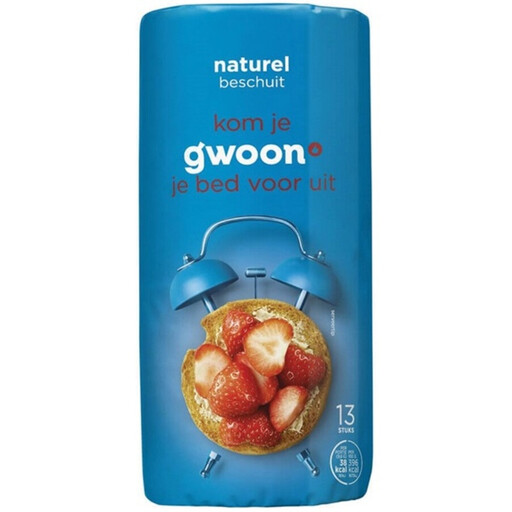 No image available
A plain option if you also want to offer rusks without a pronounced wholemeal or seeded flavour. If your guests have allergies, read the information on the exact pack.
Compare the specific products rather than relying on the name. Jumbo lists 7.7 g of fibre per 100 g for its wholemeal rusks and 3.1 g per 100 g for its plain ones; wholemeal varieties from different brands also have different fibre values.
Always check the allergen information on the current packaging of each variety. Wheat and egg are present in the rusks reviewed; a seeded variety may also contain sesame, for example. Keep the packaging or ingredients information available at the buffet.
You can’t tell from the product name. Read the ingredients list on the specific pack and, if necessary, ask the manufacturer which type of salt was used.
Store rusks according to the instructions on the packaging and only add toppings shortly before serving. Moist toppings in particular can make them less crisp.