
Households with fussy eaters
If a light, familiar rusk is important, you can compare plain rusks with a standard wholemeal variety. The nutrition table won’t tell you whether the different flavour and texture will go down well.


Choose plain rusks if a familiar, light bite matters more to your fussy eater than a wholemeal base. If fibre is your priority, look for rusks explicitly labelled as wholemeal. A darker or seed-rich variety also calls for a closer look at its flavour, ingredients and allergens. Compare similar packs per 100 g and check the current label.
If a light, familiar rusk is important, you can compare plain rusks with a standard wholemeal variety. The nutrition table won’t tell you whether the different flavour and texture will go down well.
If you buy rusks regularly, compare the wholemeal labelling and fibre content per 100 g. According to the Netherlands Nutrition Centre, wholegrain cereal products generally contain more fibre than white cereal products.
Dark or seed-rich wholemeal rusks offer a different option from a simple wholemeal variety. Check which grains and seeds they contain, and read the allergen information on the pack.
First decide whether familiarity or a wholemeal base matters most. Then compare the nutritional information and ingredients of the varieties that suit your household.
| What to consider | What should you check? | Who is this most important to? |
|---|---|---|
| Wholemeal and fibre | Check whether the rusks are labelled as wholemeal and compare fibre per 100 g across similar packs. | If fibre comes first, I want to see whether a wholemeal pack suits my needs. This is the top priority for around 33% of consumers. |
| Appeal to fussy eaters | Compare the ingredients in plain and standard wholemeal varieties, then see which texture goes down well at home. | There’s little point choosing a different rusk if the person eating it leaves it untouched. That’s why familiarity matters most to around 27% of consumers. |
| Seeds and variety | Check which seeds and grains have been added, and compare the nutrition information per 100 g with that of a simple wholemeal variety. | I’m specifically looking for a seeded rusk, even if it tastes different from our usual one. That’s the top priority for around 20% of consumers. |
| Pack size and availability | Check the number of rusks or the pack weight, and see whether the variety is available at your shop. | When I’m shopping, I want to be able to pick up a pack that suits how we use it. Around 13% of consumers prioritise this practical consideration. |
| Allergens | Read the current ingredients and allergen information on the physical pack, especially for varieties containing several grains or seeds. | If I need to avoid an allergen, I check that first, before considering flavour or fibre. This is the first thing around 7% of consumers look for. |
A dark appearance doesn’t tell you how much fibre a product contains or which grains are in it. The Netherlands Nutrition Centre recommends comparing similar products per 100 g.
Check the wholemeal labelling and ingredients list, then compare fibre, sugars, fat and salt per 100 g.
Ingredients vary between varieties. The examples reviewed include wheat and egg, and some also contain sesame or other grains.
Check the allergen information on the current pack before buying, even if you’ve bought a similar rusk before.
You can’t tell whether a product contains iodised salt from the label ‘Dutch rusk’ alone.
If this matters to your choice, look for bakers’ salt or a mention of iodised or iodine-enriched salt in the ingredients list.
A rusk shown online won’t necessarily be available in every shop. Lidl describes its wholemeal rusks as an in-store product.
Check availability at your local shop, and decide in advance which other variety also meets your main requirements.
These brands offer different options, from plain to wholemeal and seed-rich rusks. Compare the specific packs: features of one variety don’t automatically apply to the whole brand.
Bolletje offers plain rusks, standard wholemeal rusks and a dark wholemeal variety.
AH Beschuit volkoren is an own-brand option to compare with other wholemeal rusks.
Jumbo has its own wholemeal rusks and also stocks rusks from Bolletje.
Lidl lists 140 g packs of wholemeal rusks for in-store purchase.
ALDI lists Goud Gebakken Volkoren Beschuit in packs of 13.
PLUS offers both simple wholemeal rusks and a wholemeal variety with seeds.
These rusks reflect two of the options in our comparison: plain rusks if you’re looking for a familiar variety, and wholemeal rusks if a wholemeal base matters to you. The dark variety is a separate choice for anyone looking for seeds and a different blend of ingredients.
 Image unavailable
An option if you’d like to try standard wholemeal rusks before moving on to a darker variety.
The product information lists wholemeal wheat flour. Compare the fibre per 100 g on the current pack, and check the allergen information there too.
 Image unavailable
A choice for anyone specifically looking for a dark wholemeal variety with seeds, rather than just a small step up from plain rusks.
The product information lists extra wheat bran, oat flakes and seeds. Check the current allergen information, especially if you need to avoid wheat, other grains or sesame.
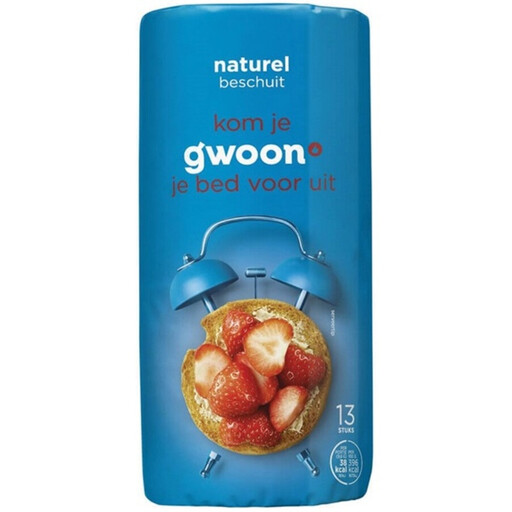 Image unavailable
A plain rusk to consider if a familiar option for fussy eaters is your priority.
The pack contains 125 g. For a fibre comparison, or if you need to avoid allergens, check the nutrition information and ingredients on the current packaging. If you have a milk allergy, check the allergen information in particular.
Check whether the variety is explicitly labelled as wholemeal, then compare the fibre per 100 g on both packs. The Netherlands Nutrition Centre recommends comparing similar products on the same 100 g basis, even if the serving sizes differ.
No. Colour alone doesn’t tell you whether a rusk is wholemeal or how much fibre it contains. Read the product description, ingredients and nutrition information; if it contains seeds, check which allergens are listed too.
Check the allergen information on the current pack before choosing your rusks. The varieties discussed have different ingredients; as well as wheat, some products contain egg, other grains or sesame. Don’t assume that another product from the same brand has the same ingredients.
No, don’t assume this applies to every pack. If iodised salt matters to your purchase, check the ingredients list for bakers’ salt or a mention of iodised or iodine-enriched salt.
Keep rusks dry and seal the packet or tin tightly. Follow any storage instructions on the pack you’ve bought.