
Everyday budget shoppers
You’re looking for a plain rusk to top with cheese, egg, hummus or another savoury topping. Weight, number of pieces and price per kilo make it easier to compare packs.


Plain rusk is a good starting point if you’re looking for a simple base for savoury toppings and keeping an eye on your shopping budget. Compare packs by weight and price per kilo. Choose a wholemeal, seeded or branded option if the grain ingredients, fibre or other ingredients matter more to you.
You’re looking for a plain rusk to top with cheese, egg, hummus or another savoury topping. Weight, number of pieces and price per kilo make it easier to compare packs.
You want rusk for a savoury breakfast and look beyond the price to fibre and grain ingredients. If you choose a wholemeal option, check the ingredients list too.
Egg, cereals containing gluten, salt or baker’s salt may influence your choice. So check the current packaging, even if two packs look similar at first glance.
First decide whether affordability, suitability for savoury toppings or the grain ingredients matter most. Then compare packs on the points that are relevant to you.
| What to consider | What to check when buying | Who it’s for |
|---|---|---|
| Everyday affordability | Compare the price per kilo and pack weight, then check the number of pieces. | If I often eat rusk with savoury toppings, I want to compare packs without being misled by different pack sizes. For around 42% of consumers, everyday affordability comes first. |
| A suitable ingredient profile | Read the ingredients and allergen information; if you wish, compare salt per 100 g and consider the topping too. | I want my rusk to suit my chosen topping and the ingredients I keep an eye on. Around 33% of consumers give this suitability of the label the highest priority. |
| Fibre and wholemeal flour | Compare fibre per 100 g and check whether flour is listed alongside wholemeal flour as a grain ingredient. | For a regular savoury breakfast, I care more about the grain ingredients than getting the cheapest pack. This is the top priority for around 25% of consumers. |
A similar price per pack tells you little if the packs have different weights. The number of rusks also doesn’t tell you how much product you’re getting.
Use the price per kilo to compare packs, then check the weight and number of pieces.
According to the Consumentenbond, rusk labelled wholemeal may also contain flour. So the name alone doesn’t tell you whether all the grain ingredients are wholemeal.
Read the ingredients list if you’re specifically looking for rusk made with wholemeal flour as its only grain ingredient.
According to the Voedingscentrum, bakers don’t have to use baker’s salt. So you can’t tell from the product category alone whether it has been used.
Check the ingredients list for baker’s salt if this matters to your choice.
At a savoury breakfast, the rusk isn’t the only thing that may contribute to the meal’s salt content; the topping you choose may add salt too.
Compare the salt content of rusk per 100 g and check the nutritional information for the topping as well.
Albert Heijn offers its own plain rusk, as well as other options including wholemeal rusk.
Jumbo offers its own plain rusk as an option to compare for a simple savoury breakfast.
PLUS offers plain rusk and a separate seeded option for shoppers who want to compare the ingredients.
Goud Gebakken offers plain and wholemeal options, both listed as packs of 13 pieces.
Lidl is an option for plain rusk if you want to compare packs in store.
Bolletje is a branded option with products including Echte Beschuit and wholemeal rusk.
These Bolletje options are worth considering for a savoury breakfast. Check the pack and label for each one before deciding which best suits your budget and preference for grain ingredients.
 Image unavailable
A seeded option to consider if you eat rusk with savoury toppings; the pack contains 10 pieces.
Check the current ingredients and allergen information if wheat or sesame is a concern for you.
 Image unavailable
A wholemeal option for anyone who focuses on grain ingredients at breakfast; the pack contains 10 pieces.
Read the ingredients list to find out which grains have been used. If you have allergies, check the current allergen information too.
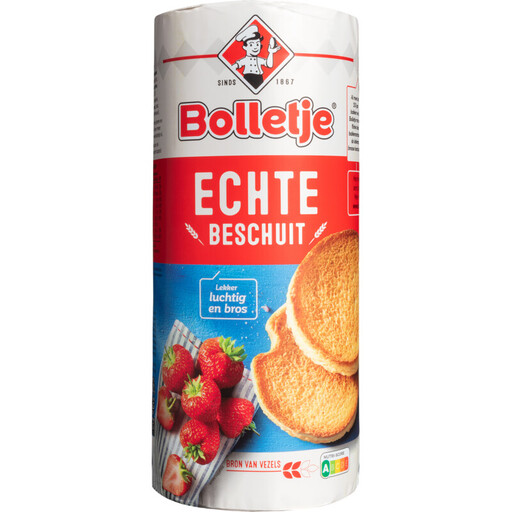 Image unavailable
A branded option to enjoy with savoury toppings; the pack contains 13 pieces.
When comparing ingredients and allergens, look out for wheat, egg and rye, among others, and check the current packaging.
 Image unavailable
A wholemeal option to compare if grain ingredients matter more to you; the pack contains 13 pieces.
Compare fibre values on a like-for-like basis, such as per 100 g. If you have allergies, check the current information for ingredients including wheat and egg.
Read the ingredients list: according to the Consumentenbond, rusk labelled wholemeal may also contain flour. If you’re looking for rusk made only with wholegrain ingredients, check whether flour is listed alongside wholemeal flour.
Don’t rely on the word ‘plain’ alone. The plain rusk from Albert Heijn, Jumbo and PLUS lists egg and cereals containing gluten. Always check the current allergen information on the pack of the product you choose.
No, you can’t tell from the product category alone: according to the Voedingscentrum, bakers don’t have to use baker’s salt. Check the ingredients list for baker’s salt if this matters to your choice.
In-store prices may differ from those shown online. PLUS points to local and interim price changes, while Lidl says current prices for food products are displayed in its shops. So check the price of the pack you’re actually buying.