
Baker short on floor space
You want extra freezer space, but need to check that the appliance will fit and that the lid can open with enough clearance. The Dutch Consumers’ Association explains that a chest freezer has a lid rather than a door.


A compact chest freezer suits pizza dough that you freeze in portions or batches, provided there’s enough space above the appliance to open the lid. If you want to reach individual portions more easily, or need the space above the freezer, compare it with an under-counter freezer with drawers. In either case, measure the full space needed for installation and opening, then compare the freezing capacity in kg per 24 hours with the size of your dough batch. The European Commission also lists annual energy consumption as a comparison figure on the EU energy label.
You want extra freezer space, but need to check that the appliance will fit and that the lid can open with enough clearance. The Dutch Consumers’ Association explains that a chest freezer has a lid rather than a door.
You make several portions at once, so you’ll want to compare the stated freezing capacity in kg per 24 hours with the weight of your batch. Tomado lists this capacity for the TCF0991W.
You often take out one portion at a time, so accessibility, visibility and space for your packaging matter. A basket and drawers offer different storage layouts; the Dutch Consumers’ Association explains that you access a chest freezer from above.
Choose this if: you have space above the appliance and can organise your dough portions by batch.
Bear in mind: you access it from above, and the external width alone won’t tell you whether the lid can open fully.
Choose this if: you want to take out individual portions separately or need the space above the appliance.
Bear in mind: the door and drawers need room to open in front of the appliance; also check that your packaging will fit.
Choose this if: you have enough floor space and clearance elsewhere for larger quantities.
Bear in mind: according to Liebherr, the Liebherr CFc 1875 is 104 cm wide. If you’re placing it in an unheated space, also check the permitted ambient temperature for the exact model.
| What to consider | What should you check? | Who should pay particular attention? |
|---|---|---|
| Will the freezer fit, and can you open it? | Measure the width, depth and height. Check the installation clearance in the manual and make sure there’s enough room for the lid or door to open fully. | If I’m short on floor space, I want to know whether the freezer will fit and open fully. Around 36% of consumers prioritise whether an appliance will fit in their space. |
| Can you freeze a batch of dough? | Weigh your usual batch and compare it with the capacity in kg per 24 hours; capacity in litres is a different measure. | If I make several portions at once, I want to match the batch size to the stated capacity. Around 29% of consumers prioritise freezing capacity. |
| What do energy use and noise levels mean? | Compare the annual kWh consumption, volume and noise emissions of the exact models on their EU energy labels. | If the freezer is near my living space, I want to take energy use and noise into account. Around 21% of consumers prioritise running costs or noise. |
| Can you find your portions easily? | Compare a basket or drawers with the dimensions of your packaging, and check the model’s care instructions. | If I often take out individual portions, I want to find them without searching the whole freezer. Around 14% of consumers prioritise accessibility and maintenance. |
The percentages give an indicative breakdown of priorities for this particular choice; they are not survey results.
A chest freezer may fit in the space available, but the lid might not open properly or you might not be able to follow the installation instructions.
Measure the depth and height too, check the clearance specified in the manual, and allow for the full opening movement of the model you choose.
Litres indicate storage space; kg per 24 hours is the stated amount of fresh food the appliance can freeze in a day.
Weigh your usual batch of dough and compare it with the model’s specifications. If needed, freeze larger quantities in smaller batches and, as recommended by the Netherlands Nutrition Centre, set the freezer to −18 °C or colder.
Since March 2021, household freezers have used the revised EU label without plus ratings. This means an older A+ rating cannot be compared directly with the current A–G scale.
Compare current models using their energy labels and annual consumption in kWh. The European Commission lists this information on the EU label.
Climate class SN alone does not confirm that the appliance will work below 10 °C. Operation at lower ambient temperatures is a separate, model-specific claim made by the manufacturer.
Measure the temperature of the room and check the documentation for the exact model before placing the freezer there.
These examples show differences in size and layout; the specifications listed apply only to the models named.
The Beko CF100EWN is a compact chest freezer. Beko lists a width of 54,5 cm and a capacity of 98 litres for this model.
According to Tomado, the Tomado TCF0991W is a chest freezer with a capacity of 99 litres and a removable basket.
The ETNA VV956WIT is an under-counter freezer with drawers rather than a chest freezer.
The Liebherr CFc 1875 is a larger chest freezer that may be worth comparing if you have space elsewhere.
This selection includes chest freezers for top-access storage and under-counter models with drawers for keeping portions separate.
 No image available
A good fit if you want to store portions of dough in a chest freezer with a storage basket and have room to open the lid.
The product name lists a capacity of 98 litres, a storage basket, a counterbalanced lid, adjustable temperature control and adjustable feet. Energy class E is also listed in the product name.
 No image available
A good fit if you’re looking for more storage space in a chest freezer and have room above the appliance for the lid.
The product name lists a capacity of 140 litres, a storage basket, a counterbalanced lid, adjustable temperature control and adjustable feet. Energy class E is also listed in the product name.
 No image available
A good fit if you’re considering a compact chest freezer with a wire basket; check that its external dimensions suit the space where you plan to put it.
The product information lists external dimensions of 54,5 × 47,6 × 83,5 cm, a capacity of 99 litres and a wire basket. The stated freezing capacity is 4,5 kg per 24 hours; the product name lists four-star freezing and energy class E.
 No image available
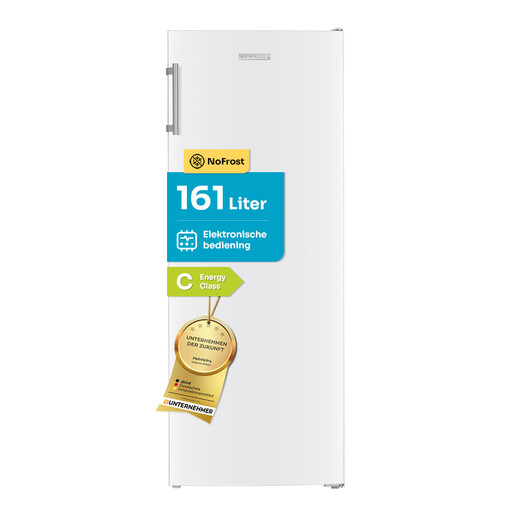
A good fit if you want to organise portions separately in drawers and trays, and have space in front of the appliance to open the drawers.
The product name lists a capacity of 161 litres, three freezer drawers, two drawers, a No Frost function and a temperature range of −14 °C to −22 °C. The product information also mentions two trays and a reversible door hinge.
 No image available
A good fit if you want to organise individual portions in drawers and can fully open the door at the front.
The product information lists a capacity of 87 litres, three transparent drawers and a freezing capacity of 4,4 kg per 24 hours. The product name lists energy label B.
Check the manual for your chosen model for installation and ventilation clearances, and make sure the lid can open fully. There’s no universal clearance that works for every model without knowing the exact freezer and kitchen dimensions.
The Netherlands Nutrition Centre recommends setting your freezer to −18 °C or colder and freezing food in small portions. Defrosting in the fridge is the general advice for frozen products; the Netherlands Nutrition Centre does not provide a specific defrosting schedule for homemade pizza dough.
No. The Netherlands Nutrition Centre recommends one month in the freezer for an opened, thin pizza base and notes that its quality may deteriorate after that. This advice does not automatically apply to every recipe or to homemade dough balls; for packaged products, follow the label too.
According to the Dutch government, when you buy something as a consumer you’re entitled to a product that works properly, and you should contact the seller if there’s a problem. The Netherlands does not have a fixed statutory warranty period of two years; a manufacturer’s warranty or an extra warranty you buy is in addition to your statutory rights.
According to the European Commission, EU energy-labelling requirements apply to household refrigerators and freezers within their scope. The label includes information such as the energy class, annual consumption in kWh, volume and noise emissions; check the details for the exact model.