Who is this relevant to?

Colleagues with short breaks

If you want to make juice for yourself or colleagues during a short break, you may want to consider speed and capacity. The Consumentenbond lists speed as an advantage of centrifugal juicers; Bosch gives the MES3500 a 1250 ml juice container.

People responsible for the shared kitchen

If you share the kitchen after use, consider how easy it is to clean the pulp, sieve and worktop. Bosch and Princess describe dishwasher-safe parts for specific models; check which parts are dishwasher-safe on the appliance you choose.

Colleagues working nearby

If you work nearby while the juicer is running, you can weigh up noise levels against juicing time. The Consumentenbond says centrifugal juicers are often louder; Kuvings describes the REVO830 as quiet, but this is not an independent measurement for an office setting.

What should you look for when buying?

Centrifugal juicer

Best for: anyone who wants to make juice during a short break and values speed. The Consumentenbond lists making juice quickly as an advantage of this type.

Consider: the Consumentenbond says centrifugal juicers are often louder; a large feed chute does not mean you can leave the thick pineapple skin on.

Slow juicer

Best for: anyone happy to spend more time juicing and cleaning, and mindful of noise while people are working. Kuvings describes the REVO830 as quiet.

Consider: according to the Consumentenbond, slow juicers are generally slower and often more expensive; Kuvings' claim is not an independent noise measurement for this office.

Concern What to look for when buying Who this matters to
Cleaning after shared use Check which parts are dishwasher-safe, how accessible the sieve is and whether the model has a drip-stop. If I share the kitchen after every juicing session, I want to make sure the next colleague doesn’t have to deal with pulp and a sticky worktop. Cleaning is a top priority for around 33% of consumers.
Speed and quantity per break Compare the capacity of the juice jug, the appliance’s dimensions and access to the feed chute on the exact model. If several colleagues are waiting to use the kitchen during their break, I want to know how much juice the appliance can hold and how quickly it’s ready. Speed and quantity are top priorities for around 25% of consumers.
Noise while colleagues are working Look for a comparable measured noise level or assess the appliance in person; also consider how long it runs for. When colleagues are working next to the kitchen, I want to avoid the juicer disrupting their work. Keeping noise down is the top priority for around 25% of consumers.
Purchase cost Compare the version you want, the parts supplied and the warranty terms; don’t pay extra based on a general claim about yield or health benefits. If I want to keep costs under control, I don’t want to pay extra for a benefit that hasn’t been demonstrated for every appliance. Purchase cost matters most to around 17% of consumers.

Common buying mistakes

  • Assuming a large feed chute means a whole pineapple will fit

    The size of the chute tells you nothing about the thick skin or the dimensions of a particular pineapple.

    Read the instructions for the model you choose and leave space to wash, peel and cut the pineapple.

    Preparing the fruit takes extra time and space alongside the appliance.

  • Buying a slow juicer solely for a general claim about vitamins or juice yield

    The Consumentenbond reports no standard advantage in juice yield or the nutrients tested compared with a centrifugal juicer.

    Compare the appliances based on what your office needs. Only assess claims about yield using tests of the exact models under comparable conditions.

  • Treating a claim such as ‘quiet’ as a measured noise level for an office

    A manufacturer’s claim without a comparable noise measurement won’t tell you how disruptive an appliance will sound next to workspaces.

    Check information about the exact model and agree on when the juicer can be used.

  • Confusing a motor or manufacturer’s warranty with cover for every part

    Kuvings gives separate warranty periods for the motor and other parts of the REVO830. That is not the same as a warranty covering the entire appliance.

    Read the cover for each part and keep your proof of purchase and model number. If a product is faulty, contact the seller about your statutory rights.

Brands compared

Bosch

The MES3500 is a centrifugal juicer with a juice container that Bosch specifies as having a 1250 ml capacity.

  • Bosch lists dishwasher-safe parts for the MES3500.
  • Check whether the model fits on the available worktop; these specifications don’t indicate pineapple yield or noise level.

Philips

The Viva HR1832/30 is a compact centrifugal juicer.

  • Philips describes quick cleaning as a feature of this model.
  • Decide for yourself whether cleaning it after each user is practical. Instructions about thick pineapple skins for other Philips models are not specifications for the HR1832/30.

Kuvings

The REVO830 is a slow juicer for anyone weighing up the juicing method, time in use and noise.

  • Kuvings describes the appliance as quiet and lists a 15-year warranty on the motor and a 2-year warranty on other parts.
  • The noise description is not an independent measurement in an office setting; the motor warranty period does not mean the entire appliance has the same warranty.

Princess

The 202040 is a centrifugal juicer for anyone comparing features related to juicing and cleaning.

  • Princess lists a drip-stop, a removable filter and dishwasher-safe parts.
  • This information from the manufacturer is not an independent measurement of noise level or pineapple yield.

Braun

According to Braun, the IdentityCollection J 500 BK is a centrifugal juicer with a juice jug and foam separator.

  • Braun also lists a drip-stop.
  • Braun’s claim that it produces juice in 15 seconds is not based on an office or pineapple test, and is not described under comparable conditions of use.

Joybuy product picks

These Joybuy product picks include a slow juicer and a juicer for shared use. Check whether the controls, capacity and cleaning requirements of each model suit your office.

WOOX MX0289 slow juicer

WOOX MX0289 slow juicer, 150 W

A slow juicer option for anyone considering this juicing method and looking to match the collection containers to shared use.

The product name lists a 600 ml juice cup and an 836 ml pulp container. The appliance is intended for domestic use; run it for no more than 10 minutes at a time, then let it rest for 20 minutes. The removable parts must be washed by hand.

View at Joybuy
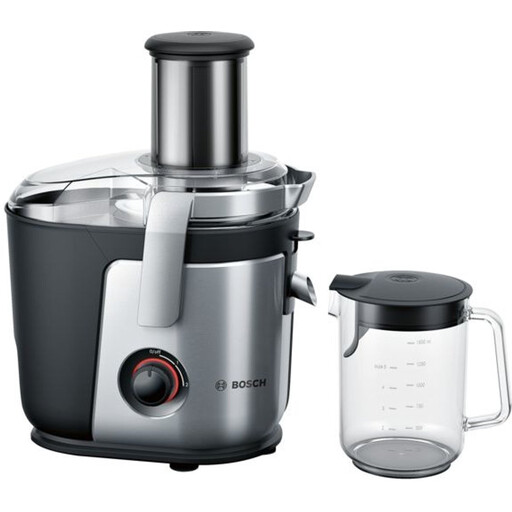
Bosch MES4000 juicer

Bosch MES4000 juicer, 1000 W

The stated capacity and dishwasher-safe removable parts may be useful when several colleagues share the appliance.

The specifications list a 1.5 l juice jug, a 3 l pulp container and an 84 mm feed chute. According to the product information, all removable parts are dishwasher-safe; also check that the appliance fits on the available worktop.

View at Joybuy

Frequently asked questions

Should you put a whole pineapple in the juicer?

No. Don’t assume that a whole pineapple will fit in every appliance without preparation. For the models covered by the relevant instructions, Philips advises washing the fruit, cutting it to size and removing thick skins, such as pineapple skin. Check the manual for the model you choose.

How should you store prepared pineapple and juice in a shared kitchen?

According to the Voedingscentrum, store cut pineapple in a sealed container in the fridge, and set the fridge to 4 °C in line with general food safety advice. For opened pineapple juice, the Voedingscentrum gives a storage period of 3–7 days; this is not a guaranteed shelf life for freshly squeezed juice. Take preparation and storage conditions into account when storing fresh juice.

Is cold-pressed pineapple juice automatically more nutritious?

No. According to the Consumentenbond, a slow juicer does not automatically produce more juice, and the nutrients tested were no higher than those in juice from a centrifugal juicer. Both types of appliance leave much of the fibre in the pulp; eating whole fruit is another option.

What do CE marking and warranties mean when buying in the Netherlands?

For electrical kitchen appliances covered by the relevant EU rules, the manufacturer must meet the requirements, affix a CE marking and draw up an EU declaration of conformity. The Netherlands Food and Consumer Product Safety Authority describes the scope of the Low Voltage Directive as 50 V to 1000 V AC; check the details for the specific appliance. When you buy as a consumer, the seller must provide a remedy if the product is faulty. According to the Dutch Government, the Netherlands has no fixed statutory warranty period of two years; a manufacturer’s warranty is additional.
