For pineapple juice at a family breakfast, a centrifugal juicer is a good choice when speed and making several glasses are priorities; according to the Dutch Consumers' Association, this type of juicer generally makes juice faster than a slow juicer. A slow juicer is a better fit if you prefer slow pressing or want to adjust the texture, but it won't automatically produce more juice or retain more nutrients. Peel the pineapple, cut it to the size specified in the manual, and check the capacity and product information for the exact model, including its CE marking.
Who is this choice relevant to?
Family with busy mornings
Wants to quickly turn peeled pineapple into several glasses of juice, so the capacity of the juice jug and pulp container matters. The Dutch Consumers' Association describes centrifugal juicers as generally fast; Bosch lists a 1500 ml juice jug for the MES4000.
Daily juice maker
Wants straining, removing pulp and cleaning parts after breakfast to be manageable. Bosch, Philips and the Dutch Consumers' Association describe cleaning features or things to consider; check the manual for each model to see which parts can be cleaned and how.
Juice drinker who cares about texture
Wants to choose how much pulp goes into the glass, without relying on health claims to guide that preference. Philips describes the HR1921/20 as offering a choice between clearer and thicker juice; Bosch lists adjustable juice thickness for the MESM731M.
What should you look for when buying?
Centrifugal juicer
A good fit when: speed and making juice for several family members in the morning are important. The Dutch Consumers' Association describes centrifugal juicers as generally faster than slow juicers.
Consider: they can be noisier, so compare the capacity of the exact model; the size of the juice jug doesn't guarantee how much juice you'll get.
Slow juicer
A good fit when: slow pressing or a particular juice texture matters more than speed. According to Bosch, the MESM731M has adjustable juice thickness.
Consider: the Dutch Consumers' Association says slow juicers are generally slower and take more work to prepare and clean; a higher vitamin content or greater yield isn't guaranteed.
| What to consider |
What to look for |
Who is this important to? |
| Speed and making juice for the family |
Compare the type of machine and the capacity of the juice jug and pulp container on the exact model. Container capacity isn't the same as the juice yield from one pineapple. |
If I want to make several glasses before breakfast, speed and having to empty the containers less often matter. Around 33% of consumers in this buying context prioritise speed and making juice for the family. |
| Cleaning effort |
Check how easy it is to access the sieve and pulp container, and which parts are dishwasher-safe according to the manual. |
If I have to clean the machine often after breakfast, I want to know how much manual work is involved. Around 27% of consumers in this buying context prioritise cleaning effort. |
| Preferred juice texture |
Check whether the exact model has a texture setting or a suitable sieve; don't assume the type of machine offers health benefits. |
If family members have different preferences for clear juice or more pulp, I want to be able to adjust the texture. Around 20% of consumers in this buying context prioritise juice texture. |
| Support if something goes wrong |
Check who to contact if there's a fault and what the terms are for any additional cover. |
If I mainly want to know what to do if the machine develops a fault, I look at the retailer and the warranty terms. Around 20% of consumers in this buying context prioritise after-sales support. |
Common buying mistakes
-
Assuming a wide feed chute means you can juice a whole pineapple with its skin on
Philips lists an 80 mm feed chute for the HR1921/20, but the Netherlands Nutrition Centre advises against eating pineapple skin.
Peel the pineapple and follow the manual for the size of the pieces and whether to remove the hard core.
-
Confusing the capacity of a hopper or juice jug with juice yield
The 2 l capacity of the Hurom H320N refers to its ingredient hopper; the Bosch MES4000's 1500 ml refers to its juice jug. Neither figure tells you how much juice you'll get from a pineapple.
Compare hopper and collection capacities separately, and don't use those figures alone to estimate juice yield.
-
Assuming the legal guarantee automatically ends after a set period
The Dutch Government states that the Netherlands has no fixed statutory guarantee period for every product. ACM ConsuWijzer points out that the retailer must resolve the issue if a product becomes faulty too soon under normal use.
If something goes wrong, contact the retailer, keep your proof of purchase and check what additional cover is actually offered.
Brands to consider
Bosch
Bosch offers centrifugal and slow juicers to suit different preparation preferences.
- Bosch lists a 1500 ml juice jug for the MES4000 and a 1000 ml juice jug for the MESM731M.
- Bosch describes the MESM731M as having adjustable juice thickness.
- Container capacity doesn't guarantee juice yield; these models haven't been compared for their performance with pineapple.
Philips
The Philips HR1921/20 is a centrifugal juicer with features for feeding ingredients and choosing the texture.
- Philips lists an 80 mm feed chute, a polished sieve and FiberBoost.
- A wide feed chute doesn't mean you can feed in pineapple with its skin on or put it in whole.
- The manufacturer's information about cleaning and texture isn't a comparative test of juicing pineapple.
Hurom
The H320N is a slow juicer for those who want to add ingredients to a larger hopper.
- Hurom lists a 2 l capacity for the ingredient hopper.
- The hopper capacity isn't the capacity of the juice jug, nor does it guarantee a particular amount of pineapple juice.
Braun
The Braun IdentityCollection J 500 BK is a centrifugal juicer you can compare with other models.
- Braun lists a power rating of 900 W and parts that are dishwasher-safe according to the instructions.
- A general manufacturer's description of juicing time doesn't prove a specific preparation time or yield for pineapple.
Juicers at Joybuy
The Joybuy products below include centrifugal juicers for those who prioritise speed, and slow juicers for those who want to compare slow-pressing options. When juicing pineapple, check the preparation required and the instructions for the exact model.
 No image available
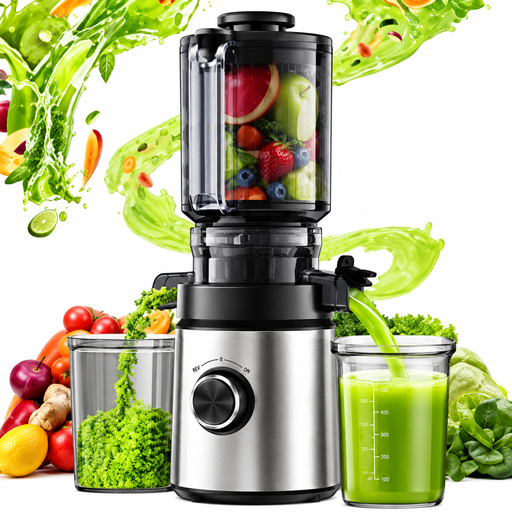
Family slow juicer, 130 mm XL feed chute, 2 glasses
For those who value a wide feed chute and two included glasses when preparing fruit.
XL feed chute: 130 mm.
Includes 2 glasses.
View at Joybuy
 No image available
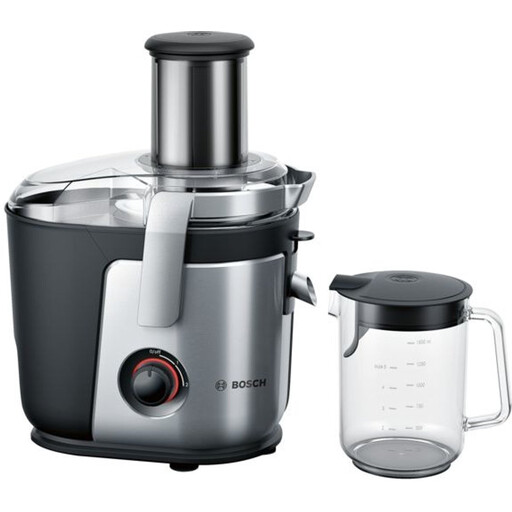
Bosch MES4000 centrifugal juicer, 1000 W, 1.5 l
For those who value the quick preparation of a centrifugal juicer and a juice jug for family breakfasts.
Power: 1000 W.
Juice jug: 1500 ml.
Ceramic blade.
View at Joybuy
 No image available
WOOX MX0289 slow juicer, 150 W, 600 ml juice jug
For those who want to press fruit slowly and collect juice and pulp separately.
Power: 150 W.
Juice jug: 600 ml; pulp container: 836 ml.
Use for a maximum of 10 minutes at a time, followed by a 20-minute rest.
View at Joybuy
Frequently asked questions
Can you put pineapple skin through a juicer?
Remove the skin. The Netherlands Nutrition Centre advises against eating pineapple skin because it's difficult to digest. Then cut the flesh into pieces that fit your machine, as specified in the manual.
Does a 2 l feed hopper mean you'll get 2 l of pineapple juice?
No. For the Hurom H320N, 2 l refers to the ingredient hopper, not the amount of juice. The final yield hasn't been established.
Is a slow juicer always healthier or does it always produce more juice?
No. The Dutch Consumers' Association doesn't describe any general vitamin advantage over a centrifugal juicer, and yield depends on the appliance. The Netherlands Nutrition Centre recommends eating fruit rather than drinking it; juice doesn't provide the fibre of a whole pineapple.
Does an electric juicer need a CE marking in the Netherlands?
Yes. The Netherlands Food and Consumer Product Safety Authority states that CE marking is compulsory for electrical products. Check the marking and product information for the specific model.
Who should you contact if a juicer breaks too soon under normal use?
Contact the retailer. ACM ConsuWijzer states that the retailer must resolve issues with faulty products; the Dutch Government says there is no fixed statutory guarantee period for every appliance in the Netherlands. A manufacturer's guarantee is additional.


