
Vandaag of morgen in huis

Kwaliteit gegarandeerd

Welkomstaanbiedingen ontgrendelen: GRATIS bezorging | Tot 80% korting | Gratis 30 dagen JoyPlus-proefperiode
Download de app
A pill organiser may seem simple, but choosing the wrong one can quickly become inconvenient. A lid that pops open in your bag, compartments where capsules get mixed up or a size that’s too small for your daily supply: these are common problems. If you take medicines, vitamins, supplements or fish oil every day, you’ll want clear organisation, portability and a fastening that suits how you use it.
So when choosing, don’t just look for terms such as “waterproof”, “airtight” or “BPA-free”. Check how the organiser is divided, how much you can actually fit in each compartment and whether the product information clearly explains these features.
A pill organiser with seven compartments might seem handy for a week, but that doesn’t necessarily mean each compartment is suitable for several capsules or large tablets. Fish oil capsules and some supplements can take up quite a bit of space. So check the dimensions and user experience, not just the number of compartments.
A simple flip-top lid may be enough for use at home. For a handbag, rucksack or suitcase, a sturdy snap-lock or sealed fastening is more practical. Also consider how the organiser opens: small lids save space, but can be harder to handle if you have a limited grip.
“Waterproof”, “airtight” and “moisture-proof” are often used in product titles. Without details about the fastening, seal or care instructions, it’s hard to know what to expect in practice. Treat these words as claims made by the seller and check the specifications before ordering.
A pill organiser also isn’t a substitute for the original packaging or patient information leaflet when medicines have specific storage requirements. If you’re unsure whether your medicines can be stored outside their original packaging, ask your pharmacist or healthcare professional.
A pill organiser with compartments is most useful when its layout fits your routine:
A weekly pill organiser divided into morning, afternoon, evening and night compartments gives you a clearer overview if you have a more complex schedule. Check that the labels are easy to read and whether individual compartments can be removed.
A compact travel pill organiser is easier to fit in a coat pocket or wash bag, but usually has less capacity. A larger model is more practical if you need several capsules at each time of day. Product dimensions are sometimes given in inches; for example, the JORDAN&JUDY model with 28 compartments is listed as 9,1 × 5,1 × 1,2 inch. This matters if you plan to carry it in a handbag or suitcase, as well as when considering how much storage space you have at home.
Check whether the material is specified, for example PP, ABS or TPE, and whether the seller states that it is BPA-free. A product title that says “BPA-free pill organiser” is a useful indication, but always check the full product information.
Also look for:
Only use a vitamin organiser for its intended purpose. A tablet splitter or cutter isn’t automatically suitable for every tablet; if you’re unsure, ask your pharmacist for advice.
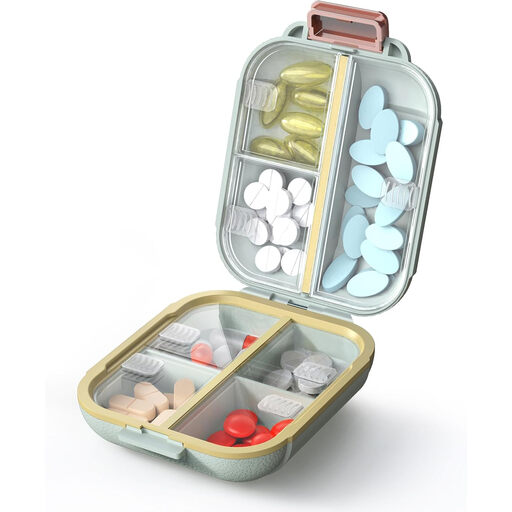
Why it suits this need: This compact model is designed for people who want to organise their medicines or vitamins across seven compartments without using a large weekly organiser.
The seven-compartment layout means you don’t need a separate organiser for each day. The product title describes an airtight lid and BPA-free material; check the fastening before carrying it in a bag.
Seven separate compartments, a compact travel size and material described as BPA-free in the product title.
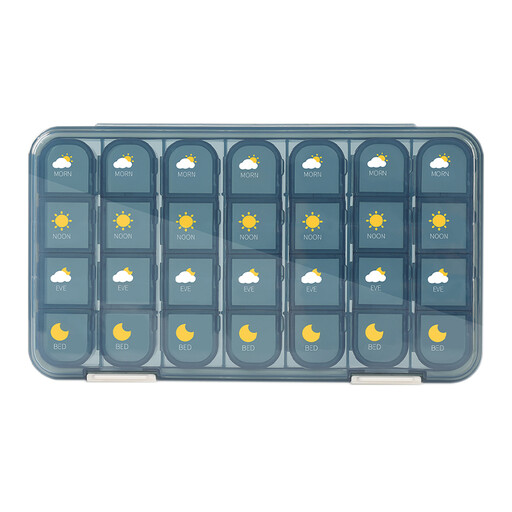
Why it suits this need: This model is designed for a regular weekly routine with several times of day for taking medicines, and has space for medicines, vitamins or supplements.
The 28 compartments are arranged across four times of day, and the specifications describe a sealed design with click-lock fastenings. This makes it easier to organise your medicines than using one large, unsorted compartment.
28 compartments, four compartments per day and a stated size of 9,1 × 5,1 × 1,2 inch.
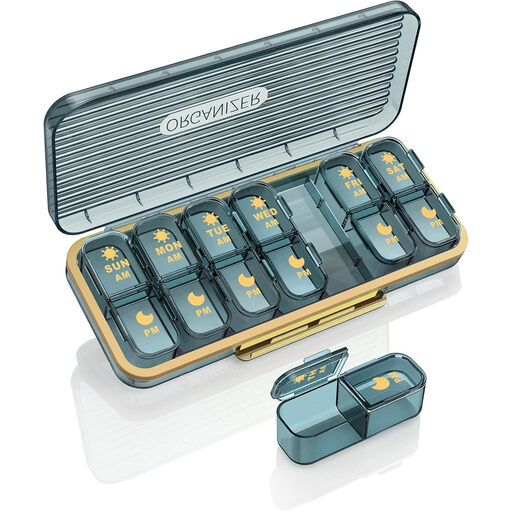
Why it suits this need: The morning and evening sections suit people who carry several supplements or medicines a day and appreciate a design with detachable sections.
Dedicated morning and evening compartments help prevent medicines for different times of day from getting mixed up. Do check that each compartment has enough room for your capsules or tablets.
A seven-day layout, morning and evening compartments, and a design described as portable and detachable in the product title.
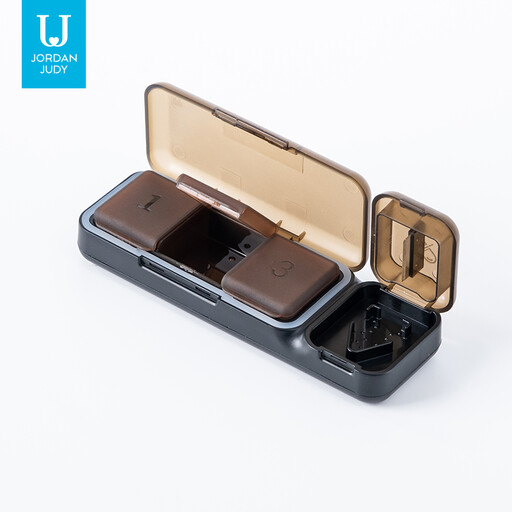
Why it suits this need: This mini design is made for carrying a small daily supply when you’re out and about, for example in a purse, coat pocket or small bag.
Its small size means you won’t have to carry an unnecessarily large organiser. The built-in tablet splitter is an added feature, but check the patient information leaflet for your medicine to make sure it can be split.
Mini size, storage for everyday use and an integrated tablet splitter, according to the product description.
We’ve put together a complete, up-to-date list of products that meet these strict selection criteria and the applicable European safety regulations.
Wash or wipe the organiser according to the care instructions and allow it to dry completely. Then fill each compartment when you have time and check the day and time labels against your medication schedule. Store medicines that are sensitive to light, moisture or temperature according to your pharmacist’s advice.
That depends on the material, the fastening and how often you use it. Check regularly for hairline cracks, loose lids, discolouration or a seal that no longer fits properly. Replace the organiser if the compartments no longer close securely or the labels become hard to read.
The price mainly depends on the number of compartments, the size, the fastening and extra features such as removable compartments or a tablet splitter. Compare more than just the price: consider the capacity and care requirements too. A cheap pill organiser that’s too small or can open while you’re carrying it may be less practical than a model that better suits your daily routine.
