
Livraison le jour même et le lendemain

Qualité garantie

Débloquez vos offres de bienvenue: Livraison GRATUITE | Jusqu'à -80 % | 30 jours d'essai gratuits à JoyPlus
Téléchargez l'application
A pill organizer may seem like a simple product, but the difference between a convenient pill box and an impractical medication organizer becomes especially clear after a few weeks of use. A lid that is difficult to open, compartments that are too small, or unclear day markings can make your daily routine unnecessarily complicated.
For anyone taking medication, vitamins, fish oil, or dietary supplements, the choice mainly comes down to layout, capacity, portability, and ease of use. Below, you’ll find what to look for and which models suit different needs.
Not every pill organizer has compartments suitable for large vitamins, fish oil capsules, or multiple tablets. A compact model may look appealing, but quickly becomes inconvenient if the compartments are difficult to close or the contents are hard to keep organized.
So don’t just look at the number of compartments; also consider the shape and capacity of each compartment. A 7-day pill organizer with one large compartment per day is suitable for a simple routine. If you take medication at multiple times of day, a pill organizer with several compartments is more practical.
A weekly medication planner with compartments only for Monday through Sunday may not always be enough. If you take medication in the morning, afternoon, and evening, three or four compartments per day can help prevent mix-ups.
Check whether the compartments are clearly marked by day or time. Permanent markings offer a practical advantage over labels that may come loose or fade.
Terms such as moisture-resistant, waterproof, or airtight are not always used consistently. Check whether the product description specifies a closure mechanism, sealed construction, or moisture-resistant properties. A pill organizer is not a substitute for the original medication packaging and should be stored in a dry place.
Always store medicines according to the instructions on the packaging or provided by your pharmacy. Use an organizer primarily to stay organized and manage daily doses—not for products requiring special storage conditions unless you have first sought professional advice.
Choose the layout based on your personal schedule:
A model with separate or removable day modules can be useful when you only want to take one or two days’ worth of medication with you. However, check that the closures are secure enough for transport in a bag or suitcase.
Many pill organizers are made from PP, ABS, TPE, or BPA-free plastic. Check the product specifications to see which material is actually listed. “Medical-grade” or “food-safe” should be treated as a product specification, not as a guarantee regarding the effectiveness of your medication.
An organizer should be easy to clean. In most cases, use a damp cloth or mild soap, rinse thoroughly if permitted, and allow all compartments to dry completely before refilling them. Not every model is dishwasher-safe.
For people with arthritis or reduced hand strength, small, stiff lids can be difficult to use. An easy-open lid, wide edge, or smooth hinge may make more difference than an additional compartment.
Also check that the lid closes securely. A loose closure increases the chance of pills mixing together in your bag. At the same time, opening the organizer should not require so much force that daily use becomes frustrating.
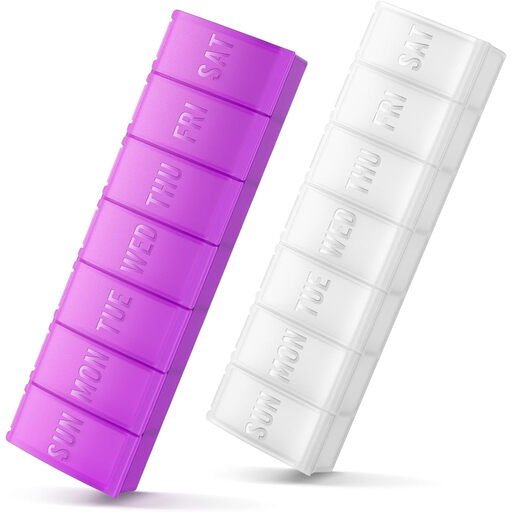
Why it’s a good fit: A clear, straightforward choice for daily use, vitamins, and supplements. The set includes two organizers, and the spacious compartments are described as suitable for larger capsules.
The day labels are permanently engraved according to the description, and the lids are designed for easy opening.
BPA-free plastic, 7 daily compartments, spacious sections, and a compact two-piece set.
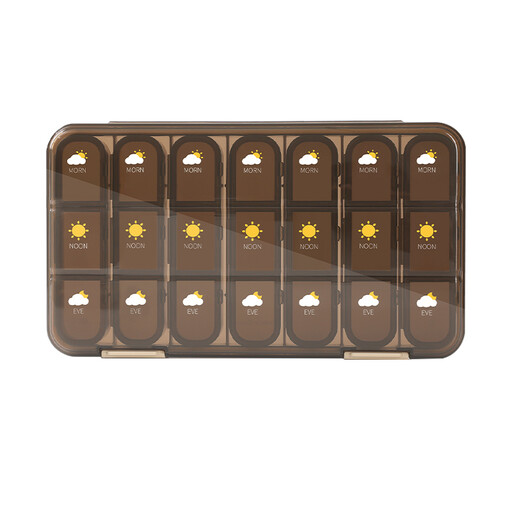
Why it’s a good fit: The three-compartment-per-day layout is designed for morning, afternoon, and evening or night. That makes this model well suited to a more detailed weekly medication schedule.
With three compartments per day, you don’t need to combine multiple doses in one small section.
21 compartments, a portable format, and a sealed design with snap closures according to the description.
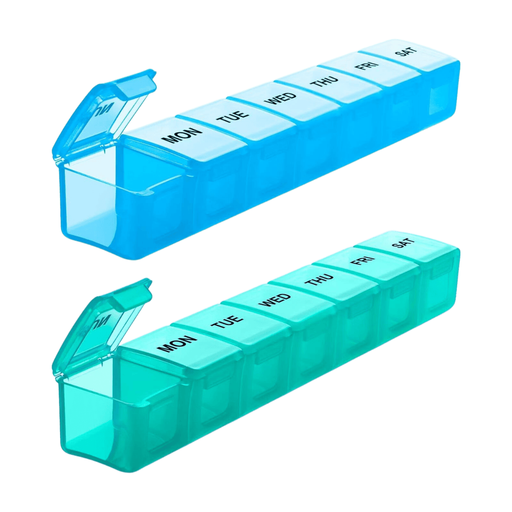
Why it’s a good fit: The extra-large 7-day layout is designed for larger vitamins, fish oil, and supplements. Two organizers are practical for use at home and on the go.
The product description mentions extra-large compartments and a moisture-resistant design, so you don’t have to compromise on capacity for a compact travel format.
BPA-free plastic, 7 separate daily compartments, snap closures, and a two-piece set.
For a single day, a handbag, or a short trip, a small travel pill box may be all you need. The JORDAN&JUDY Small Pill Organizer with Pill Cutter has seven daily compartments and an integrated stainless-steel blade. Use a pill cutter only when the package insert or your pharmacy confirms that a tablet may be split. According to the product information, capsules and liquid-filled pills are not suitable for this.
For a single dose or a few supplements, models with three or six compartments are more practical than a full weekly planner. With compact models, pay particular attention to whether the compartments are large enough and whether the lid could open accidentally inside your bag.
Explore a current selection of medication storage boxes and organizers for home, travel, vitamins, and daily medication.
No. Some medicines must remain in their original packaging, be protected from light, or be stored at a specific temperature. If you’re unsure, ask your pharmacy for advice and follow the information on the label or in the package insert.
That depends on how it is used. Clean the organizer whenever you notice powder, residue, or dirt, and allow the compartments to dry completely before refilling them. Do not use harsh cleaning products, and check whether the manufacturer confirms that the organizer is dishwasher-safe.
Focus especially on clear day markings, wide lids, easy opening, and a secure closure. For multiple dosing times, 21 or 28 compartments are often easier to manage than seven large compartments. Make sure the chosen layout matches the actual medication schedule, and discuss any concerns with your pharmacy.
