
Vandaag of morgen in huis

Kwaliteit gegarandeerd

Welkomstaanbiedingen ontgrendelen: GRATIS bezorging | Tot 80% korting | Gratis 30 dagen JoyPlus-proefperiode
Download de app
A pill organiser might seem straightforward, but the wrong model can quickly become a nuisance. A lid that doesn’t close properly, compartments that are too small, or days that are hard to read can lead to confusion and waste. This is especially true when you’re taking several medications, vitamins or supplements at different times.
So, making the right choice isn’t about colour or a catchy marketing term. It starts with the layout, the closure, the size, and how you plan to use the organiser.
A 7-day pill organiser with one compartment per day is practical for a simple routine. If you take pills in the morning, afternoon and evening, you may need several compartments per day. Otherwise, different intake times end up lumped together.
Pay attention to the difference between:
Vitamins, fish oil capsules and some supplements take up more space than small tablets. A compact model is easy to carry, but may therefore have too little capacity per compartment. So, check not only the number of compartments, but also the available space.
A product description might, for example, talk about a large capacity. Look to see if concrete information is given, such as dimensions or an indicated number of capsules per compartment. According to the product information for the VVM Weekly Pill Organizer Large, the compartments can each hold several large supplements. That’s a product specification, not a guarantee that every type of capsule will fit.
For a bag or suitcase, a well-sealing lid is important. A model with a simple snap closure can be pleasant for home use, while a sealed or moisture-resistant design may be more practical on the go. Claims like “waterproof” or “airtight” shouldn’t automatically be equated with protection against prolonged contact with water. The closure is intended for storage and transport, not as a replacement for the original medicine packaging.
For a complex routine, a weekly medicine organiser with three or four compartments per day is clearer than a standard 7-day pill organiser. Choose, for example:
Check that the day labels are clear and whether they are printed or engraved on the product. According to the product information for the VVM 7-Day Pill Organizer, the labels are permanently applied. This can prevent labels from peeling off with use, but always check on receipt that the markings are easy to read.
Many pill organisers are made from PP, ABS, TPE or similar plastics. Products with BPA-free plastic are often offered for medicines, vitamins and supplements. However, this doesn’t automatically say anything about suitability for every specific medicine. Store medicines according to the instructions on the packaging or from your pharmacy and manufacturer.
Also pay attention to:
Clean a pill organiser according to the product instructions. For several models, hand washing with mild soap and thorough drying is recommended. Only refill the compartments when there is no moisture left.
A pill organiser for travel must fit in your bag without the lids being constantly under pressure. A small, portable pill organiser is suitable for one day or a few moments. For a full week, you’ll need more space.
When choosing, consider:
For prescription medication, preferably also use the original packaging or a clear medication overview, especially when travelling. A pill organiser makes intake times clearer, but doesn’t replace the patient information leaflet or the advice of your doctor and pharmacist.
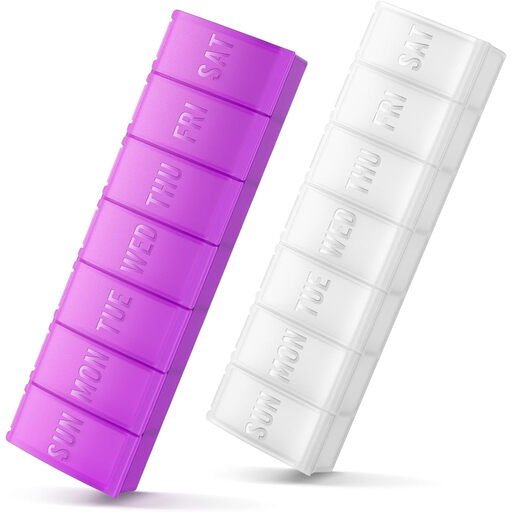
Why this suits the profile: This model is designed for simple weekly planning and comes as a set of two. According to the product information, the spacious compartments are suitable for larger vitamins, fish oil and supplements.
The engraved day labels are described as wear-resistant. This helps against unclear markings with regular use.
Set of 2; BPA-free plastic according to the product information; easy-open lids and spacious daily compartments.
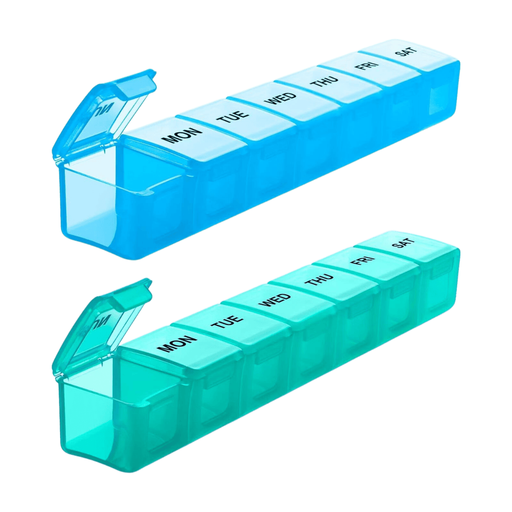
Why this suits the profile: Suitable for users who want an extra-large weekly compartment for supplements or multiple tablets per day, and who also want to use a second unit.
The product information mentions a thickness of 1.6 mm, reinforced hinges and a moisture-resistant design. Nevertheless, check whether the size fits your bag.
Extra-large compartments; set of 2; closures that, according to the product description, are suitable for daily opening.
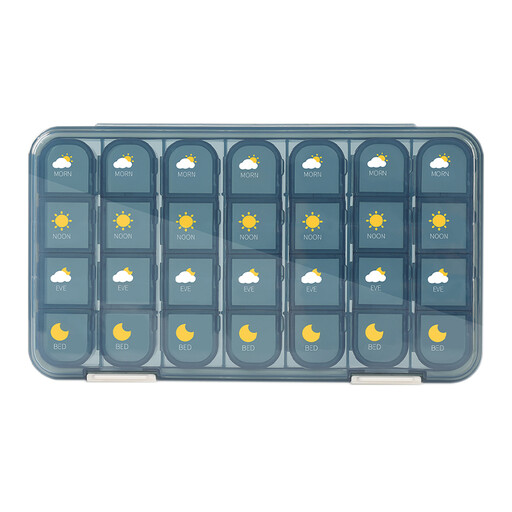
Why this suits the profile: A logical choice for people with four intake times per day, carers preparing a weekly schedule, or travellers with a detailed routine.
The 28 separate compartments prevent morning, afternoon, evening and night doses from ending up together. The closure must be fully clicked shut for transport.
Four compartments per day; dimensions of 9.1 × 5.1 × 1.2 inches; ABS, PP and TPE materials according to the product information.
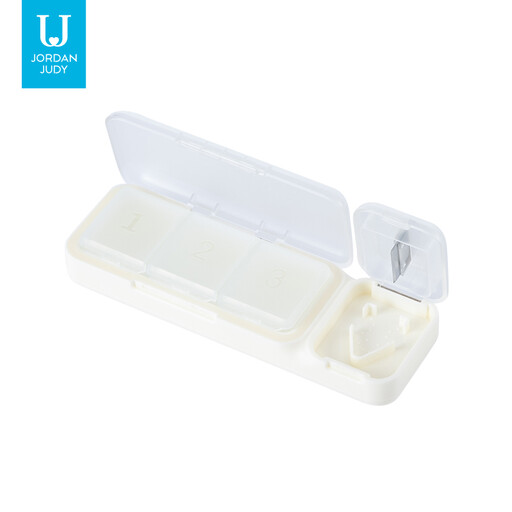
Why this suits the profile: According to the product description, this compact model fits in a pocket, handbag or small travel bag and combines seven daily compartments with an integrated tablet splitter.
The seven marked daily compartments keep a simple schedule separate. Only use the pill splitter when the patient information leaflet or healthcare provider indicates that a tablet may be divided.
Seven removable daily compartments; integrated stainless steel splitter according to the product information; compact PP design.
We’ve put together a full, up-to-date list of products that fully meet these strict selection criteria and comply with current European safety regulations.
Only if the model has multiple compartments per day. A box with seven compartments is suitable for one daily dose. For morning, afternoon and evening, choose a model with 21 compartments; for four times a day, 28 compartments are more practical.
The lifespan depends on the material, the hinges, how often you open the organiser and how you clean it. Regularly check that lids still close properly, labels remain legible and no cracks appear. Replace the organiser if it is damaged or when pills could get between compartments.
That depends on the medicine and the storage instructions. Some medicines must remain in their original packaging, protected from light or moisture. If in doubt, ask your pharmacy for advice. Use a pill organiser mainly as a tool for planning and transport, not as a replacement for the original information on the packaging.
