
Livraison le jour même et le lendemain

Qualité garantie

Débloquez vos offres de bienvenue: Livraison GRATUITE | Jusqu'à -80 % | 30 jours d'essai gratuits à JoyPlus
Téléchargez l'application
A pill organiser may seem simple, but the wrong model can quickly become inconvenient. A lid that is difficult to open, compartments that are too small or unclear day markings can make it harder to keep your medicines, vitamins or supplements organised. This is especially frustrating if you take medication several times a day or are often on the go.
As a Joybuy Product Recommendation Officer, I filter product information based on practical features. Don’t just look for terms such as “large capacity” or “waterproof”. Above all, check the layout, closure, dimensions and care instructions.
A 7-day pill organiser with one compartment per day is useful for a simple schedule. If you take medication at several times throughout the day, everything can become mixed up. A 28-compartment medication organiser, for example, provides four timeslots per day: morning, afternoon, evening and night.
Fish oil, large vitamins and some capsules take up more room than standard tablets. Check whether the product description mentions spacious compartments. A compact pill organiser is not automatically suitable if you take several large capsules each day.
A sturdy click closure is useful during transport, but can be difficult to open for people with limited hand strength or stiff fingers. Conversely, a loose lid may open inside a bag. Look for the right balance between closing securely and opening easily. When choosing a travel pill organiser, protection against moisture is also important. If a manufacturer uses terms such as “moisture-proof” or “waterproof”, read the care instructions too: this does not automatically mean that the product can be kept underwater for a long time.
Choose a layout that fits your routine:
A pill organiser with compartments should have clear day or time markings. Permanently applied labels may be more practical than stickers that come loose over time.
Don’t just measure the outside. Pay particular attention to the usable space in each compartment. A large pill organiser is not always the most convenient choice for a handbag or coat pocket. For use at home, extra capacity can save time when filling it.
Also check whether the dimensions are given in centimetres or inches. This helps prevent surprises when ordering online. Product photos give you an impression of the size, but they are not a substitute for the product specifications.
Many models are made from PP, ABS, TPE or BPA-free plastic. These terms tell you something about the material, but not automatically whether it is suitable for every type of medicine. Always store medicines according to the instructions on the packaging or from your pharmacist.
When cleaning the organiser, follow the product instructions. Some boxes can be washed by hand, while others may only be cleaned with a dry or slightly damp cloth. Allow a medicine organiser to dry completely before refilling it. Moisture can be particularly undesirable around metal components, such as a pill splitter.
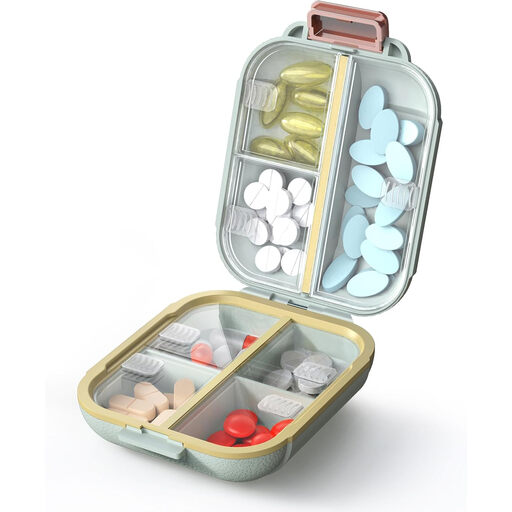
Why it suits this profile: This compact model is designed for a simple weekly schedule and, according to the product description, fits in a bag or luggage. It is suitable for daily medicines, vitamins and travel planning.
The seven separate compartments prevent a simple weekly schedule from becoming completely mixed up. However, check that each compartment has enough capacity for your supplements.
Seven compartments, a compact shape and an airtight lid, as stated in the product title.
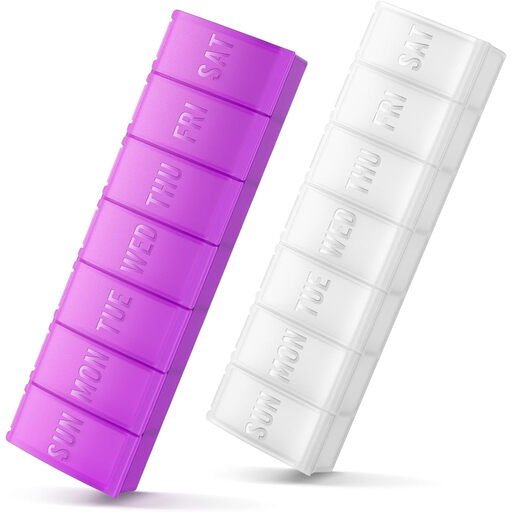
Why it suits this profile: According to the product information, the spacious compartments are designed for large vitamins, fish oil and supplements. The set of two can be practical for use at home and when travelling.
The spacious compartments reduce the risk of large capsules getting stuck. According to the description, the day labels are permanently applied.
BPA-free plastic, two organisers and compartments for larger pills.
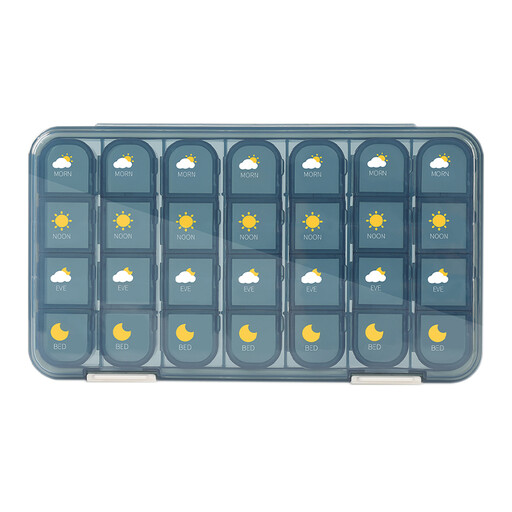
Why it suits this profile: Four compartments per day provide space for morning, afternoon, evening and night. This suits a more complex medication routine or several supplement times.
The 28 compartments prevent different medication times from ending up in the same compartment. According to the product description, the sealed design and click lids are intended to keep pills separate during transport.
28 compartments, dimensions of 9,1 × 5,1 × 1,2 inch and a portable design.
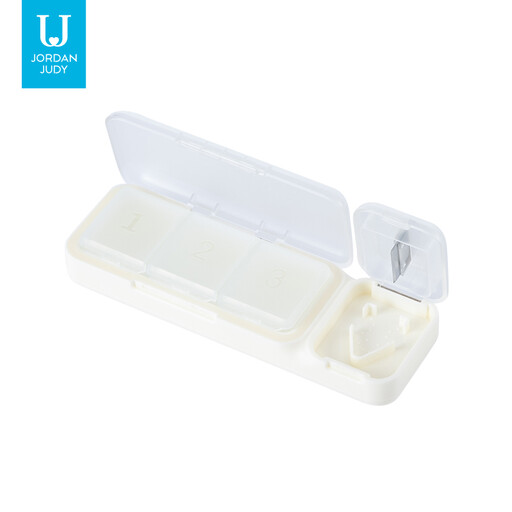
Why it suits this profile: The mini size is suitable for a coat pocket, handbag or small piece of luggage. The seven daily compartments combine storage with a built-in pill splitter.
The weekly layout keeps your daily supply organised, while the splitter means you do not need to carry a separate tool. According to the product information, the blade is not intended for capsules or liquid-filled pills.
Seven removable daily compartments, PP plastic and an integrated stainless-steel cutting blade.
A pill organiser is an organisational aid and does not replace the original packaging or advice from your doctor or pharmacist. Keep the following points in mind:
We have put together a complete, up-to-date list of products that fully meet these strict selection criteria and the applicable European safety regulations.
That depends on your routine. For one medication time per day, seven compartments are often sufficient. If you take medicines several times a day, choose a pill organiser with 14 or 28 compartments. Always check that the compartments are large enough for your tablets and capsules.
Its lifespan depends on the material, hinges, closures and daily use. Replace the organiser when a lid no longer closes properly, labels become unreadable or the material is damaged. Clean it according to the product instructions and only refill it once all the compartments are dry.
Only if this is compatible with the storage instructions for the products concerned. Check the packaging and patient information leaflet. If you want to keep medicines and supplements clearly separated, choose a medication organiser with separate compartments or several individual sections.
