
Livraison le jour même et le lendemain

Qualité garantie

Débloquez vos offres de bienvenue: Livraison GRATUITE | Jusqu'à -80 % | 30 jours d'essai gratuits à JoyPlus
Téléchargez l'application
A pill organiser may seem simple, but you’ll soon notice if you’ve chosen the wrong one. A lid that pops open in your bag, compartments that are too small or unclear day labels can make a medication organiser more of a nuisance than a help. Claims such as ‘waterproof’, ‘airtight’ and ‘BPA-free’ are only meaningful if the product description clearly explains what they’re based on.
This buying guide will help you choose a pill organiser for medicines, vitamins or food supplements. We focus on layout, fastening, size, material and intended use.
A weekly pill organiser with lots of compartments can be useful, but only if they’re easy to identify. For everyday use, you want to see at a glance which tablet belongs to which time of day. For example, a model with 28 compartments is laid out differently from a compact pill box with four or six compartments.
Look out for:
An inexpensive medicine box may look compact, but a loose fastening can be a nuisance in a handbag, rucksack or suitcase. Check whether the product information mentions a snap closure, double lock, sealing ring or sealed design.
A fastening won’t automatically prevent moisture from getting in. Treat terms such as ‘moisture-resistant’ or ‘waterproof’ as the supplier’s product specifications, not a guarantee for every journey or weather condition. Always store medicines according to the instructions on the packaging or advice from your pharmacy.
If you’re considering a BPA-free pill organiser, check that this is explicitly stated in the product description. Some products only list the material, such as PP, ABS or TPE. For example, the JORDAN&JUDY model with 28 compartments is listed as being made from ABS, PP and TPE.
BPA-free also doesn’t mean that a product is suitable for every use or temperature. Use your pill organiser as intended and follow the cleaning instructions. Don’t put it in the dishwasher unless the supplier says it’s dishwasher-safe.
Choose a layout that suits your routine:
A pill box for vitamins and supplements doesn’t need the same layout as a medication organiser for several daily doses. Check your routine first, then choose the number of compartments you need.
A travel pill box is often all you need for your commute or a day out. For a longer holiday, a larger capacity may be more convenient. Check the dimensions in centimetres or inches, especially if the box needs to fit into a small pocket in your bag.
A model may be described as compact but still be relatively wide if it has several rows of compartments. So check the listed dimensions as well as the product title.
A secure fastening helps keep compartments closed while you’re on the move. A silicone sealing ring may be part of the design, but that alone doesn’t mean the box is fully waterproof.
A pill splitter or tablet splitter can be useful if your tablets can be split according to the instructions. Always check the patient information leaflet or ask your pharmacy whether a tablet can be split. Not all tablets are suitable. A pill organiser is not a substitute for medical advice and doesn’t change how your medicine has been prescribed.
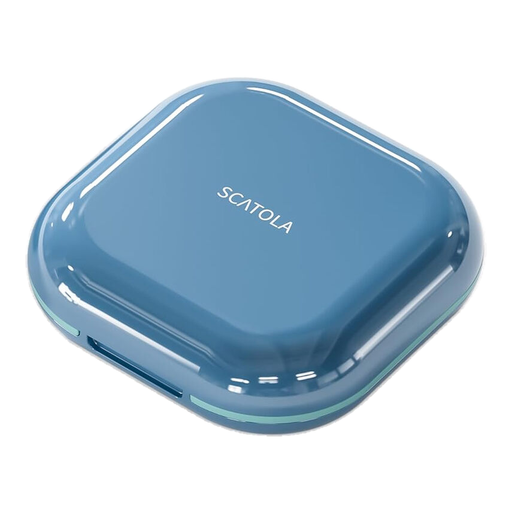
Why it suits this profile: This small model has four compartments and is designed to be carried in a bag or coat pocket every day. It’s a good choice if you’re looking for a straightforward layout.
Its simple layout means you don’t pay for compartments you won’t use. Just check that four compartments are enough for your medication schedule.
Four compartments and a compact design for everyday use, vitamins or a small supply for travelling.
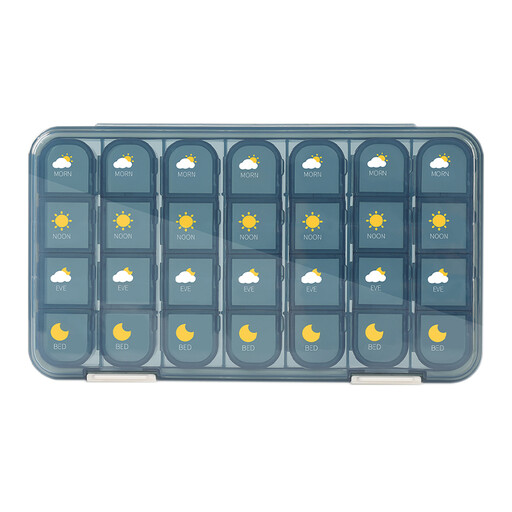
Why it suits this profile: This weekly pill organiser has 28 compartments: four a day for seven days. It’s a good fit for more involved routines with several daily doses.
The compartments are organised by day and time, helping you avoid an overcrowded, confusing layout. The supplier describes it as having a portable sealed design with snap-on lids.
28 compartments, materials listed as ABS, PP and TPE, and dimensions of 9,1 × 5,1 × 1,2 inch.
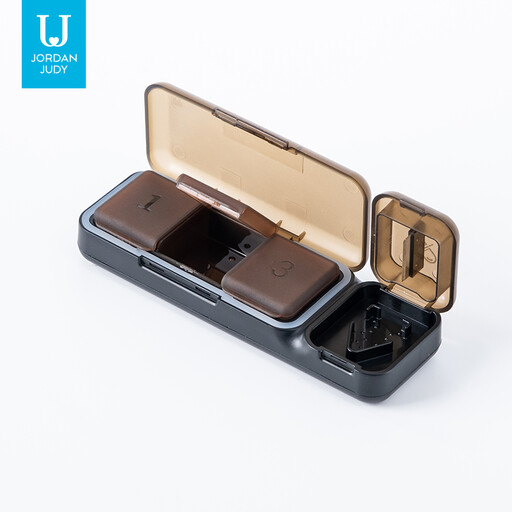
Why it suits this profile: This mini medicine box combines storage with a built-in tablet splitter. It’s designed to be carried every day, taken on trips and used outdoors.
The tablet splitter means you don’t need to carry a separate tool. Only use it if splitting the tablet is permitted by the patient information leaflet or your pharmacy.
Mini size, PP material according to the product information, and a built-in tablet-splitting function.
We’ve put together a complete, up-to-date list of products that meet these strict selection criteria and current European safety regulations.
Always follow the supplier’s instructions. A common method is to wash it by hand with mild soap and warm water, then rinse it thoroughly and leave it to air-dry. If a product isn’t dishwasher-safe, don’t put it in the dishwasher. Don’t refill the box until all the compartments are completely dry.
Its lifespan depends on the material, how often you use the fastenings, and whether the box is dropped or exposed to moisture and heat for long periods. Replace it if a lid no longer closes properly, a compartment is damaged or the labels are no longer readable. For medicines, also check the expiry date on the original packaging regularly.
That depends on the medicine and its storage instructions. Some medicines need to be kept in their original packaging and protected from light or moisture. If you’re unsure, ask your pharmacy for advice. A pill organiser is mainly a way to keep track of your medicines and carry them with you; it doesn’t replace the official packaging or medical advice.
