For recorded piano music, a single Wi-Fi speaker is a practical choice if space is limited or you want to stream with ease. Choose a stereo pair if you can position two speakers around a regular listening spot and want separate left and right playback. Check your music source in advance, along with whether you have room for the speakers and any connecting cables. KEF Netherlands points out that speaker placement in relation to your listening position matters. If you play a digital piano yourself, also check that its output is compatible and that the connection you choose doesn’t introduce distracting latency.
Who is this guide for?
Listener with a regular listening spot
You listen closely to piano recordings and may be able to position speakers to the left and right of your listening spot. Start by considering the setup and stereo imaging, rather than just the stated wattage. KEF Netherlands offers placement advice that takes the position of your listening spot into account.
Resident with shared walls
You want to enjoy listening in an open-plan living space without unnecessarily disturbing your neighbours. Consider speaker placement and a comfortable volume. The Dutch government advises trying to reach an agreement if noise might disturb your neighbours.
Digital piano player
You want to amplify the sound of your own instrument, not just stream recordings. The piano’s output and the speaker’s compatible input determine which connection you need. Yamaha Support recommends checking the connections in your instrument’s manual.
What should you consider when choosing?
| What to consider |
What should you check? |
Who is this important for? |
| Stereo imaging and placement |
Check whether you can position two speakers in suitable places, and whether the pair needs a cable between them. |
If I listen to piano recordings from a regular spot, I want separate left and right playback. Around 31% of consumers prioritise stereo imaging and placement. |
| Tonal balance |
Listen to familiar recordings at your usual volume and assess the balance from your listening spot. |
If I mainly listen closely to piano recordings, I want to assess how the sound comes across in my room. Around 23% of consumers say tonal balance is their main concern. |
| Consideration for neighbours |
Try your intended placement and a comfortable listening volume, and check any agreements that apply to your home if necessary. |
If I listen in a flat, I want to play music without avoidable disturbance to my neighbours. Around 23% of consumers say this is their main consideration when choosing. |
| Music source and controls |
Check that your source works with your preferred Wi-Fi, Bluetooth or wired connection, and whether you need an adapter. |
If I want to keep using my existing music source and controls, I first check the connections and the system they work with. Around 15% of consumers prioritise source compatibility. |
| Live digital piano |
Find out the exact audio output on your instrument and check for a compatible input and any latency. |
If I want to amplify my digital piano live, the connection needs to match my instrument’s output. Around 8% of consumers mainly choose speakers for live piano playing. |
Buying pitfalls
-
‘Wireless stereo pair’ doesn’t always mean there’s no cable between the speakers
The two speakers in the Edifier R1280DB and KEF LSX II LT are connected by a cable. This can affect where you can position them in an open-plan space.
Check how the exact model connects its speakers and plan the cable route before deciding where to put them.
-
A line input doesn’t prove that a speaker is suitable for live piano playing
Sonos says the Era 100 needs a separately available adapter for line input. Sonos also describes latency between a line-in source and playback. The connection on a digital piano varies by instrument.
Check your piano’s output in its manual, find out which adapter or cable you need, and test for latency while playing.
Allow for a separate line-in adapter for the Era 100 if you need this connection; Sonos says it is sold separately.
-
A larger speaker or one with more bass won’t automatically solve a placement problem
Speaker placement and your listening position can affect how the sound comes across. In a flat, it’s also worth considering the potential impact on your neighbours.
First, try your intended placement and a comfortable listening volume. If necessary, agree on suitable times for playing music.
Brands to consider
Sonos
The Era 100 is an option if you want to start with one home speaker and might later add a second compatible unit to use as a stereo pair.
- Sonos lists Wi-Fi, Bluetooth and line input via a separately available adapter.
- If you’re using an external source for live piano playing, consider latency too. Sonos describes latency between the line-in source and playback.
KEF
The LSX II LT is a compact streaming system sold as a pair for a fixed stereo setup.
- KEF lists streaming, USB-C and HDMI ARC as connection options.
- The two speakers are connected by a cable, so check that you can route it neatly in your room.
Edifier
The R1280DB is an active stereo pair with wired inputs. The ES60 is a portable Bluetooth speaker that can be used in stereo with a second unit.
- Edifier lists RCA, optical and coaxial inputs for the R1280DB, as well as a speaker cable between the units. For the ES60, Edifier mentions a battery and the option to pair two units.
- Connections and features vary by model, so check the details of the one you’re considering.
Denon
The Home 150 is a compact HEOS home speaker for anyone who mainly wants to listen over Wi-Fi or Bluetooth and is considering expanding within the same system.
- Denon says the Home 150 is a mono speaker with Wi-Fi, Bluetooth and HEOS.
- Check that the available source connection is compatible with your music source and how you plan to use it.
Joybuy products
This selection includes stereo sets for desks or living spaces, a 5.1ch soundbar system and passive bookshelf speakers. If you choose passive speakers, check that you have a suitable amplifier and that the setup will work in your room.
 No image available
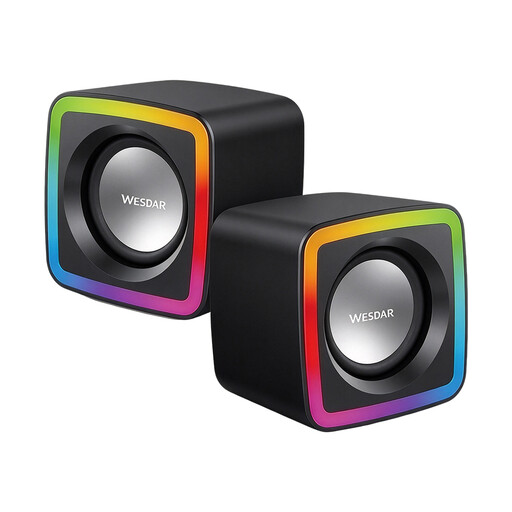
Compact RGB gaming speakers, stereo set for PC and desk
A stereo set to consider if you can position two speakers on a desk or shelf; the product name specifies PC and desk use.
The product name mentions RGB lighting.
View at Joybuy
 No image available
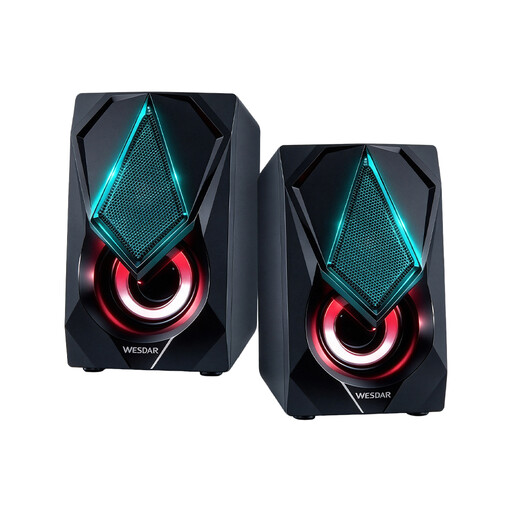
Compact stereo desktop speakers with coloured LED lighting
A compact stereo set to consider if you can position two speakers by your desk or listening spot.
The product name mentions coloured LED lighting.
View at Joybuy
 No image available
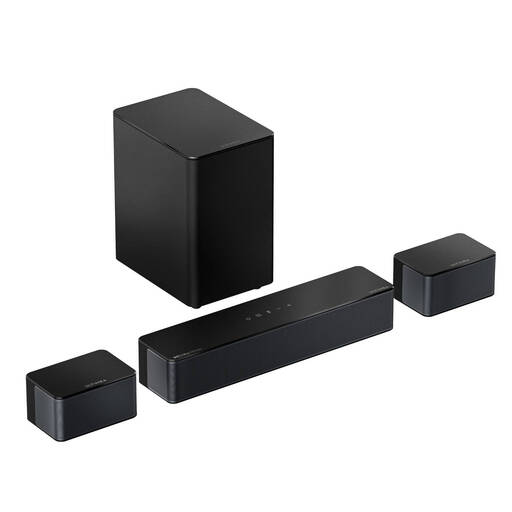
ULTIMEA Poseidon M4T 5.1ch soundbar with wireless subwoofer, 450 W
A soundbar system to consider if you’re looking for a multi-channel setup for music playback.
The product name mentions 5.1ch, Dolby Atmos and a 5.25-inch wireless subwoofer. The surround speakers are wired, so allow for the cable route.
View at Joybuy
 No image available
HiVi-Swans DIY3.1 passive 6.5-inch bookshelf speakers, pair
A passive bookshelf pair for a regular listening spot with room for two speakers.
You’ll need a separate amplifier to use these passive speakers.
View at Joybuy
 No image available
HiVi-Swans D3.1MKII passive 6.5-inch bookshelf speakers, pair
A passive bookshelf pair for stereo playback from a regular listening spot.
You’ll need a separate amplifier; the product information describes these speakers as passive.
View at Joybuy
Frequently asked questions
Is one speaker enough for piano recordings?
It can be, if simplicity or limited space for speaker placement is your priority. If you want separate left and right playback from a regular listening spot, compare stereo pairs and try the setup in your room.
How should I position two speakers in an open-plan living space?
Start by considering two possible positions in relation to your listening spot, and try different distances from the walls. Follow the manual for the exact model when setting up and pairing the speakers; placement advice isn’t a universal installation requirement.
Can I connect my digital piano directly?
Only if your instrument’s output is compatible with the input on the system you choose. Yamaha Support recommends checking the connections in your instrument’s manual. If you’re playing live, also test whether the latency is acceptable.
What extra components should I check for my setup?
Check whether you need a second speaker, connecting cable or adapter. Sonos says the Era 100 line-in adapter is sold separately; the KEF LSX II LT has a cable connecting the speakers.
Is there a set volume or time when you’re allowed to play music in a flat?
Don’t assume there’s one general volume limit or time that applies to every home. The Dutch government advises trying to reach an agreement with your neighbours if noise is an issue. Also check any agreements that apply to your home.


