
Piano listener with a regular listening spot
You want to position two speakers around your listening spot and enjoy piano music there. Teufel recommends using an equilateral triangle as a starting point for positioning.


For recorded piano music listened to from a fixed spot, a pair of speakers you can position around you, with inputs to suit your music source, is a sensible choice. If you want simple wireless listening around the home, a single Wi-Fi speaker may suit you better. If you also want to amplify a digital piano, first check the instrument’s audio output and the speaker’s inputs. Passive models need a suitable amplifier, and some monitors are sold individually.
You want to position two speakers around your listening spot and enjoy piano music there. Teufel recommends using an equilateral triangle as a starting point for positioning.
You may also want to amplify your own instrument. Yamaha recommends connecting the instrument’s audio output to a suitable active speaker with a cable.
You mainly play music from a phone or music service and want to know whether one speaker will suit you. The Consumers’ Association lists Wi-Fi as an option for listening at home; Sonos says you can pair two Era 100 speakers.
Start with your listening spot and the output from your music source. Then check how many speakers and any additional equipment you’ll need.
| What to consider | What should you check? | Who is this important for? |
|---|---|---|
| Stereo and listening spot | Check that the set includes two speakers and that you can position them around your listening spot. | If I mainly listen from one regular spot, I want to be able to position two speakers and adjust their placement for that spot. An estimated 36% of consumers give stereo playback and listening position top priority. |
| Connecting to your source | Compare the audio output from your source with the inputs on the exact model; a MIDI connection is not an audio output. | If I also want to connect my digital piano, I first check that its audio output is compatible with the speaker. Around 29% of consumers prioritise source compatibility. |
| Space and controls | Measure the space available for one or two speakers and decide whether you want to control them via an app, Bluetooth or directly. | If I have limited space or mainly want to play music easily from my phone, the layout and controls are important. An estimated 21% of consumers place the greatest emphasis on these factors. |
| Complete set-up | Check how many speakers you need, and whether you’ll also need an amplifier, adapters or suitable cables. | I want to know what I’ll need to use my chosen set-up, not just what’s mentioned in the product name. Around 14% of consumers focus mainly on having a complete system. |
Yamaha states that the HS5 is sold individually, while PreSonus offers the Eris 3.5 2nd Gen as a pair. You’ll need two separately sold monitors for a stereo pair.
Before you buy, check how many speakers are included and whether that’s enough for your intended set-up.
Allow for a second monitor and suitable cables if you need them for your set-up.
The KEF Q1 Meta is passive and needs a suitable amplifier; without one, the pair won’t work as a complete playback system.
Check whether your existing amplifier is suitable, or factor one into your choice of complete set-up.
If you don’t already have a suitable amplifier, you’ll need to include one in your set-up.
Sonos says that a separate Line-In Adapter is needed to use the analogue line-in on the Sonos Era 100. The piano’s output must also be compatible with the chosen connection.
Compare the piano’s and speaker’s connections, and check which adapter and cables you’ll need.
You may need an adapter and an audio cable for this connection.
Yamaha gives frequency ranges for the HS5 at different levels, including −10 dB and −3 dB. These figures aren’t directly comparable unless they use the same measurement basis.
Only compare range figures when the measurement conditions match. Where possible, listen using a set-up that suits your room.
The active R1700BTs is worth considering for a permanent stereo pair with Bluetooth or a compatible analogue source.
The Eris 3.5 2nd Gen is a compact active pair for listening at a desk; the separate 3.5BT version adds Bluetooth.
The active HS5 is a wired nearfield option for a workspace or a suitably connected digital piano.
The Q1 Meta is a passive bookshelf pair for anyone who already has a suitable amplifier or wants to choose an amplifier and speakers separately.
The Era 100 is an option if app control and wireless playback at home are your priorities.
This selection includes compact desktop stereo speakers, active speakers, passive bookshelf pairs and a soundbar for playing music. When choosing, check that the number of speakers, connections and any amplifier or adapter suit your source and listening spot.
 No image available
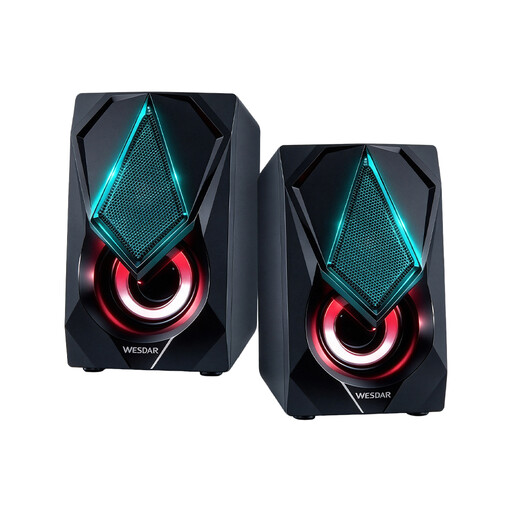
The product title describes a compact set of desktop speakers, suitable for a regular listening spot.
The title mentions coloured LED lighting.
 No image available
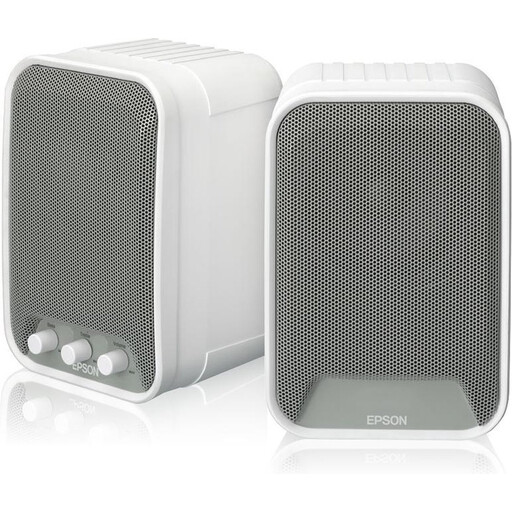
This active pair may suit you if you’re looking for stereo playback; check that the connection is compatible with your source.
The product information recommends connecting to the ELPCB01 for optimum performance; check whether this suits your set-up.
 No image available
This passive bookshelf pair may suit you if you have a suitable amplifier or want to choose one separately.
A suitable separate amplifier is required for use.
 No image available
This passive pair is designed for stereo music at home; check whether you have a suitable amplifier.
To use the pair, you’ll need to connect it to a separate amplifier.
 No image available
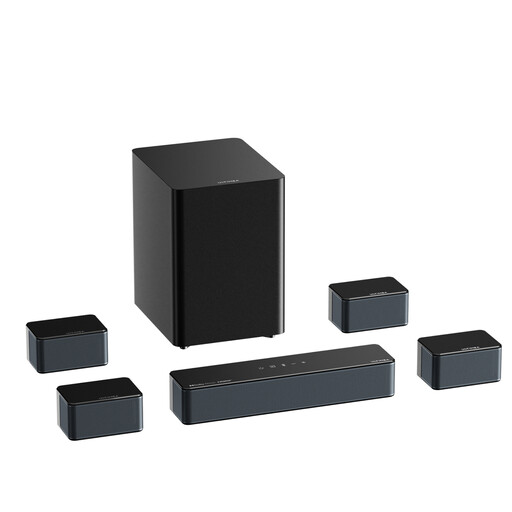
The product information mentions music playback; check whether a soundbar suits the set-up you’re looking for to enjoy piano music.
The described 7.1 set-up isn’t a conventional stereo pair. The title lists Bluetooth 5.3 and 500 W.
Don’t assume you can: check whether your piano has a suitable audio output and whether the speaker can receive that source. Yamaha describes connecting an instrument’s output to an active speaker with an audio cable; Bluetooth on the speaker alone doesn’t confirm that it will work with your instrument.
Use an equilateral triangle as a starting point, then adjust the placement after listening in your own room. This is positioning advice from speaker manufacturer Teufel, not a guarantee of how a specific model will sound.
It depends on your chosen set-up: check which audio cables you need for your source, whether passive speakers need a suitable amplifier and whether you’ll need a second monitor if they’re sold individually. Sonos says you’ll need to buy a separate adapter to use the analogue line-in on a Sonos Era 100.
According to the Dutch government, you’re entitled to a product that works properly, and there is no fixed statutory warranty period in the Netherlands. If a product is faulty, contact the seller; a manufacturer’s warranty is in addition to your statutory rights.
According to the Dutch government, purchases made remotely from a business usually come with a 14-day cooling-off period. Before ordering, check the seller’s information and the applicable terms; buying from a private seller is different.