For photographing old keys under artificial light, a compact camera with suitable close-up capabilities may be enough if you want to capture both an overall view and details without changing lenses. For small inscriptions, a mirrorless camera with a suitable macro lens gives you more choice of magnification. If your current camera already captures the framing you want, first try stabilising it and adjusting the lamp, key and white balance. In all cases, check that there’s room for the lighting at your chosen working distance. Focus stacking can help if the whole key isn’t sharp in a single shot.
Who is this choice relevant to?
Collector focusing on key details
If you want to capture stamps, inscriptions or wear, pay close attention to the magnification of the specific lens rather than just the megapixel count. Canon Netherlands and Nikon Netherlands highlight focusing and magnification as important considerations for close-ups.
Photographer creating a consistent catalogue
If you’re photographing several keys in one place, repeatable framing, manageable reflections and consistent colours under artificial light are important. Canon Netherlands explains the benefits of a stable product setup and suitable white balance.
Photographer who doesn’t want to change lenses
If you want to switch quickly between a full view of a key and a close-up, check whether a fixed-lens camera can capture the framing you want with your own lighting. The Consumers’ Association describes compact cameras as cameras with a fixed lens; OM Digital Solutions describes close-up photography with the Tough TG-7.
What should you look for when choosing?
Compact camera with a fixed lens
Choose this if: you want to take both an overall shot and a close-up without changing lenses, and your lighting suits the shooting setup.
Trade-off: a fixed lens gives you less choice of magnification and working distance. OM Digital Solutions says the Tough TG-7 can focus as close as 1 cm, but that doesn’t guarantee every inscription will be framed clearly.
Mirrorless camera with a macro lens
Choose this if: a small inscription or worn area needs to fill a large part of the frame, or you want to match the lens to your preferred shooting distance.
Trade-off: the camera body and macro lens are separate components unless the exact set specifies otherwise. The 1:1 magnification quoted by Nikon applies to the NIKKOR Z MC 50mm f/2.8, not automatically to every Nikon set.
Keep your existing camera
Choose this if: your current camera already shows the smallest detail you want at a suitable size, but colour casts, reflections or movement are affecting the result.
Trade-off: a different lighting setup won’t increase the maximum magnification of your current lens, so check the framing of the smallest detail first.
| Consideration |
What to look for |
Who is this important for? |
| Small markings |
Compare the maximum magnification of the specific lens and check the framing of the smallest inscription. |
If you want to inspect small stamps or signs of wear clearly, the detail needs to appear large enough in the frame. That’s why around 25% of consumers prioritise magnification and framing. |
| Colour and reflections |
Check the white balance under your artificial light and see whether reflections obscure important markings. |
If you want to assess colour and how the metal looks carefully, try repositioning the lamp and key. Around 25% of consumers give this control over light and colour top priority. |
| Depth of field |
See whether a single shot is enough and check whether the specific model offers focus bracketing or stacking. |
If you want to capture a raised key in sharp focus from front to back, depth of field is crucial. Around 20% of consumers focus on this first. |
| Ease of shooting |
Try to capture both an overall view and the close-up you want with one camera and the lighting available. |
If you want to move from a shot of the whole key to a detail without changing lenses, ease of use matters. Around 15% of consumers prioritise this. |
| Complete setup |
Check the exact contents of the set, the lens mount and whether the lens you need is included. |
If you don’t want to buy components you don’t need, see whether your current camera and lens can already capture the framing you want. Around 15% of consumers make avoiding unnecessary purchases their top priority. |
Pitfalls when choosing a camera
-
Confusing a standard kit with a macro lens kit
The maximum magnification of a kit zoom can differ from that of a separate macro lens. Canon specifies a maximum of 0.16× at 45 mm for the RF-S 18-45mm with autofocus, or 0.26× with manual focus; for the RF 85mm F2 Macro IS STM, Canon quotes 0.5×.
Before choosing a camera body, check the exact lens included in the set and whether its magnification suits the smallest detail you want to photograph.
Depending on the set, a suitable macro lens may be a separate component.
-
Comparing megapixels alone
A high resolution doesn’t determine how much space a small inscription takes up in the shot. The lens magnification and working distance matter too. A short focusing distance can also leave less room for the lamp.
Take a test shot of the smallest marking and check at the same time whether you can position the lamp somewhere useful.
-
Buying another camera to solve reflection problems
With shiny metal, the position of the camera, key and lamp affects which reflections are visible. A different camera body won’t automatically fix poor lighting.
First change the angle of the key or lamp, and keep the camera steady so you can compare the framing.
A new camera body may be unnecessary if an adjusted lighting setup works with your current camera.
Camera brands and macro options
These examples show different camera and lens options. A camera body and lens mentioned together don’t automatically come as a kit, so check the exact combination and what’s included.
OM SYSTEM
The Tough TG-7 is a fixed-lens option for anyone who wants to take close-ups without using a separate macro lens.
- OM Digital Solutions says the TG-7 can focus as close as 1 cm and describes focus stacking as a way to combine shots taken at different focus distances.
- At such a short shooting distance, check that there’s still room to position the lamp and frame the detail you want clearly.
Nikon
A Z camera with the separate NIKKOR Z MC 50mm f/2.8 is an interchangeable-lens option for anyone who wants to match the magnification to small details.
- Nikon Netherlands quotes 1:1 magnification for this lens and says it can be used with FX and DX cameras.
- Nikon quotes a distance of around 5 cm between the front of the lens and the subject at the closest focusing distance. Check that there’s room for the lighting; the lens isn’t automatically included with every camera body set.
Canon
The EOS R50 is an RF system camera body for which Canon lists, among other options, a separate close-up or macro lens.
- Canon says the RF 85mm F2 Macro IS STM is compatible with the EOS R50 and specifies 0.5× magnification for this lens.
- According to Canon, the RF-S 18-45mm kit zoom offers a maximum of 0.16× at 45 mm with autofocus, or 0.26× with manual focus. This isn’t the same specification as that of the separate RF 85mm.
Sony
The α6700 is an APS-C camera with an E-mount that can be paired with a separate macro lens.
- Sony Netherlands specifies 1.0× magnification for the separate FE 90 mm F2.8 Macro G OSS.
- The magnification applies to the lens mentioned, not automatically to a camera body set. Check that the specific lens and camera make the combination you want.
Joybuy products
This Joybuy selection focuses on a portable camera setup with additional lighting. Before relying on the extra lamp, check that the camera can capture the framing you want for small inscriptions.
 No image available
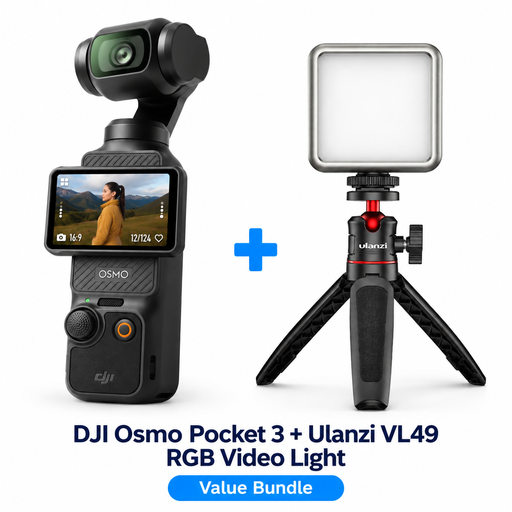
DJI Osmo Pocket 3 + Ulanzi VL49 RGB LED Video Light bundle
This bundle could be a good fit if you want extra lighting in a portable setup for product photography.
The product name lists a DJI Osmo Pocket 3 with a Ulanzi VL49 RGB LED Video Light. Before buying, check that the camera can capture the close-up you want of your smallest inscription; the extra lamp doesn’t determine magnification.
Joybuy
Frequently asked questions
Do I definitely need a new camera body for a small inscription?
Not necessarily. First check whether your current lens can capture the framing you want. Canon Netherlands and Nikon Netherlands describe magnification as a lens feature, so check the mount and exact lens combination too.
How should I get started photographing under an artificial light?
Set the camera up securely, take a test shot and move the lamp or key if a reflection obscures a marking. Set the white balance to suit the artificial light; Canon Netherlands explains how artificial light can cause a colour cast.
How can I get a raised key sharp from front to back?
First check whether a single shot gives you enough depth of field. If different areas need to be in focus, a focus stack may help; OM Digital Solutions describes combining shots taken at different focus distances with the TG-7.
What are my rights in the Netherlands when I buy a camera online?
According to ACM ConsuWijzer, online product purchases generally come with a statutory cooling-off period that ends 14 days after delivery. Check which exceptions apply to your purchase. The statutory guarantee is separate from any manufacturer’s warranty: if a product doesn’t meet the applicable requirements, the seller is responsible for providing a solution, according to ACM ConsuWijzer.


