Start with the camera you already have, a consistent set-up and controlled white balance. You don’t automatically need a new camera for overview shots. If you want to capture small imperfections without changing lenses, look for a compact camera with a suitable close-up mode. For more control and the option to change lenses, a mirrorless camera could be a good fit. With every kit, check which lens is actually included.
Who is this relevant for?
Sellers who want to show colours faithfully
If you photograph glazes and decorations in changing window light, you’ll want to minimise colour differences between listing photos. Canon Netherlands emphasises that natural light depends on the conditions.
Sellers of ceramics with small signs of wear
If you want to show a chip or crazing as well as an overview shot, check the close-up capabilities of the specific camera-and-lens combination. OM SYSTEM and Canon Netherlands describe different options for specific modes and lenses.
People who regularly photograph a range of pieces
If you photograph objects of different sizes, consider whether you can create a repeatable set-up and expand your complete kit. Canon Netherlands and Nikon Netherlands describe standard zoom kits for different compositions.
What should you look for when choosing?
Start by asking whether your current camera, with a consistent set-up, already takes the overview shots you need. Window light can change; Canon Netherlands describes white balance as a setting that helps you account for this.
| What to consider | What should you check? | Who is this for? |
|---|
| Colour in changing window light |
Check that you can adjust the white balance and, if you edit your photos, that the exact camera supports RAW. |
If I want glazes and colours to remain recognisable as the window light changes, I prioritise colour reproduction. Around 33% of consumers put colour accuracy at the top of their list when buying. |
| Small imperfections |
Check the close-up mode or the minimum focusing distance and magnification of the included lens. |
If I want to show a small chip clearly alongside an overview shot, I first check the close-up capabilities of my camera and lens. Around 25% of consumers prioritise capturing small details. |
| Consistent overview shots |
Check whether you can position the camera steadily and frame the whole object from where you work. |
If I want to photograph several pieces in a similar way, I look for a consistent set-up and an easy way to frame different sizes. Around 25% of consumers prioritise a repeatable workflow. |
| Complete kit |
Compare the camera body, the exact kit lens and any extras, such as a tripod or macro lens. |
If I don’t want to buy more than I need for a usable set-up, I look at the complete kit and what I already own. Around 17% of consumers prioritise the total cost of a usable kit. |
Common buying mistakes
-
Comparing camera bodies only
A body without a suitable lens doesn’t make a complete set-up for overview and detail shots. Close-up capabilities vary from lens to lens.
Check everything included in the kit, the lens mount and the close-up specifications before comparing kits.
A lens or tripod may be an additional purchase. Check what you already own and what your intended set-up requires.
-
Assuming the shortest focusing distance guarantees a useful detail shot
A quoted distance applies to a specific lens or shooting mode. Composition, lighting and how visible the imperfection is also determine whether the photo is useful.
Take separate test shots of the whole piece and a small imperfection using the exact camera-and-lens combination.
-
Using a fixed colour setting while the window light changes
The colour of natural light can change with the conditions. As a result, the same setting may not give you the same result in every photography session.
Check the white balance for each session and see whether RAW shooting suits your editing workflow. Canon Netherlands describes white balance as a setting for dealing with changing light.
Correcting colour or taking the photos again may take extra time.
Camera brands to consider
Canon
The EOS R50 is a mirrorless camera available with a standard zoom kit; an RF 35mm macro lens is a separate upgrade option.
- Canon Netherlands specifies 24.2 effective megapixels and compatibility with RF and RF-S lenses for the EOS R50.
- Magnification of up to 1:2 applies to the separate RF 35mm F1.8 MACRO IS STM, not automatically to a standard zoom kit.
Nikon
The Z50II with NIKKOR Z DX 16–50mm VR is a standard zoom kit to consider for different compositions.
- Nikon lists a minimum focusing distance of 0.2 m for the 16–50mm lens.
- The kit lens isn’t automatically a dedicated macro lens. Check whether its close-up capabilities suit the details you want to show.
OM SYSTEM
The Tough TG-7 is a compact camera with a built-in microscope mode, for anyone who’d rather not change lenses to take a close-up.
- According to the OM SYSTEM manual, the microscope mode can take photos from a distance of 1 cm; OM SYSTEM lists 12 megapixels.
- These specifications don’t prove that the camera is a better choice in every window-light set-up than a mirrorless camera or a device you already own.
Sony
The ILCE-6400 is an APS-C mirrorless camera for anyone looking for RAW shooting and an interchangeable E-mount lens.
- Sony specifies approximately 24.2 effective megapixels and RAW shooting.
- These specifications refer to the camera body; the ability to capture small ceramic details also depends on the lens you choose.
Cameras at Joybuy
The cameras below are related to this topic. For each model, check that its controls, lens and close-up capabilities suit your ceramic photography.
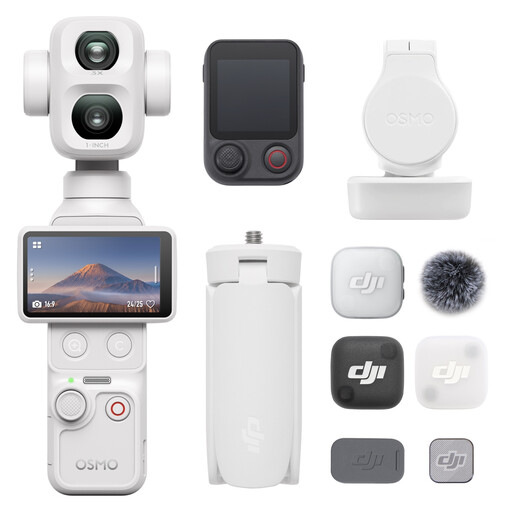 No image available
DJI Osmo Pocket 4P Vlog Combo (White)
The product name describes a vlogging camera. Check whether its close-up capabilities and controls suit photographing ceramics.
Joybuy
 No image available
Komery W6, 12× optical zoom
The product name mentions optical zoom. Check whether you can frame the whole ceramic piece from where you work and whether the close-up capabilities are sufficient.
The product name lists 12× optical zoom, 64 MP, 4K and Wi-Fi.
Joybuy
 No image available
DJI Osmo Pocket 3 Creator Combo
The product name describes a vlogging camera. Assess its close-up capabilities separately before choosing this model for ceramic photography.
The product name lists a 1-inch CMOS sensor, 4K/120fps video, 3-axis stabilisation and a microphone.
Joybuy
 No image available
DJI Osmo Pocket 3
The product name describes a compact camera for photography and video. Check that its lens and close-up capabilities suit the details you want to capture.
The product name lists a 1-inch CMOS sensor, 4K/120fps video and a rotating touchscreen.
Joybuy
 No image available
Sony ZV-E10 + 16–50mm Zoom Black
According to the product information, the kit includes a zoom lens. Check whether its close-up capabilities suit your detail shots.
The product information lists a 24.2 MP APS-C sensor and an E PZ 16–50mm lens. An SD card and adapter/charger are not included, according to the product information.
Joybuy
Frequently asked questions
Does a tripod help when photographing by a window?
Yes, a tripod can help you keep your composition steady and reduce camera shake. Canon Netherlands describes a tripod as a useful aid for consistent product photos, although it isn’t necessary for every shot.
Do I need to buy a macro lens straight away to photograph a small chip?
No, try the close-up capabilities of your current camera first. The OM SYSTEM TG-7 has a dedicated microscope mode; with a mirrorless camera, check what the lens you’re actually using can do.
How can I make sure white ceramics look true to colour in window light?
Check the white balance when the colour of the light changes and compare the photo with the object. RAW can give you room to adjust the white balance afterwards, but it’s no substitute for taking care when you shoot.
What are my rights when buying a second-hand camera online?
If you’re buying remotely as a consumer from a business, you’ll generally have a 14-day cooling-off period, including for second-hand products. The Dutch government distinguishes between buying from a business and buying online from a private seller; the latter isn’t covered by the distance-selling rules. When you buy from a business, the seller is responsible for the statutory guarantee. What you can expect from a second-hand product also depends on its condition and the terms agreed.


