
Creator of wide stationery flat lays
You want to arrange several products from one set and photograph them from above, so you need room in the frame and the freedom to position the light.


For small stationery sets that fit within your desired frame, a photo box with built-in lighting is a compact option. For a wide flat lay, a separate softbox with a suitable lamp gives you more freedom to position the light. Adobe describes flat-lay photography as shooting from above, so measure the entire composition, including the margin around the background, before choosing a box. To keep paper colours looking true to life, make your lighting as consistent as possible and set the white balance to match the light actually falling on the set, as Canon Europe advises.
You want to arrange several products from one set and photograph them from above, so you need room in the frame and the freedom to position the light.
You might photograph cards or notebooks, for example, where the colours need to look true to life. Consistent lighting and a suitable white balance are important to you.
You photograph a compact composition and want to set up and put away your equipment quickly. First, though, check that the entire set will fit in the photo box.
Choose this when: you photograph small sets that fit in the box with your desired framing, and want a compact set-up with a background.
The trade-off: the box limits the available space and composition, so measure the entire set beforehand.
Choose this when: you create a larger flat lay, want to position the light source freely or already have a compatible studio light.
The trade-off: a softbox isn’t automatically a complete lighting kit. Check the mount and which components are included.
| What to consider | What to check before buying | Who is this most important for? |
|---|---|---|
| Colour reproduction | Check whether a lamp is included and whether its lighting settings suit your set-up. Set the white balance to match the light you’re using. | When I photograph cards or notebooks, I want the paper colours to look true to life and be able to adjust the lighting. Around 31% of consumers prioritise colour control. |
| Space and framing | Measure the set with a margin around the background and compare it with the usable space in the box. Also check that you can position the camera directly above the composition. | For a flat lay shot from above, I want to keep every item in the set in frame without changing the arrangement I want. Around 31% of consumers prioritise fitting the whole composition in the frame. |
| Shadows and reflections | Check which diffusers or grid are included and whether you can reposition the light source. | If shiny packaging or accessories are in the frame, I want to be able to move the light and subject around to assess shadows and reflections. Around 23% of consumers prioritise control over how the light falls. |
| Complete set-up | Check the contents list, power supply and mounting; find out whether a lamp and stand are supplied with your chosen softbox. | For small sets at a desk, I want to be able to set up and pack away quickly, as long as the whole composition fits. Around 15% of consumers prioritise a compact, complete set-up. |
NEEWER states that the SB-BW6090 does not include a lamp or stand. Without a suitable light source and support, you can’t use the softbox as a complete set-up.
Read the contents list for the exact model and check that the mount is compatible with your lamp.
A compact box can limit the space and framing you need. PULUZ lists the PU5041B as a 40 cm box.
Arrange your stationery set as you want to photograph it, then check that everything fits with enough margin around the background.
Godox gives the light output for the SL60IIBi as measured with a standard reflector at 1 metre. This is a different set-up from a lamp with a softbox above a stationery set.
Only compare light output figures when the light modifier, distance and settings are the same.
According to PULUZ, the PU5041B is a 40 cm photo box with built-in adjustable LED lighting and an opening at the top, designed for small set-ups that fit inside.
Godox lists rectangular Bowens softboxes, including the SB-FW6090, and separate continuous lights such as the SL60IIBi.
According to NEEWER, the SB-BW6090 is a 60 × 90 cm rectangular softbox with a Bowens mount.
According to SmallRig, the RA-R6090 is a 60 × 90 cm rectangular Bowens softbox with a quick-release mechanism.
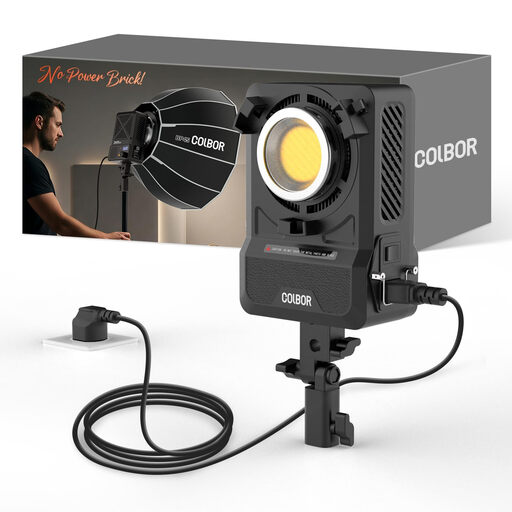
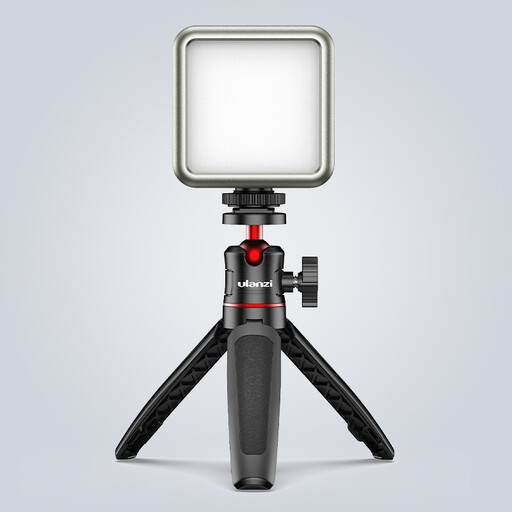
These product choices are adjustable lamps for continuous lighting. The COLBOR lamp lists a Bowens Mount; the compact ULANZI VL49 is described as a camera light for uses including macro shots and product photography. For a softbox set-up, check the mount, power supply and support you’ll need.
 No image available
An option if you want to adjust the colour temperature and use a Bowens softbox.
200 W; colour temperature 2700K–7000K; built-in design with power adapter; Bowens Mount.
 No image available
A compact light for small product shots, including macro photography; the product title also describes it as a camera light.
Dimmable; colour temperature 2500K–9500K; 2000 mAh battery; magnet on the back.
First, arrange the full composition on your chosen background and check that you can position the camera directly above it. Adobe describes flat-lay photography as shooting from above, so before buying, measure to check whether the composition will fit in a photo box, if you’re considering one.
The white balance needs to match the light falling on the set. Canon Europe warns that light sources with different colour temperatures make it harder to set the white balance. Keep the lighting as consistent as possible and adjust the white balance for that set-up.
That depends on the model and the equipment you already have. NEEWER lists diffusers for the SB-BW6090, but no lamp or stand; also check that the mount is compatible with your light source.
In addition to any manufacturer’s warranty, consumer purchases are covered by the statutory guarantee: the product must do what you could reasonably expect it to do under normal use. ACM ConsuWijzer states that the seller must resolve problems with a faulty product through repair, replacement or, where appropriate, a refund. There is no general fixed two-year guarantee period in the Netherlands.
According to the Dutch Ondernemersplein, businesses selling electrical or electronic equipment in the Netherlands must ensure it meets the applicable European rules. Where the requirements apply, the information also covers CE marking and an EU declaration of conformity. Check the information for the specific lamp and power supply; general rules do not prove that every individual item is compliant.