
Vandaag of morgen in huis

Kwaliteit gegarandeerd

Welkomstaanbiedingen ontgrendelen: GRATIS bezorging | Tot 80% korting | Gratis 30 dagen JoyPlus-proefperiode
Download de app
An outdoor light needs to do more than look attractive in a product photo. On a Dutch house wall, balcony or driveway, lighting has to cope with rain, wind, damp and limited sunlight in winter. If you focus only on design or lumens, you could end up buying a light that isn’t right for the location or how you plan to use it.
Watch out for these three common pitfalls:
Philips outdoor lighting is available as outdoor wall lights, solar outdoor lights, ground spotlights and freestanding garden lights. The right choice depends on what you need it for:
If you live in a rented home, consider how the light will be installed. A fixed Philips outdoor light running on 230 volts may require wiring and your landlord’s permission. A solar outdoor light is generally easier to install, as long as the panel gets enough sunlight.
The IP code shows how well a light fitting is protected against ingress. For IP44 outdoor lighting, the first 4 indicates protection against solid particles, while the second 4 indicates protection against splashing water from different directions.
This makes IP44 suitable for many sheltered locations, such as a house wall, balcony or covered area. It doesn’t mean the light is waterproof if submerged. So don’t install a water-resistant outdoor light in a low-lying spot where rainwater collects. For an exposed spot in the garden, it may be worth considering a higher IP rating.
2700K is generally considered warm white light. It’s well suited to a patio, balcony or house wall where ambience matters. According to the product specifications, the Philips Fyns has a colour temperature of 3000K and an output of 1000 lumens, making this version more suited to practical lighting for a driveway or access path.
Don’t look at wattage alone. Lumens tell you how much light a lamp produces, while wattage tells you how much power it uses. A lamp with 800 lumens and 4,3 watts has different characteristics from a solar lamp with 400 lumens. Always compare these figures for the same type of use.
Fixed LED outdoor lighting running on 230 volts must be connected safely. For models such as the Philips Capricorn without solar power, the product information states that professional installation by a qualified electrician is required.
Solar lighting works without a connection to the mains. However, check:
An E27 outdoor wall light, such as the Philips Nayl, gives you more flexibility because you can choose a light source that fits the socket. Always check that the bulb you use is suitable for the fitting and for outdoor use.
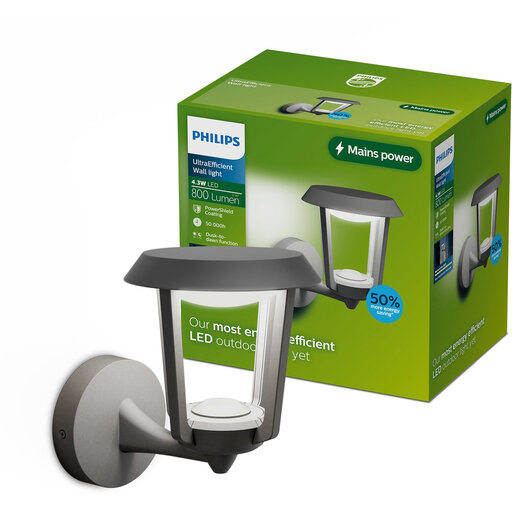
Why it suits this type of user: This fixed outdoor wall light combines an integrated LED, 2700K warm white light, and motion and dusk sensors in one fitting. It’s a practical choice for an entrance or balcony where you don’t want to combine a separate light and sensor.
The IP44 rating makes it clear that the light is splash-resistant, but not suitable for submersion. Make sure you plan for the fixed installation in advance.
800 lumens, 4,3 watts, 2700K and an aluminium housing with PowerShield coating, according to the product information.
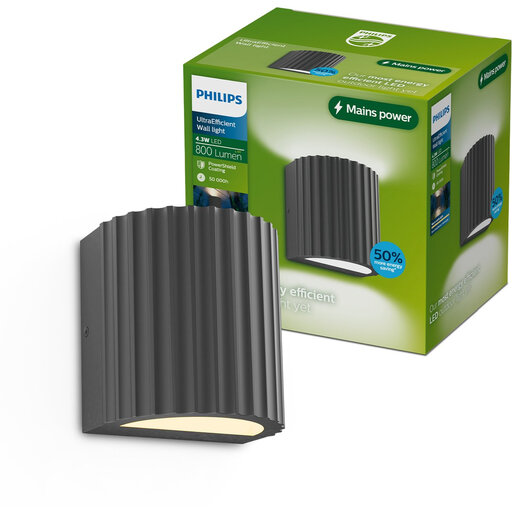
Why it suits this type of user: The light shines in two directions, making it a good choice for a modern house exterior where you want both ambience and a clear lighting effect.
You can see upfront that this is fixed 230V lighting with an IP44 rating. So don’t choose this light for a location where you need a wireless installation.
800 lumens, 2700K warm white light and an integrated LED; the product information lists aluminium, plastic and a PowerShield coating.

Why it suits this type of user: This solar outdoor light is designed for a spot without a fixed power connection, such as a shed, driveway or back path where practical lighting is needed.
According to the product specifications, the light has a motion sensor, dusk function and two light modes. Make sure you install the panel somewhere that gets enough direct sunlight.
1000 lumens, 3000K, IP44 and integrated solar power, with no fixed power cable needed.
We’ve put together a complete, up-to-date list of products that meet these strict selection criteria and the applicable European safety regulations.
IP44 is suitable for many sheltered outdoor locations, such as a house wall, balcony or covered area. This rating protects against splashing water, but not submersion or powerful jets of water. So check where you plan to install the light and make sure rainwater won’t sit on it for long periods.
No. A solar outdoor light charges its internal battery via the solar panel and doesn’t need a fixed connection to the mains. However, how long it stays lit depends on the amount of sunlight, the battery charge and the selected light mode.
The stated lifespan varies by model. The product information for some Philips outdoor lights gives a lifespan of 25.000 or 50.000 hours. This is a product specification, not a guarantee of an exact number of years in use. Switch off the power before cleaning a fixed light, and keep the panel free of dirt on solar models.
