
Vandaag of morgen in huis

Kwaliteit gegarandeerd

Welkomstaanbiedingen ontgrendelen: GRATIS bezorging | Tot 80% korting | Gratis 30 dagen JoyPlus-proefperiode
Download de app
Good outdoor lighting should suit the location, the available power point and the amount of light you need. With Philips outdoor lighting, there are big differences between a fixed wall light, solar light, ground spotlight and a sensor light. Focusing only on the look or the lumen count can therefore lead to the wrong purchase.
An IP44 outdoor light is protected against solid objects larger than 1 millimetre and splashing water from various directions. That makes IP44 suitable for many sheltered facades, balconies, terraces and garden paths. It does not mean the light may be submerged or can withstand powerful jets of water.
So don’t mount a Philips outdoor wall light where rainwater collects or where a garden hose is aimed directly at the housing. For a very exposed facade or a spot that gets a lot of driving rain, a higher IP rating can be more practical.
Some fittings have an E27 or GU10 fitting, but are supplied without a bulb. That’s fine if you want to choose the colour temperature and brightness yourself, but you do need to add a suitable LED bulb to your basket.
The Philips Juli, for example, has an E27 fitting and, according to the product information, is supplied without an LED bulb. The Philips Fylx uses GU10 and also lets you choose your own light source. Always check the maximum wattage, the fitting and the bulb dimensions.
A solar outdoor light works without a connection to the mains, but the solar panel does need enough direct daylight. Under a solid canopy, next to a tall fence or in a shady corner, the battery may charge less. As a result, the run time can vary.
A solar-powered outdoor light is especially handy where there’s no cable in place. For an entrance that needs to be lit constantly all evening, a fixed connection is often more predictable.
Integrated LED lighting is compact and usually doesn’t require a separate bulb. However, in many cases you’ll need to replace the entire fitting when it reaches end of life. A replaceable E27 or GU10 light source gives you more flexibility.
Also look at the colour temperature:
An outdoor light with a motion sensor can switch on when someone walks by. Check whether the product also has a dusk sensor, automatic mode or permanent on mode. These features determine how the light can be used day to day.
For solar lighting, two modes are practical: an automatic mode for daily use and an on mode for moments when you want to switch the light on yourself. Bear in mind that a motion sensor is not the same as constant lighting.
Aluminium fittings, such as various anthracite Philips models, suit a modern facade and are relatively compact. A black outdoor light with a classic design may better complement a country or traditional home.
Measure before you buy:
For fixed 230V connections, switch off the power before you start. If you’re unsure about the wiring, have a qualified electrician do the connection. A plug-in ground spotlight requires a suitable outdoor socket.
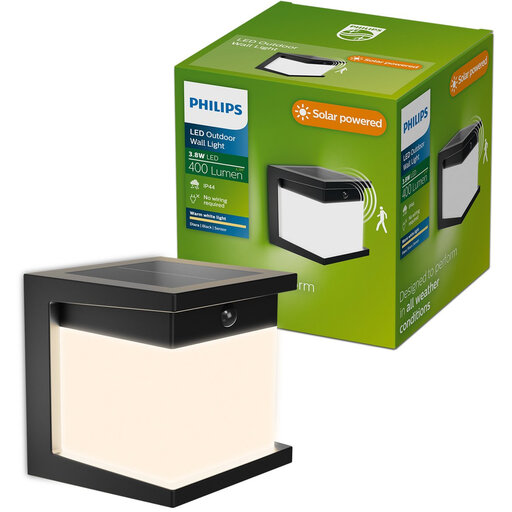
Why this suits the profile: This solar wall light doesn’t need a fixed power connection, making it ideal for a balcony, shed or garden wall where there’s no cabling.
The integrated LED and simple installation save you from having to pick a separate fitting or bulb. Do place the solar panel in a sunny spot.
According to the product data: 400 lumen, 2700 K, two lighting modes, motion sensor and IP44.
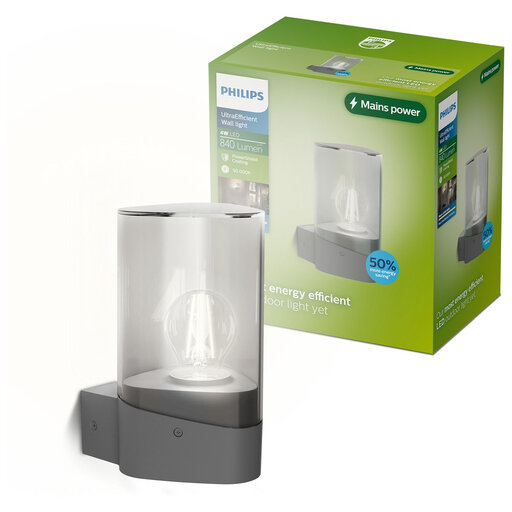
Why this suits the profile: The anthracite aluminium wall light combines a fixed connection with warm light for an entrance, patio or facade.
The E27 fitting allows a replaceable light source. Do check whether the included E27 LED bulb and your preferred brightness suit your set-up.
As per the product information: 840 lumen, 2700 K, E27 fitting, aluminium housing and IP44.

Why this suits the profile: For driveways, back gardens and larger facades where high light output and automatic switching are desired.
The stated IP65 rating offers higher protection than IP44. Even so, direct submersion is unsuitable and the panel must be kept free of dirt.
According to the product data: 4000 lumen, 3000 K, solar powered, dusk sensor, motion sensor and a stated detection distance of 8 meter on direct approach.
We’ve put together a complete, up-to-date list of products that fully meet these strict selection criteria and current European safety regulations.
A fixed Philips outdoor wall light is usually connected to a power point. Check in advance whether the wall suits the supplied or required plugs. With a ground spotlight such as the Philips Cylr, the ground spike must be firmly in the soil and the cable must not present a trip hazard.
For lasting performance:
A long quoted lifespan is a product specification, not a guarantee of identical performance in every environment. Weather, installation, hours of use and maintenance all play a role.
IP44 is usable for many sheltered outdoor locations, such as a facade under an overhang, a balcony or a terrace. The classification protects against splashing water, but not against submersion or powerful water jets. Choose the mounting position carefully.
A solar outdoor light does not use power from the mains during normal operation. The battery is charged during the day via the solar panel. The actual run time depends on sunlight, season, temperature, charge state and the selected lighting mode.
The quoted lifespan differs per model. The product information for some integrated LED models mentions up to 50,000 hours, while other light sources have a lower value. Always check the specifications of the exact fitting. A replaceable E27 or GU10 bulb can be replaced separately; with integrated LED you often have to renew the entire fitting.
