
Vandaag of morgen in huis

Kwaliteit gegarandeerd

Welkomstaanbiedingen ontgrendelen: GRATIS bezorging | Tot 80% korting | Gratis 30 dagen JoyPlus-proefperiode
Download de app
A Philips blender can be useful for smoothies, soups, sauces and icy drinks. Yet many households buy an appliance that doesn’t suit their kitchen routine. A compact blender, for example, is practical for one person but less suitable if you make blends for the family every day. A hand blender takes up little space, but it doesn’t offer the same capacity as a jug blender.
This buying guide helps you compare Philips blenders using verifiable specifications. That way, you can avoid choosing based solely on wattage, marketing terms or an attractive product photo.
Higher power can be useful for hard ingredients, but it doesn’t tell you everything about how easy an appliance is to use. The blade design, jug capacity, speed settings and the way ingredients circulate also play a part. A Philips mini blender rated at 350 W may be suitable for smoothies and small portions, while a 1200 W hand blender may be a better fit for nuts, sauces or larger quantities mixed in a bowl.
A 1.9 or 2-litre jug may look roomy, but the practical fill capacity is often lower. According to the product information, the Philips HR3020/20 has a 2-litre jug capacity and a 1.5-litre working capacity. This difference matters if you want to blend for several people at once.
Blender parts with lots of crevices or a fixed blade can take more work to clean than expected. Check whether the jug, blade and lid can be removed and whether they are dishwasher-safe. The motor unit must not be submerged. With every model, you should also take care around sharp blades and follow the recommended maximum operating time.
You don’t always need a very powerful blender for soft fruit and yoghurt. For ice cubes, nuts or hard vegetables, the blade design and instructions for use are just as important as the wattage.
Look out for these points:
A jug blender makes sense if you prepare smoothies or soup for several people. A Philips stick blender or Philips hand blender is a better choice for blending directly in a pan, bowl or measuring jug. Check which accessories are included:
If you mainly make dough, batter and a variety of other preparations, you could also consider a Philips kitchen machine or Philips food processor. This type of appliance takes up more space, but often offers several functions.
Check whether the parts are described as BPA-free, whether the jug is made of plastic or glass, and which parts are dishwasher-safe. Also look for non-slip feet, a safety lock and overheat protection.
Do not use hot liquids above the limit stated in the manual. For the models mentioned here, that limit varies by product and is around 60 to 80 °C. Always unplug the appliance before removing accessories or cleaning it.

Why it suits this profile: The compact 0.6-litre jug and 350 W of power are ideal for everyday smoothies, sauces and small portions, without taking up much room on your worktop.
Its capacity and compact size make it clear that this model is intended for small preparations, not large family portions. The product information lists two speed settings, a pulse function and an ice-crushing function.
0.6-litre capacity, 350 W, ProBlend system, ice function and removable dishwasher-safe parts according to the product description.

Why it suits this profile: This model is designed for households that want to make larger quantities of smoothies, soups and sauces, with several speed settings to choose from.
The product information gives both the total jug capacity of 2 litres and the working capacity of 1.5 litres. This helps you estimate more realistically how much you can blend.
1000 W, three speed settings plus pulse, removable blades and dishwasher-safe parts according to the stated specifications.
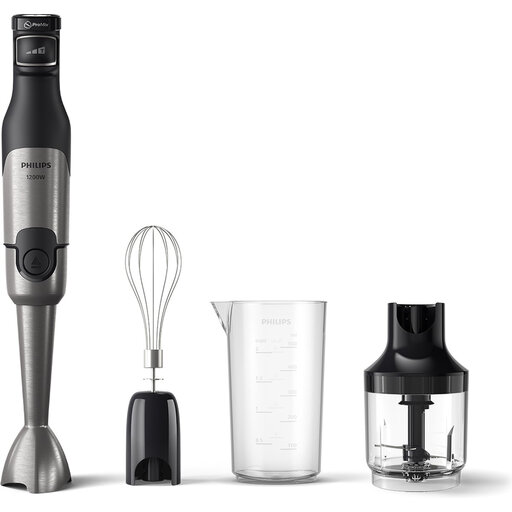
Why it suits this profile: This hand blender is a good choice if you want to blend directly in a pan, bowl or measuring jug, and need extra attachments for chopping and whisking.
You get more than just a motor unit: the set includes a chopper, whisk and measuring beaker. The product specifications list 1200 W and three speed settings.
1200 W, 3-in-1 use, splash protection and a 0.5-litre measuring beaker. According to the product description, the set is designed for sauces, smoothies, nuts and ice cubes, among other things.
We’ve put together a complete, up-to-date list of products that meet these strict selection criteria and the applicable European safety regulations.
It depends on the model. Check whether crushing ice is specifically listed in the product specifications. The Philips HR2510/90, HR2041/00 and HR3020/20 list this function. Always use the specified quantity and pulse setting.
Its lifespan depends on how you use and maintain it, the ingredients you blend and whether you follow the maximum operating time. Let the motor cool down when instructed in the manual, and don’t use a damaged jug, cable or blades. According to the product information, many of the models mentioned come with at least a two-year statutory guarantee; your statutory consumer rights still apply.
Energy consumption depends on the power rating and how long each preparation takes. A 1000 W appliance running for one minute would theoretically use around 0.017 kWh. In practice, a blender usually runs for only a short time. Ease of cleaning, portion size and whether you use one appliance for several tasks may therefore matter more than wattage alone.
