
Livraison le jour même et le lendemain

Qualité garantie

Débloquez vos offres de bienvenue: Livraison GRATUITE | Jusqu'à -80 % | 30 jours d'essai gratuits à JoyPlus
Téléchargez l'application
Buying a new frying pan seems simple—until you start reading the packaging. Terms like "PFOA-free," "ceramic," and "healthy" are thrown around constantly. But what do they really mean? Many people invest in a pan that starts sticking after a few months, warps on an induction hob, or turns out not to be so scratch-resistant after all.
As a Joybuy Product Recommendation Officer, I see where things go wrong every day. Before you make a choice, it's wise to understand the most common pitfalls that can lead to unnecessary expense.
By seeing through these marketing claims, you can choose a pan that truly suits your cooking style and kitchen.
You don't need to be a materials scientist to make a good choice. Pay attention to the following three concrete points.
The search for a pan without Teflon (PTFE) leads many people to a ceramic frying pan. These pans have a non-stick coating based on a sand derivative (silicon) and do not contain PFAS. They can often withstand higher temperatures than traditional non-stick coatings. Another option is a 'granite' or stone coating, which is often a reinforced ceramic layer. Check the product information: manufacturers who are proud of their product often explicitly state that it is free of PFOA, PFOS, lead, and cadmium.
Do you cook on an induction hob? Then the base of the pan is the most important feature. A good induction pan has a thick, perfectly flat base with a magnetic stainless steel layer. This ensures:
An aluminum pan with an inlaid steel base is a common and effective construction.
A pan is more than just its coating. An oven-safe frying pan gives you much more flexibility. You can first sear a dish on the stovetop and then finish it in the oven. Pay attention to the handle material. Stainless steel handles can often withstand high oven temperatures, while handles made of Bakelite or plastic are limited. A non-stick saucepan with a sturdy, riveted handle is often a more durable choice than a pan with a screwed-on handle that can loosen over time.
Based on these criteria, we have selected a number of pans that suit different user profiles.
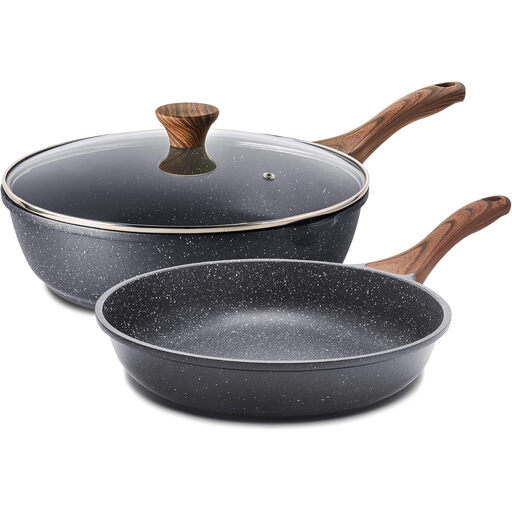
Why it's a match: An affordable and complete set to get you started right away. Ideal for those who have just moved out on their own or are taking their first steps into cooking with pans free from traditional non-stick coatings. You immediately have the two most commonly used sizes at home.
The manufacturer is transparent about the coating (free of intentionally added PFOA/PFOS) and the base is specifically designed for induction, which reduces the risk of poor performance.
Complete 2-piece set with lid. The pans are suitable for all heat sources, including induction, and are oven-safe up to 204°C (400°F).
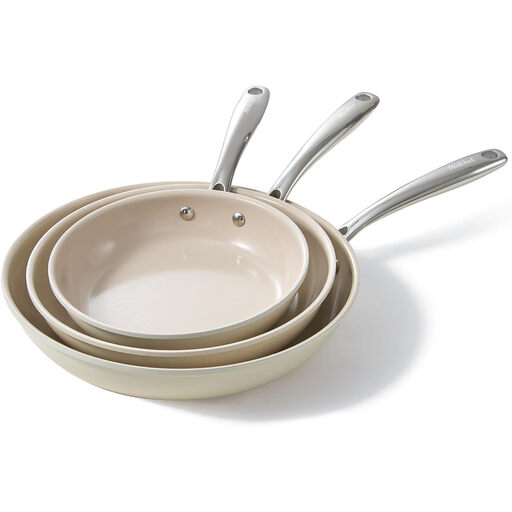
Why it's a match: Three sizes (20, 24, and 28 cm) for intensive daily use, from frying an egg to preparing a full meal. The ceramic coating makes cleanup quick and easy—a must for a busy household.
Instead of a vague 'scratch-free' claim, the manufacturer emphasizes a triple-layer ceramic coating for durability. The pans are dishwasher-safe, although hand washing is recommended for maximum lifespan—an honest piece of advice.
Complete induction pan set with three sizes. The pans are oven-safe to a very high temperature (450°C / 840°F) thanks to the stainless steel handles.
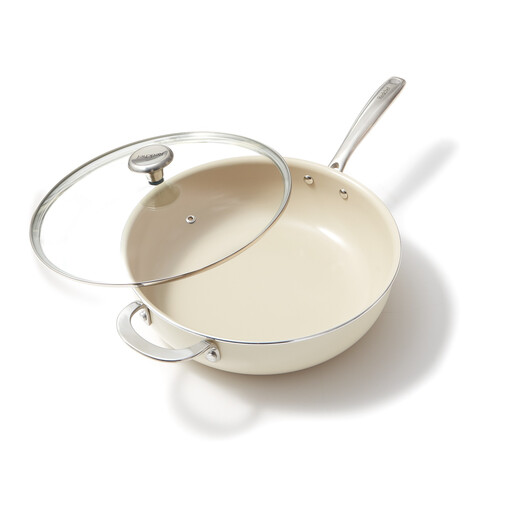
Why it's a match: For those who want to do more than just fry. The deep sides and large diameter (28 cm) make this pan perfect for sauces, stews, and one-pan meals. The high oven-safe temperature offers maximum flexibility for the creative cook.
This isn't just a frying pan, but a deep sauté pan. The specifications are clear: an oven-safe frying pan up to 450°C (840°F) with stainless steel handles that can take the heat, unlike pans with plastic grips.
Large capacity (almost 5 litres) and extremely high oven resistance. The pan is made of cast aluminum, which prevents warping, and comes with a glass lid.
We have compiled a complete, up-to-date list of products that fully meet these strict selection criteria and local regulations.
The lifespan depends heavily on the coating material and maintenance. A high-quality ceramic frying pan, with proper use, will last an average of 2 to 5 years. Proper use means: cooking on medium-high heat, not using metal utensils, and washing the pan by hand.
No pan with a non-stick coating is completely scratch-proof. The term scratch-free pan is often used in marketing but should not be taken literally. Ceramic coatings are harder and more scratch-resistant than traditional PTFE layers, but they can still be damaged by sharp objects like knives or metal spatulas. Always use wooden or silicone utensils to maximize the pan's lifespan.
Maintenance is simple but crucial. Always let the pan cool down completely before cleaning it to prevent thermal shock (and warping). Wash the pan by hand with a soft sponge and mild dish soap. Even if a pan is labeled "dishwasher-safe," hand washing will keep the non-stick coating in good condition for significantly longer. Harsh dishwasher tablets can degrade the coating.
