
Vandaag of morgen in huis

Kwaliteit gegarandeerd

Welkomstaanbiedingen ontgrendelen: GRATIS bezorging | Tot 80% korting | Gratis 30 dagen JoyPlus-proefperiode
Download de app
Anyone looking for PFAS-free pans will soon come across terms such as ceramic coating, healthy non-stick coating and induction compatibility. These terms do not always tell the full story. A pan may, for example, be PFOA-free without clearly stating whether the entire coating is free from PFAS or PTFE.
For UK households, there are practical considerations too: is the pan suitable for induction, can it go in the oven, is it dishwasher-safe and will a cookware set take up too much cupboard space? With the following checks and product recommendations, you can compare cookware based on verifiable properties rather than marketing language.
PFOA is one specific substance within the broader PFAS group. A statement that a product is PFOA-free therefore does not automatically mean that it is free from all PFAS or from PTFE. When looking for a PFAS-free non-stick pan, look for a clear product specification stating PFAS-free AND PTFE-free.
Pay attention to the wording too. “Free from intentionally added PFAS” is a different claim from a general statement about the full composition. If in doubt, check the product information and the manufacturer’s instructions.
A ceramic coating can help food release easily, but the word ceramic alone says nothing about the construction, durability or care requirements. According to Redchef’s own information, certain models feature a multi-layer or dual-sided ceramic coating. The manufacturer advises avoiding metal utensils and dry heating.
Use wooden, silicone or nylon utensils instead, and allow a pan to cool before washing it. Even if a pan is dishwasher-safe, washing it by hand with a soft sponge can put less strain on the coating.
A pan may be suitable for “all hobs” while the base diameter does not properly match your induction zone. A base that is too small or poorly centred can result in less even heating.
Also check each of the following separately:
A ceramic cookware set usually consists of a metal base with a ceramic coating. Aluminium heats up quickly, while stainless-steel pans generally have a sturdy, coating-free cooking surface. With a stainless-steel pan without a non-stick coating, cooking technique is more important: preheating properly and using enough fat will help prevent food from sticking.
If you are specifically looking for a PTFE-free pan or PFOA-free pan, you need an explicit product specification. For the Redchef and Brabantia models below, the product information states that the coating is PFAS-free; Redchef also mentions PTFE and PFOA. These are claims from the manufacturer’s product description, not a general guarantee covering every pan from the same brand.
For induction cooking, you need a magnetically compatible base. A cookware set for induction must therefore be not only ceramic, but also explicitly marketed as suitable for induction. Gas, electric, halogen and ceramic hobs each place different demands on heat distribution.
An induction wok also works best when its flat base fits the induction zone properly. The Brabantia Onyx wok has a stated base diameter of 16 cm. So check that this measurement is suitable for your hob.
A small kitchen, campervan or student room can benefit from stackable pans. A cookware set with a removable handle can save space, but requires extra care when locking the handle in place. Always attach the handle fully before lifting the pan.
A set with several sizes is practical for families, but is not automatically better value. Consider which pans you actually use. For everyday cooking, a saucepan, frying pan and possibly a wok are often enough.
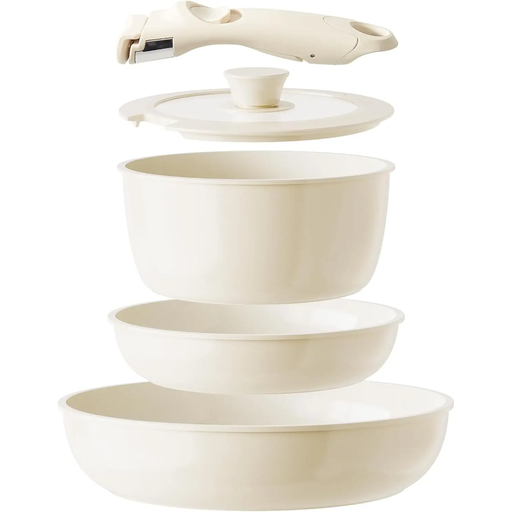
Why it suits this profile: This set combines a saucepan, two frying pans, a lid and a removable handle for everyday cooking. According to the product information, the set is suitable for gas, electric and induction hobs.
The manufacturer explicitly states that the ceramic coating is free from PFAS, PTFE and PFOA. The set is also specified as dishwasher-safe, with advice to avoid metal utensils.
Ceramic interior and exterior coating, stackable design and removable handle. Always check the instructions before using the pan in the oven and remove the handle if required.

Why it suits this profile: This ceramic frying pan is designed for everyday use and, according to the product information, its size is suitable for meals for up to around three people.
Brabantia states that it has a PFAS-free ceramic coating and is suitable for induction, gas, electric, ceramic and halogen hobs. The oven limit is clearly specified: up to 200 °C.
Made from 100% recycled forged aluminium according to the product information, with a riveted stainless-steel handle. Dishwasher-safe, although hand-washing is recommended for a longer service life.
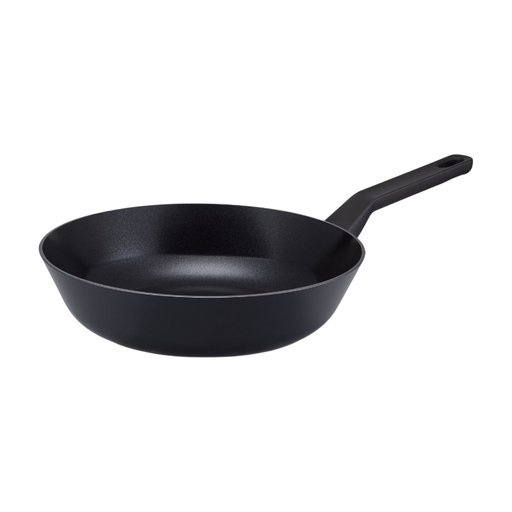
Why it suits this profile: This wok is designed for stir-frying vegetables, noodles and meat. The 28 cm diameter provides room for larger portions, while the product information states that the pan is suitable for induction.
The product information states that it has a 100% PFAS-free ceramic double coating and gives a maximum food load of 2 kg. The 16 cm base diameter must fit the induction zone properly.
Lightweight aluminium, heat-resistant Bakelite handle and suitability for induction, gas, electric, ceramic and halogen hobs. Hand-washing is recommended to protect the coating.
We have put together a complete, up-to-date list of products that fully meet these strict selection criteria and the applicable European safety regulations.
No. “Ceramic” describes the type of coating, but is not a complete statement about its composition. Check whether the manufacturer explicitly states PFAS-free, PTFE-free and, where applicable, PFOA-free. These terms do not mean the same thing.
Only choose a model that explicitly lists induction in its product details. For a wok or large frying pan, also check the diameter of the flat base. A ceramic cookware set for induction must also be suitable for the size of your cooking zones.
Its service life depends on heat, utensils, cleaning and how often it is used. There is no fixed lifespan that applies to every pan. Avoid metal spatulas, dry heating and sudden changes in temperature. Replace the pan when the coating is visibly damaged or the handle is no longer firmly attached.
