
Vandaag of morgen in huis

Kwaliteit gegarandeerd

Welkomstaanbiedingen ontgrendelen: GRATIS bezorging | Tot 80% korting | Gratis 30 dagen JoyPlus-proefperiode
Download de app
As a Product Recommendation Officer at Joybuy, I see the overwhelming number of choices customers face daily. Especially when you're looking for PFAS-free pans, you're bombarded with claims. My job is to cut through the marketing jargon and help you find a pan that delivers on its promises, without overpaying. Let's look at the most common pitfalls and how to avoid them.
Many pans promise a healthy and durable cooking experience, but in practice, they often fall short. These are the three most common problems consumers encounter:
A good pan doesn't have to be complicated. By paying attention to a few key specifications, you can avoid these disappointments and choose a pan that truly fits your needs.
Before you make a decision, it's wise to check three technical aspects. These determine whether a pan is worth the investment.
The term pans without PFAS is an umbrella term. PFAS are chemical substances traditionally used in non-stick coatings like Teflon (PTFE). While PFOA-free pans have been the standard for some time, more and more people are opting for pans that are completely free of all PFAS substances.
The most popular choice is a ceramic frying pan. It has a non-stick coating based on a derivative of sand (silicon). These layers are generally hard, smooth, and can withstand high temperatures. Pay attention to the product description: a reputable manufacturer will explicitly state that the pan is free of PFAS, PFOA, lead, and cadmium.
Do you cook on an induction hob? Then the base of the pan is the most critical factor. An induction pan set requires a base that is magnetic and perfectly flat. Pans made of aluminium or copper naturally don't work on induction unless they have a special encapsulated steel base. This base not only ensures compatibility but also provides fast and even heat distribution, which prevents the dreaded hotspots. Always check for the induction symbol (a coil) on the packaging or in the specifications.
A smart design makes your life easier. A pan set with a detachable handle is a perfect example. You click off the handle to stack the pans compactly, which can save up to 70% of space in your cabinet. Moreover, you can also use the pan without the handle in the oven. This is ideal for small kitchens, student rooms, campers, or caravans.
Based on these criteria, we have selected several products that suit a variety of households.
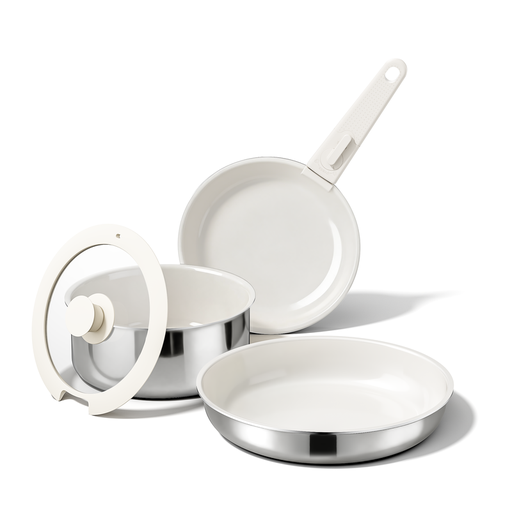
Why This Fits Their Persona: Perfect for those living in compact spaces, such as an apartment, studio, or caravan. This set solves the classic storage problem while still offering a complete cookware solution.
Directly tackles the 'storage puzzle' with its detachable handle. The three-layer stainless steel construction ensures better heat distribution than cheap, thin pans, thus reducing hotspots.
Saves up to 70% of cabinet space, according to the manufacturer. The pans are suitable for all heat sources, including induction and the oven (up to 250°C).

Why This Fits Their Persona: A reliable duo from a well-known brand for daily meals. The two sizes (20 and 24 cm) are ideal for everything from a fried egg to preparing a meal for 2-3 people.
Avoids the 'hotspot frustration' thanks to its forged aluminium construction, which ensures fast and even heating. The ceramic coating is designed for daily use and is 100% PFAS-free.
Made from 100% recycled aluminium (RCS-certified). Suitable for all heat sources, including induction, and oven-safe up to 200°C.
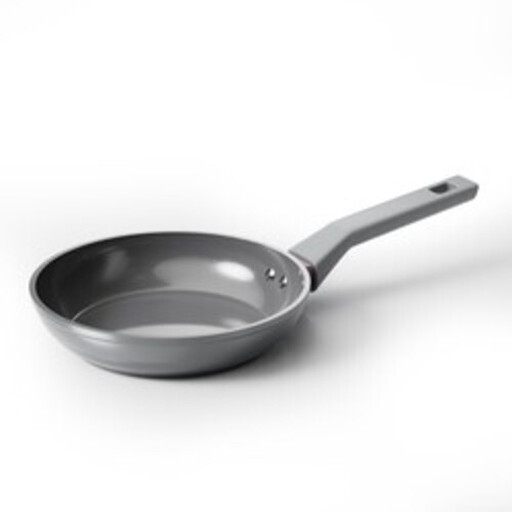
Why This Fits Their Persona: Ideal for someone seeking a specific, high-quality pan for delicate tasks like cooking a perfect omelette or pancake. The focus is on a non-toxic surface and durability.
Bypasses the 'green marketing trap' by being specific: the product information states that the pan is free of PFAS, PFOA, lead, and cadmium. The multi-layer base is designed for even heat distribution.
According to the manufacturer, the diamond-titanium coating is extra hard and durable. The pan is suitable for all heat sources, including induction, and is dishwasher-safe.
We have compiled a complete, up-to-date list of products that fully meet these strict selection criteria and local regulations.
The lifespan of a ceramic pan set depends heavily on use and maintenance. With daily use and proper care (hand washing, no metal utensils, not overheating), you can expect a lifespan of several years. Cheaper pans with a thinner coating may wear out more quickly.
According to manufacturers, pans with a ceramic coating, which by definition are pans without Teflon and PFAS, do not release harmful fumes when overheated. Traditional PTFE coatings can release fumes at very high temperatures (above 260°C). For normal household use and extra peace of mind, a PFAS-free pan is a sensible choice.
Maintenance is simple but crucial:
