
当日/次日达

品质保障

开启新人专享福利: 全场免邮 | 低至 2 折 | 免费试用 30 天 JoyPlus 会员
下载 Joybuy
The search for a good, healthy frying pan can feel like navigating a maze. You're aware of the discussions surrounding PFAS and are looking for a safer alternative, but the market is flooded with claims that seem too good to be true. As a Product Recommendation Officer at Joybuy, I see the challenges buyers face every day. Many pans promise the world, only to lose their functionality after just a few months.
Before you make a choice, it's crucial to recognise three common pitfalls that lead to a bad purchase.
By understanding these points, you can search more effectively for a pan that truly suits your needs and is worth the money.
To choose a durable and functional PFAS-free frying pan, it's wise to look beyond the marketing terms. Focus on a few concrete, verifiable features.
Most pans without PFAS use a ceramic non-stick coating. This is essentially a sand-based (silicon) layer that creates a smooth surface. It's a popular alternative to the traditional Teflon-free frying pan.
For those who cook on an induction hob, the construction of the base is everything. An induction frying pan needs a base that is magnetic.
A pan is more than just a cooking surface. Its versatility is determined by the details.
Based on these objective criteria, we have selected a number of pans that suit different cooking styles and households.
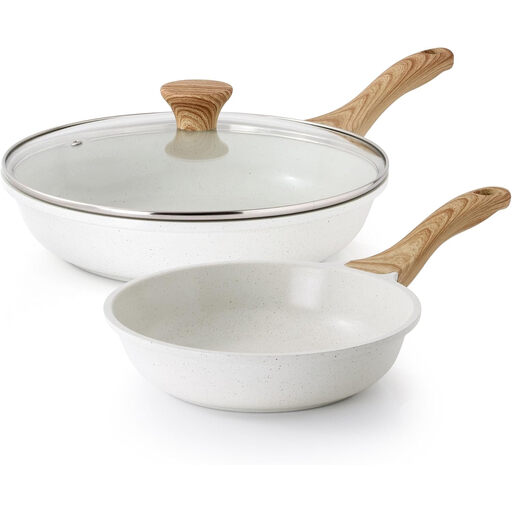
Why This Fits Their Persona: Ideal for those just starting with PFAS-free cooking or looking for a complete, affordable set. With a small pan for an egg and a larger pan with a lid for a one-pan meal, you immediately have a versatile foundation.
The bakelite handle stays cool on the stovetop, a practical advantage. The set is oven-safe up to a specified temperature (176°C / 350°F), which provides clarity on the limitation of the "oven-safe" claim.
Complete 2-piece set with lid. The die-cast aluminium construction ensures good, even heat distribution on all heat sources, including induction.
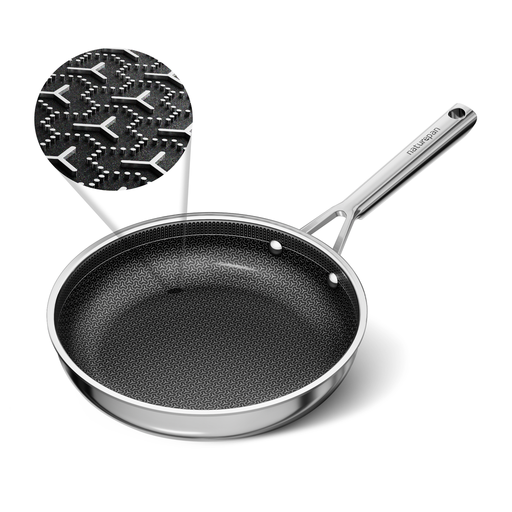
Why This Fits Their Persona: For the home chef who loves to perfectly sear a steak while also wanting the convenience of a non-stick surface. This pan is built for performance and a longer lifespan.
Tackles the "scratch-resistant" myth. The laser-etched stainless steel pattern sits higher than the ceramic coating, so metal spatulas touch the steel, protecting the coating. This makes the pan significantly more durable than a standard ceramic pan.
Hybrid technology for searing and non-stick convenience. The 5-ply construction ensures superior, rapid heat distribution. Fully oven-safe up to 260°C (500°F) thanks to the stainless steel handle.
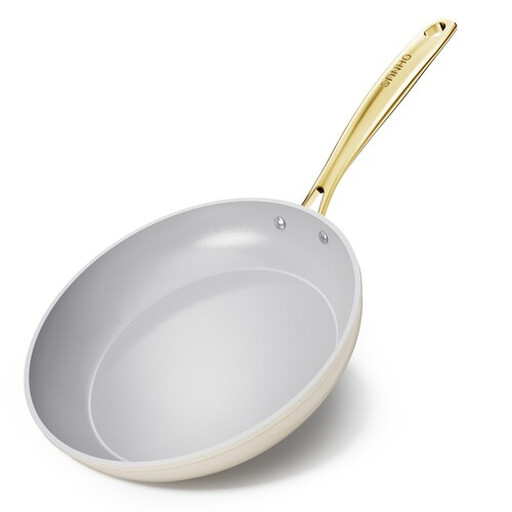
Why This Fits Their Persona: A reliable all-rounder for daily use. The 26cm (10-inch) size is perfect for family meals, from chicken breasts to a quick pasta sauce. The focus is on ease of use, a healthy coating, and simple cleaning.
This pan addresses the pitfall of poor induction performance. The combination of an aluminium core and an encapsulated stainless steel base ensures fast and, most importantly, very even heating, which is essential for efficient cooking on induction.
Highly versatile: suitable for all heat sources, oven-safe up to 260°C (500°F), and dishwasher-safe (though hand washing is recommended for a longer lifespan). The PVD handle stays cool on the stovetop.
We have compiled a complete, up-to-date list of products that fully meet these strict selection criteria and safety regulations.
The lifespan of a ceramic frying pan heavily depends on its use and care. With daily use and careful maintenance (hand washing, no metal utensils, avoiding extreme temperature shocks), you can expect a lifespan of 1 to 3 years before the non-stick properties noticeably diminish. Pans with a reinforced or hybrid coating generally have a longer lifespan.
Many manufacturers state that their pans are dishwasher-safe. However, the harsh detergents and high temperatures in a dishwasher can degrade the ceramic coating over the long term. For maximum lifespan, it is almost always recommended to wash the pan by hand with a soft sponge and mild dish soap.
A healthy pan is a broad concept. The main advantage of a ceramic pan is that it is made without the intentional addition of PFAS, PFOA, and PTFE. This means that no potentially harmful fumes are released upon overheating, which can be a risk with traditional non-stick coatings. Additionally, the smooth surface allows you to cook with less oil or butter, which can contribute to a healthier meal.
