
Vandaag of morgen in huis

Kwaliteit gegarandeerd

Welkomstaanbiedingen ontgrendelen: GRATIS bezorging | Tot 80% korting | Gratis 30 dagen JoyPlus-proefperiode
Download de app
A PFAS-free frying pan for induction sounds straightforward, but product pages often use terms that do not tell the whole story. For example, a ceramic non-stick coating may be PFAS-free, while the pan itself may not be suitable for induction. Likewise, “dishwasher-safe” does not automatically mean that the coating will last just as long after many washes.
Pay particular attention to these three common pitfalls:
A ceramic frying pan uses a ceramic non-stick coating instead of a traditional PTFE-based coating. The product information should clearly state whether the pan is PFAS-free. Also check whether this applies to the inside of the pan and what care conditions the manufacturer specifies.
According to Brabantia’s product information, the Dusk and Onyx pans feature a 100% PFAS-free ceramic coating. WMF Durado is also described as PFAS-free and featuring a ceramic coating. These are product claims made by the respective brands, so treat them as information from the product specifications rather than a general guarantee for all ceramic pans.
A double ceramic layer or an extra scratch-resistant finish can be useful, but no coating is designed for metal utensils, prolonged heating while empty or extremely high heat without ingredients.
A good induction frying pan has a base that responds magnetically and sits flat on the hob. Pay attention to the following points:
According to the product information, the Brabantia Dusk 20 and 24 cm pans are suitable for all the heat sources mentioned and for oven use up to 200 °C. The WMF Durado 24 cm is listed as suitable for induction and oven use up to 250 °C, but is not dishwasher-safe. If in doubt, always check the current specifications on the product page.
Be careful with wide pans that are not made for induction. For example, the 32 cm Tefal Easy Cook & Clean is suitable for gas, electric and ceramic cooking, but not for induction. This makes it unsuitable if you use an induction hob exclusively or mainly.
The right size depends on your household and cooking style:
Also consider the material. Recycled aluminium is lightweight and generally heats up quickly. The Brabantia Dusk and Onyx specify a body made from 100% recycled aluminium. The Dusk set also carries an RCS quality mark for its recycled content. A stainless-steel pan, such as the WMF Durado, feels heavier and may offer a different balance and heat distribution.

Why it suits this profile: Two popular sizes offer flexibility without having to buy several separate pans straight away. The set is suitable for induction and other heat sources.
The product information lists PFAS-free ceramic non-stick coatings, induction compatibility, dishwasher use and oven use up to 200 °C. Hand washing is still recommended to help protect the coating.
20 and 24 cm in one set; 100% recycled forged aluminium according to the stated RCS specification; suitable for oven use up to 200 °C.
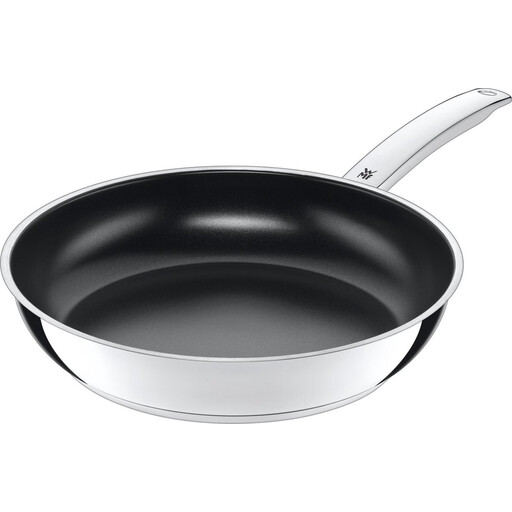
Why it suits this profile: This pan combines Cromargan 18/10 stainless steel with a ceramic coating, an ergonomic handle and a wide pouring rim.
The specifications state that it is suitable for induction and has a PFAS-free ceramic coating. The pan is not dishwasher-safe, so hand washing is part of its care routine.
Oven-safe up to 250 °C according to the product information; 24 cm is suitable for everyday use; wide rim for controlled pouring.
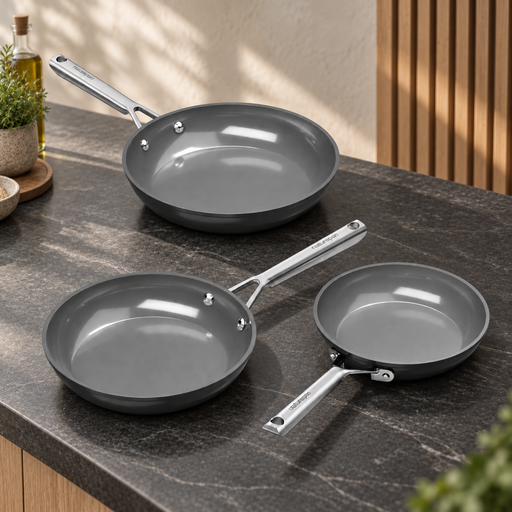
Why it suits this profile: The three sizes are useful for small portions as well as meals for several people. The set is designed for induction, oven use and everyday cleaning.
The listed specifications state that it is induction-compatible and features a PFAS- and PTFE-free ceramic coating, oven use up to 260 °C and dishwasher safety.
20, 24 and 28 cm; reinforced ceramic coating according to the product description; suitable for oven use up to 260 °C and for the dishwasher.
We have compiled a complete, up-to-date list of products that fully meet these strict selection criteria and the applicable European safety regulations.
The service life of a ceramic frying pan depends largely on how it is used. These habits help protect the coating and base:
A pan may be dishwasher-safe and still last longer when washed by hand with a soft sponge. There is no contradiction: dishwasher safety indicates permitted use, while hand washing generally puts less strain on the coating.
No. PFAS-free describes the coating or material, not the heat source. Always check that induction is explicitly mentioned and that the base is suitable for your cooking zone.
The service life varies from pan to pan and depends on how intensively it is used. High temperatures, metal utensils, heating the pan empty and harsh cleaning can damage the coating more quickly. Always follow the manufacturer’s care instructions and replace the pan when the coating is visibly peeling or damaged.
For one to three people, a 24 cm frying pan is often practical. A 20 cm frying pan is better suited to small portions, while a 28 cm frying pan offers more space for family meals. When cooking on induction, also check the diameter of the magnetic base, not just the rim size.
