
Vandaag of morgen in huis

Kwaliteit gegarandeerd

Welkomstaanbiedingen ontgrendelen: GRATIS bezorging | Tot 80% korting | Gratis 30 dagen JoyPlus-proefperiode
Download de app
You're hearing more and more about PFAS and might be wondering if your current frying pan is still the right choice. The search for a high-quality, PFAS-free frying pan can be overwhelming due to the wide variety of materials and marketing terms. It's difficult to know what really matters for your style of cooking.
As a Joybuy Product Recommendation Officer, my job is to help you. I filter the information and provide practical advice so you can choose a pan that fits your needs, without the fuss. In this article, we'll discuss what to look for and highlight some popular choices.
Before we look at the products, here are a few key points to help you make your choice.
The term 'PFAS-free' simply means that no poly- and perfluoroalkyl substances have been used in the pan's construction. These are the common alternatives you'll encounter:
Not every pan works on every heat source. If you're looking for an induction frying pan, the base must be magnetic. This is usually clearly indicated with a coil icon on the packaging or in the product description. Furthermore, a pan with a thick, flat bottom ensures better heat distribution, which saves energy and prevents burning.
Consider what you'll be using the pan for most often. A standard 24 or 28 cm frying pan is an all-rounder for most dishes. Do you often cook for a larger family or enjoy making one-pan meals and stir-fries? Then a deeper sauté pan or a wok might be a better investment.
Based on product specifications and functionality, we have selected a few pans that are worth considering.
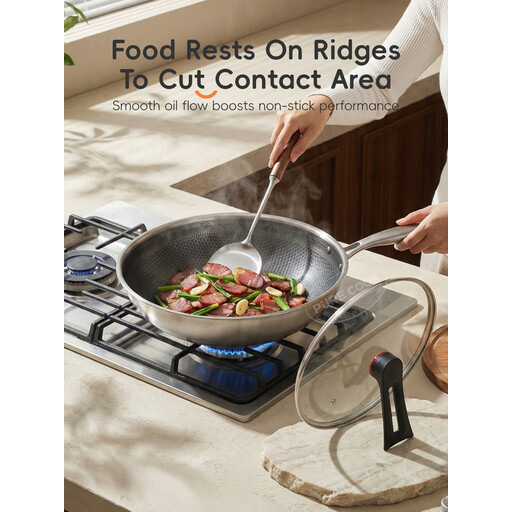
Why It Stands Out: This wok does not use a chemical non-stick coating. Instead, the interior features a honeycomb texture of 304 stainless steel. This texture creates a physical barrier between the food and the pan, allowing you to cook with less oil without sticking. The tri-ply steel construction ensures fast and even heat distribution.
Key Features:
Who Is This Pan For? For the home cook who loves making Asian dishes or is looking for a large, versatile pan that will last a lifetime. It's an excellent choice if you prioritise durability and cooking without chemical coatings.
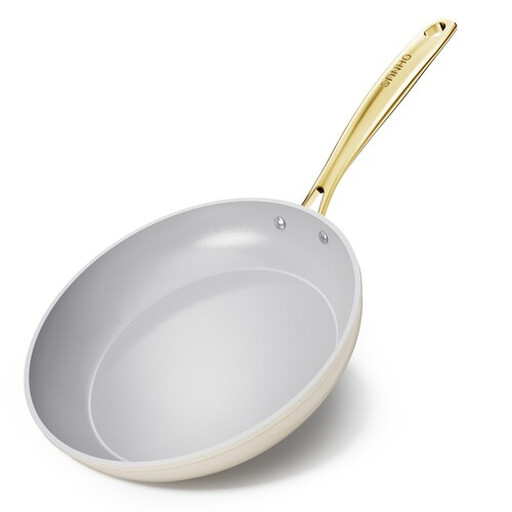
Why It Stands Out: Sanho states that this pan has a patented diamond-titanium ceramic coating that is completely free of PFAS, PFOA, and PTFE. The combination of an aluminium core and a stainless steel base ensures rapid and even heating on all cooktops, including induction.
Key Features:
Who Is This Pan For? This is an excellent all-round ceramic frying pan for the health-conscious cook. The 26 cm size is perfect for daily use, from frying an egg to preparing a meal for two. Its oven-safe feature makes it extra versatile.

Why It Stands Out: Tefal is a well-known brand that focuses on user-friendliness. This pan features a Titanium non-stick coating. According to Tefal, this coating is highly durable and produced without PFOA, lead, and cadmium. The Thermo-Signal in the centre of the pan turns solid red when the ideal cooking temperature is reached, taking the guesswork out of cooking.
Key Features:
Who Is This Pan For? For those seeking a reliable and user-friendly all-rounder from a trusted brand. If you appreciate the performance of a traditional non-stick coating but want to ensure it's PFOA-free, this is a solid option.
The perfect pan is different for everyone. You might be looking for a different size, a specific material, or another price point. Every kitchen has different needs.
Browse our full range and find the pan that's right for you. Discover more choices in our Induction non-stick pan category.
1. What is the difference between PFAS-free and PFOA-free? PFAS is a large group of thousands of chemical substances. PFOA is one specific, well-known substance from that group, which is now banned in the EU for the production of consumer products like pans. A pan that is 'PFOA-free' does not contain that specific substance but may still contain other PFAS variants (like PTFE). A pan labelled as 'PFAS-free', such as a ceramic pan, should not contain any substance from the PFAS group.
2. What is the best way to maintain a ceramic frying pan? To extend the life of a ceramic coating, it's best to wash it by hand with a soft sponge. Avoid abrasive scourers and metal utensils; use wooden or silicone spatulas instead. Always let the pan cool down completely before running it under cold water to prevent thermal shock.
3. Is a Teflon-free pan always a healthy frying pan? A Teflon-free pan (PTFE) or one without other PFAS coatings, such as a ceramic or stainless steel pan, is often considered a healthy frying pan because no chemical substances can be released upon overheating. However, healthy cooking also depends on your cooking method. A good pan allows you to cook with less oil or butter, which contributes to a lighter meal.
