
当日/次日达

品质保障

开启新人专享福利: 全场免邮 | 低至 2 折 | 免费试用 30 天 JoyPlus 会员
下载 Joybuy
Buying a new frying pan seems simple—until you start searching online. You're flooded with terms like "healthy," "sustainable," and "professional." Especially with the growing awareness around PFAS, choosing a PFAS-free frying pan is a logical step. But how do you avoid investing in a pan that needs replacing after just a few months?
As a Product Recommendation Officer at Joybuy, I see the daily challenges consumers face. Many marketing promises fall short in practice. Let's expose the most common pitfalls so you can make an informed choice.
Pitfall 1: The "healthy" coating that wears out quickly Many pans are promoted with a ceramic non-stick coating as a PFAS-free alternative. This is a positive development. The problem, however, is the vast difference in quality. A cheap, thin coating can lose its non-stick properties within a few weeks, especially with intensive use or cleaning in the dishwasher.
Pitfall 2: The pan that doesn't work on your cooktop You've found the perfect pan, but at home, it won't heat up. This is a common problem for induction users. Not every Teflon-free frying pan is automatically an induction-ready frying pan. Without a magnetic base, the pan is useless on an induction cooktop.
To avoid these pitfalls, it's crucial to look beyond the marketing slogans. Focus on a few concrete specifications that determine whether a pan is worth its price.
A healthy frying pan starts with a coating free from intentionally added PFAS, PFOA, and PTFE. Ceramic coatings are a popular example. Pay attention to the construction: a cast aluminium pan with a thicker, multi-layer ceramic coating is generally more durable and scratch-resistant than a thin, stamped pan. Aluminium ensures fast and even heat distribution.
Always check the product information for compatibility with your cooktop. For an induction frying pan, a ferromagnetic base is essential. This is often indicated by a coil icon on the packaging or the bottom of the pan. A simple test: if a magnet sticks to the bottom, the pan is suitable for induction.
The standard 28 cm frying pan is a good all-rounder for most households. Do you often cook eggs for one? Then a smaller 20 or 24 cm model is more practical. For stews or one-pan meals, a PFAS-free sauté pan with a higher rim and a lid is ideal. Considering a complete replacement of your old pans? A PFAS-free cookware set can be a cost-effective and convenient solution.
Based on these objective criteria, we have selected a number of pans that suit different user profiles.
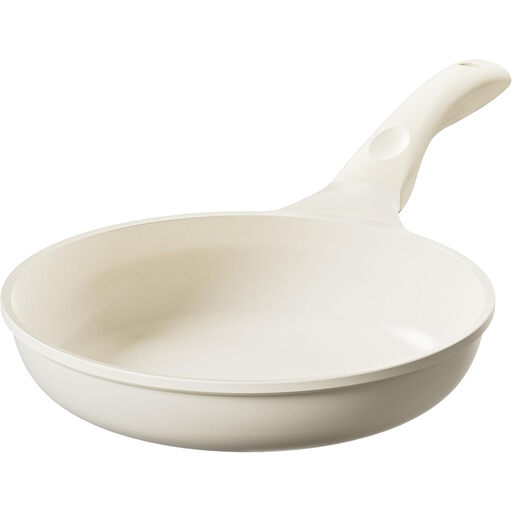
Why This Fits Their Persona: Ideal for one or two-person households, or if you need a compact, reliable pan for daily tasks like frying an egg or small portions of vegetables. An affordable and safe start.
This pan has a specified PFAS-free ceramic coating and a base suitable for all heat sources, including induction. No unpleasant surprises when you get home.
Fast, even heating thanks to the aluminium base. The non-stick coating makes cleaning easy: a simple wipe-down is often enough.
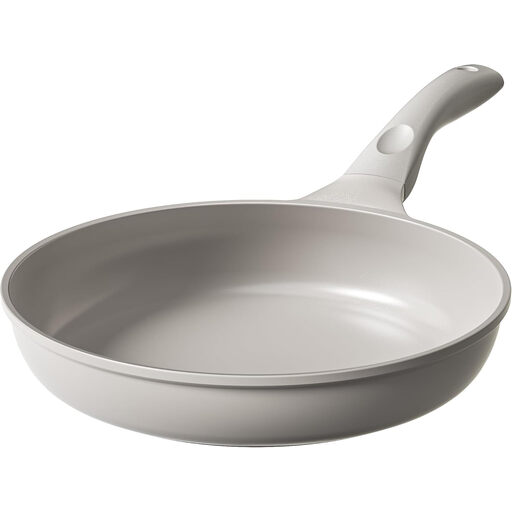
Why This Fits Their Persona: The 28 cm size is perfect for preparing family-sized meals. It's large enough for multiple pieces of meat, a generous portion of stir-fried vegetables, or pancakes for everyone.
The thickened base ensures stability and prevents warping on powerful heat sources like induction. The scratch-resistant ceramic coating is designed for daily, intensive use.
According to the manufacturer Redchef, the pan is dishwasher-safe for maximum convenience. The ergonomic handle stays cool during stovetop cooking.
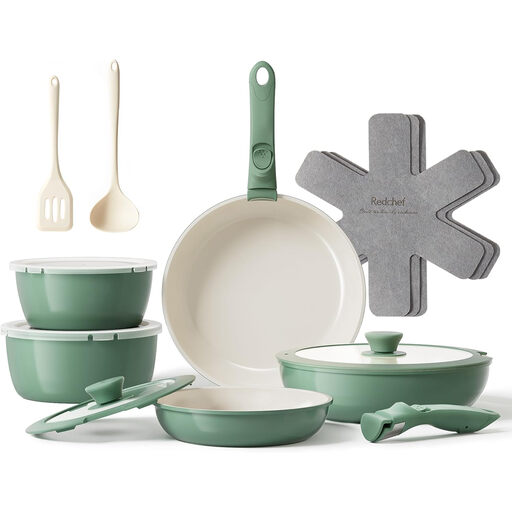
Why This Fits Their Persona: Perfect for those living in a compact apartment, studio, or RV. This set is designed for maximum stackability, saving you precious cabinet space.
This is more than a gimmick. It's a complete, functional PFAS-free cookware set. The detachable handle clicks securely into place and makes the pans suitable for oven use.
Extremely versatile: use the pans on the stove, in the oven (without the handle), and serve directly at the table. The set is compatible with all heat sources.
We have compiled a complete, up-to-date list of products that meet these strict selection criteria and Dutch safety regulations.
The lifespan of a PFAS-free frying pan heavily depends on the quality of the coating and its maintenance. A high-quality ceramic frying pan can last for several years with proper use. Cheaper models often need to be replaced within a year. You can significantly extend its life by hand-washing the pan and avoiding metal utensils.
The most reliable method is to check the manufacturer's product specifications. Look for the induction logo (a symbol with three loops) or the explicit mention "suitable for induction." If you already have the pan at home, you can do the magnet test: if a refrigerator magnet sticks to the bottom of the pan, the base is magnetic and suitable for induction.
To keep the non-stick coating in good condition, there are a few simple rules:
