
Vandaag of morgen in huis

Kwaliteit gegarandeerd

Welkomstaanbiedingen ontgrendelen: GRATIS bezorging | Tot 80% korting | Gratis 30 dagen JoyPlus-proefperiode
Download de app
If you're in the market for a new frying pan, you've likely come across the term "PFAS-free." A growing number of home cooks are switching to a PFAS-free ceramic frying pan for a healthier way to cook. However, the market is flooded with options, and not every pan lives up to its promises.
Before you make a decision, it's crucial to understand the common pitfalls. Many pans are advertised with features that disappoint in practice, leading to frustration and wasted money.
To find a pan that retains its value, it's helpful to look beyond the marketing slogans. Focus on the verifiable specifications that determine performance and lifespan.
Not every frying pan with a ceramic non-stick coating is created equal. The base is often a sol-gel coating, which is naturally free of PFAS and PFOA. However, durability depends on its reinforcement. Coatings enriched with particles like titanium or diamond typically offer better resistance to wear and scratches. This is a key feature for a pan you intend to use daily. A quality coating ensures a truly toxin-free pan that lasts longer.
A good ceramic frying pan for induction has a thick, stable base that won't warp. A base with an encapsulated stainless steel plate ensures rapid and even heat distribution, which is essential for efficient cooking. Also, check if it's an oven-safe frying pan. The maximum oven temperature is determined by the materials of the pan and its handle. A pan that is oven-safe up to 260°C offers significantly more versatility for finishing dishes.
The handle is crucial for both safety and ease of use. Bakelite handles stay cool on the stovetop but usually can't go in the oven. Stainless steel or PVD-coated handles can often withstand high oven temperatures. Also, pay attention to the attachment: double rivets typically provide a sturdier and more durable connection than a single screw.
Based on these objective criteria, we have selected a few pans that suit different user profiles.
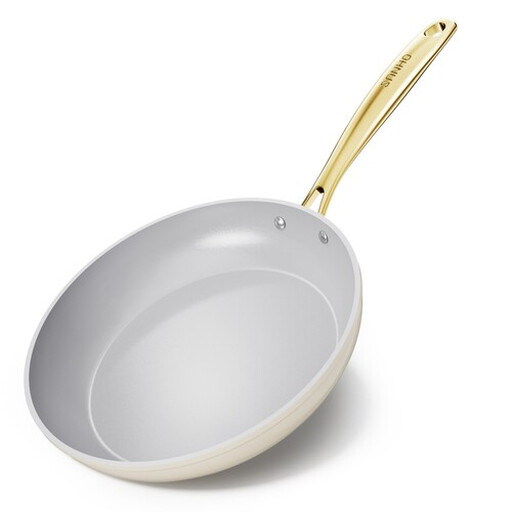
Why This Fits Their Persona: With a 26 cm diameter, this pan is ideal for family meals, from pasta dishes to fried potatoes. Its high oven-safe temperature makes it extremely versatile for dishes that go straight from the stovetop to the oven.
The patented diamond-titanium coating is engineered for a longer lifespan than standard ceramic layers. The encapsulated stainless steel base ensures stable, efficient heat distribution on induction, preventing hotspots.
Completely free of PFAS, PFOA, lead, and cadmium. Oven-safe up to a high temperature of 260°C, which offers exceptional versatility.
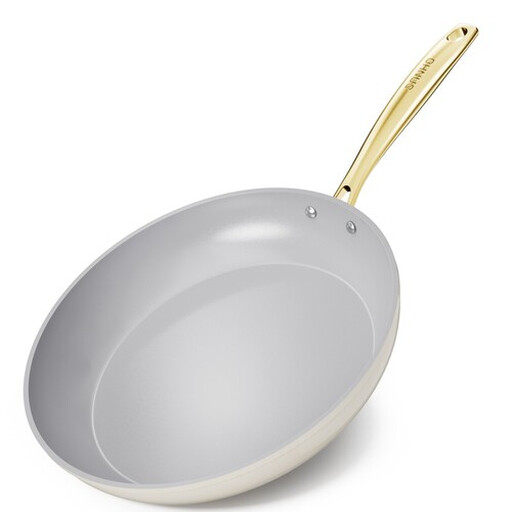
Why This Fits Their Persona: The compact 20 cm size is perfect for frying a couple of eggs, an omelette, or a quick meal for one. The pan is lightweight, heats up quickly, and has a small footprint.
Despite its small size, this pan features the same thick aluminium body and diamond-titanium coating as larger models, ensuring durability and excellent, even heat distribution without burning.
Seamless transition from stovetop to oven (up to 260°C). The PVD handle stays cool on the stovetop for safe handling.
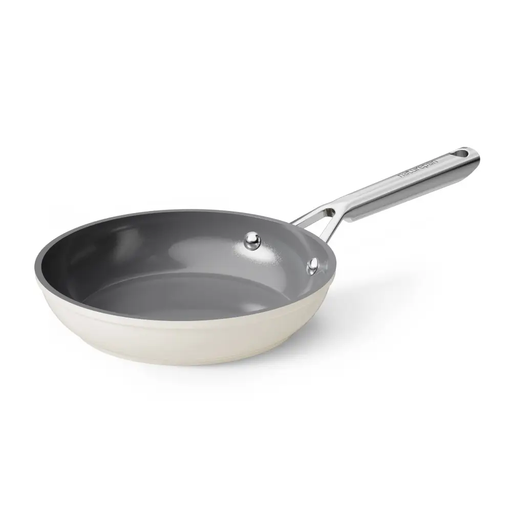
Why This Fits Their Persona: For those seeking top performance and a long lifespan. The focus is on the advanced coating and robust construction, ideal for intensive use and preparing delicate dishes like fish.
The exclusive ceramic coating, reinforced with diamond and titanium particles, is specifically designed for superior durability and scratch resistance, tackling the pitfall of a rapidly wearing layer.
Suitable for all heat sources, including induction. Oven-safe up to 230°C, and the stainless steel handle stays cool on the stovetop.
We have compiled a complete, up-to-date list of products that meet these strict selection criteria and EU safety regulations.
The lifespan of a healthy frying pan with a ceramic coating heavily depends on its quality and maintenance. A basic model might lose its non-stick properties within a year. A pan with a reinforced coating (like one with diamond or titanium) can last for several years with proper care. Proper care means: cooking on low to medium heat, using wooden or silicone utensils, and washing the pan by hand.
Many manufacturers state that their pans are dishwasher-safe. However, to maximise the lifespan of the non-stick coating, hand washing is almost always recommended. The harsh detergents and high temperatures in a dishwasher can degrade the coating over time.
If your pan starts to stick, there could be several reasons. The most common are:
