
当日/次日达

品质保障

开启新人专享福利: 全场免邮 | 低至 2 折 | 免费试用 30 天 JoyPlus 会员
下载 Joybuy
A PFAS-free ceramic frying pan may seem like a straightforward purchase at first glance. However, pans vary considerably in size, coating, heat source compatibility and maintenance requirements. A pan that is suitable for gas will not automatically work on induction. And “dishwasher-safe” does not mean that the non-stick coating will last just as long after every wash.
For home chefs, families and people living in a small kitchen, three pitfalls are particularly important:
A ceramic pan without Teflon usually has an aluminium base with a ceramic coating. Aluminium generally heats up quickly, while a suitable induction base enables magnetic heat transfer.
Look for explicit terms such as PFAS-free, PTFE-free and PFOA-free. According to the product descriptions of the brands mentioned, these refer to their own product specifications. This is different from a general guarantee that every ceramic coating has the same properties. Always check the latest information on the product page.
According to the manufacturer, a double or triple ceramic layer can help improve durability, but you should still use wooden, silicone or plastic utensils. The coating is not a reason to use metal spatulas.
A 24 cm frying pan is practical for up to around three people and suitable for eggs, vegetables, fish or a small quantity of meat. For one person or smaller portions, a 20 cm pan takes up less space.
For families, 26 to 28 cm may be more convenient. A larger pan provides more cooking surface, but also requires a suitably sized cooking zone. So do not just look at the diameter of the rim; check the diameter of the base as well.
If you want to prepare sauces, stews or one-pan meals, a sauté pan with lid is often more functional than a shallow frying pan. A glass lid allows you to keep an eye on your dish without constantly lifting the lid.
A dishwasher-safe frying pan is particularly convenient for everyday use, but washing by hand with a soft sponge can help keep the ceramic non-stick coating usable for longer. Allow the pan to cool first and avoid running cold water into a hot pan.
When using the pan in the oven, pay attention to three points:
On some Redchef models, the handle can be detached for use in the oven or for compact storage. According to the product description, the stated oven suitability applies only under the specified conditions. Always check the instructions and product specifications before use.
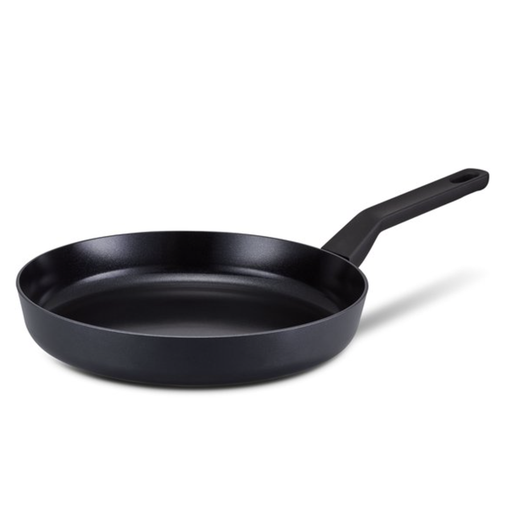
Why it suits this profile: This compact size is easy to handle for small portions, student kitchens and one-person households.
The specifications state that it has a PFAS-free ceramic coating and is suitable for induction, gas, electric, ceramic and halogen hobs.
20 cm, 100% recycled aluminium according to the product description, a double ceramic non-stick coating and dishwasher-safe.
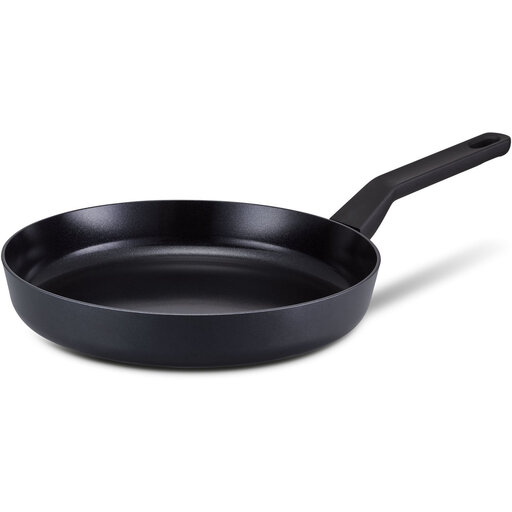
Why it suits this profile: A versatile size for everyday cooking in an average Dutch household.
The product information states that it is PFAS-free, induction-compatible and has a rivet-attached handle.
24 cm, recycled aluminium, double ceramic layer, dishwasher-safe and oven-safe up to 200 °C.
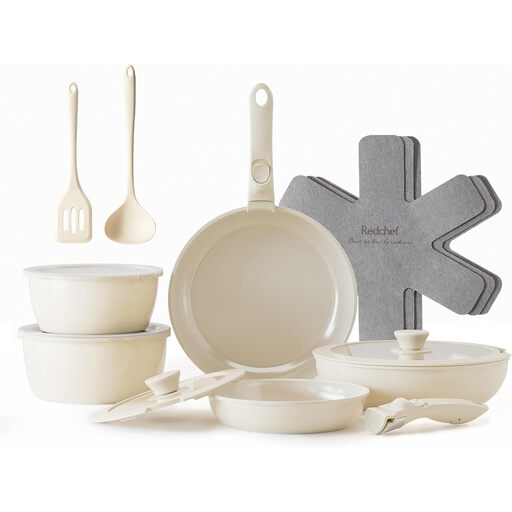
Why it suits this profile: The stackable set is designed for families, small kitchens, motorhomes and users who combine several cooking methods.
The set states that it is free from PFAS, PTFE and PFOA, compatible with induction and equipped with a detachable handle for oven use.
16 pieces, stackable design, oven- and dishwasher-safe according to the product description; remove the handle before using it in the oven or dishwasher.
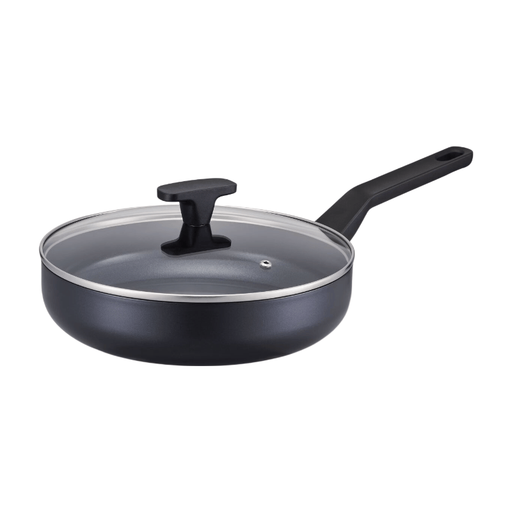
Why it suits this profile: The higher sides and lid are practical for simmering, stewing and larger one-pan meals.
The specifications state that it has a PFAS-free ceramic coating and is suitable for all common heat sources, including induction.
26 cm, glass lid, recycled aluminium, double ceramic layer and dishwasher-safe according to the product information.
A ceramic cookware set is worth considering when you need several sizes and have limited cupboard space. A set with a detachable handle can also be stacked compactly and used on the hob, in the oven or as a serving dish, depending on the instructions.
A single induction frying pan makes more sense if you are mainly replacing one pan. That way, you do not pay for saucepans or lids you rarely use. For everyday frying, 20, 24 or 28 cm is usually sufficient; for larger quantities, a deep pan or sauté pan may be more practical.
Use a ceramic coating on a low to medium heat, add oil if recommended in the instructions and avoid heating the pan when empty. This helps reduce the risk of losing its non-stick performance. If you notice wear, a loose handle or damaged coating, check whether the pan needs replacing.
We have put together a complete, up-to-date list of products that fully meet these strict selection criteria and the applicable European safety regulations.
No. PFAS-free describes the coating, not the base. Check whether the manufacturer explicitly states induction compatibility. A magnetic base or an indication that the pan is suitable for all hobs is relevant here.
Its lifespan depends on how it is used, the temperature and how it is maintained. Do not use metal utensils, do not heat the pan when empty and avoid sudden changes in temperature. Washing by hand can be gentler on the coating, even when the pan is dishwasher-safe according to the product description.
According to product descriptions, ceramic non-stick coatings can make it easier for food to release with little oil. This is a usage characteristic, not a medical claim. To help preserve the coating, using a small amount of oil and cooking at a moderate temperature is often advisable.
