First, check your chair’s care instructions: a cleaner designed for upholstery doesn’t mean every seat can be wet-cleaned. For suitable, fixed upholstered seats, look for an upholstery tool that fits the job and check how to clean the tanks and hose after use. If the cover is removable and its care label says it can go in the washing machine, washing it may be easier than using a machine.
Who is a spot cleaner suitable for?
Households dealing with recurring pet stains
If you regularly need to deal with little accidents on a suitable, fixed upholstered dining chair seat, look for an upholstery tool and consider how to clean the machine after use. BISSELL and Kärcher describe upholstery applications; always check the care instructions for your own chair.
Owners of delicate or unfamiliar chair fabrics
If you’re not sure whether the fabric can be cleaned with water or detergent, check the label and the chair’s care instructions first. BISSELL specifies W and WS codes for using its water-based upholstery cleaners; this isn’t a general approval for other fabrics.
Households with removable chair covers
A cover that can go in the washing machine according to its own care label may be an alternative to wet-cleaning with a machine. IKEA states that the BERGMUND cover in Hallarp beige can be machine-washed at up to 40 °C; this applies only to that specific cover.
What should you look for when choosing one?
Compact spray-extraction cleaner
Suitable if: you want to spot-clean a fixed upholstered seat that can be wet-cleaned.
Bear in mind: you’ll still need to fill, empty and clean it, even if the machine is compact.
Cleaner with greater reach or more accessories
Suitable if: you want to reach several seats or seams, and the specified hose and tools are up to the task.
Bear in mind: compare the accessories included and the storage space needed for the exact model.
Washing a removable cover
Suitable if: your cover can be removed and its care label says it can go in the washing machine.
Bear in mind: the washing instructions for a cover don’t automatically apply to the fixed seat or other covers.
Start with the fabric care instructions, then choose a machine based on its tool, reach and maintenance requirements.
| Buying concern |
What should you look for? |
Who is this important to? |
| Localised pet stains |
Check whether an upholstery tool is included and whether the chair fabric can be wet-cleaned. |
If I want to tackle recurring stains on a suitable, fixed upholstered seat, targeted cleaning matters most to me; around 36% of consumers say localised pet stains are their main buying concern. |
| Fabric suitability |
Read the chair or cover label and the care instructions before using water or cleaning solution. |
If I don’t know the fabric well, I want to find out which cleaning methods are allowed first; around 29% of consumers put the suitability of their own chair upholstery first. |
| Reach across several chairs |
Compare the hose length, tank capacity and tools included with the exact model. |
If I want to clean several suitable seats or hard-to-reach seams, I focus on reach and the right attachments; around 21% of consumers give this top priority. |
| Maintenance after use |
Check how to clean the tanks and hose, and which cleaning solution is approved for the machine and fabric. |
After cleaning, I want to know how much maintenance the machine needs and which products are suitable; around 14% of consumers prioritise maintenance and running costs. |
Common mistakes
-
Assuming ‘suitable for upholstery’ means ‘suitable for my chair’
A machine designed for upholstery isn’t automatically suitable for every chair fabric. Your chair’s instructions determine which cleaning method you can use.
Check the chair or cover label before wet-cleaning.
-
Overlooking a removable, washable cover
Some covers can go in the washing machine according to their own care labels, but this doesn’t apply to every chair or its fixed upholstery.
Check whether the cover can be removed and follow the care label for that specific cover.
-
Forgetting about cleaning solution and machine maintenance
A rinse or self-cleaning function doesn’t automatically remove the need for all maintenance. It’s also important to check which cleaning solutions are approved for both the machine and the chair fabric.
Check the user instructions, what’s included in the box and which products are approved for the exact model.
Brands to compare
BISSELL
BISSELL describes the SpotClean ProHeat as a portable cleaner for upholstery and localised stains, among other uses.
- The manufacturer lists a 7.5 cm tool, a 5 m power cord and a 1.37 m hose.
- The manufacturer specifies W or WS codes as a requirement for its water-based upholstery cleaners. The name ProHeat doesn’t mean the machine uses steam or that every fabric is suitable.
Rowenta
Rowenta positions the Clean It Compact IN3010 for spot cleaning and the Clean It IN5020 for bigger jobs.
- Rowenta lists a 1.4-litre clean-water tank for the IN3010 and a 2.3-litre clean-water tank for the IN5020. According to the brand, both models come with an accessory for machine maintenance.
- These are the stated product specifications, not the results of a comparative hands-on test. Check the specifications for the exact model.
Kärcher
Kärcher describes the SE 3 Compact Home N1 as a compact spray-extraction cleaner for upholstered furniture and other uses.
- The manufacturer lists an upholstery tool, a crevice tool and a rinse function.
- The manufacturer’s claims about deep cleaning or residual moisture are not independent confirmation that a particular chair can be wet-cleaned.
Joybuy upholstery cleaning products
These portable spot cleaners are designed for cleaning upholstery; use one on a dining chair only if its care instructions allow wet-cleaning.
 No image available
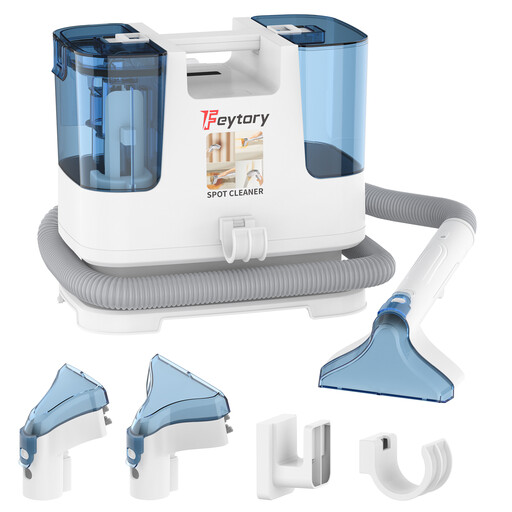
Portable spot cleaner, 15 kPa, 0.6 l and 1.5 l tanks
The stated uses for sofas and stains make it suitable for spot-cleaning an appropriate upholstered seat.
The product name lists 0.6 l and 1.5 l tanks. The description mentions a flexible hose, a large brush head and a small spray nozzle.
View at Joybuy
 No image available
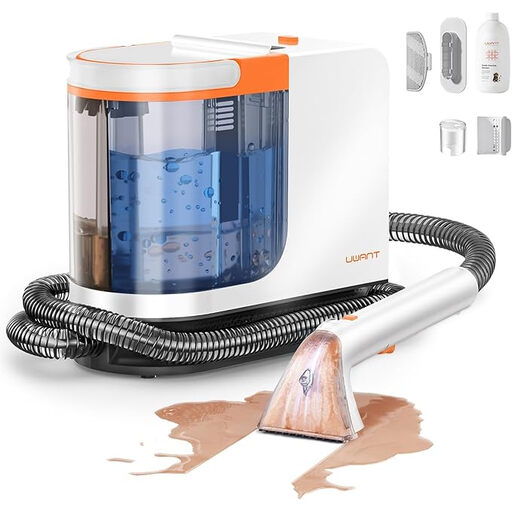
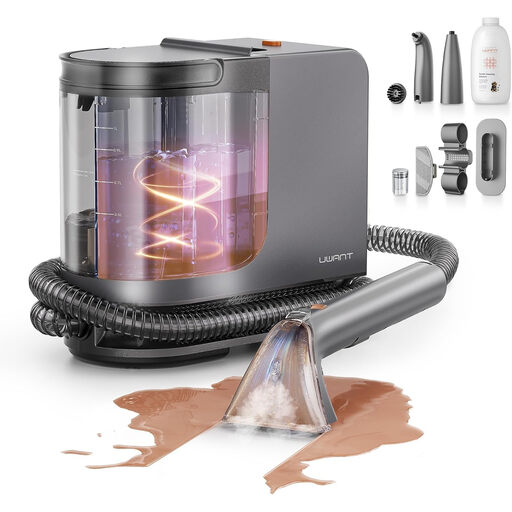
UWANT B300pro
The description lists upholstery, sofas and pet stains among its uses; first check whether your chair can be wet-cleaned.
The product name lists 18 kPa and self-cleaning. The description mentions a 14 cm brush head and an integrated tank design.
View at Joybuy
 No image available
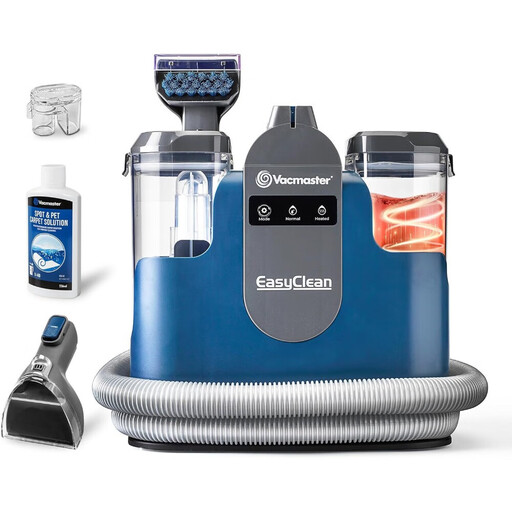
Vacmaster SCC1201H
The stated uses for upholstery and sofas make it suitable for spot-cleaning an appropriate chair seat.
The product name lists 500 W, 1.6 l and 0.95 l tanks, and a 1.8 m self-cleaning hose.
View at Joybuy
 No image available
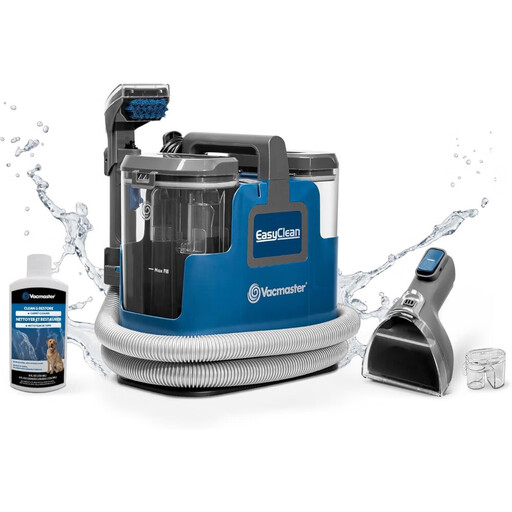
Vacmaster SCB0501
The description mentions sofas and pet stains; use the cleaner on a chair only if its fabric care instructions allow wet-cleaning.
The product name lists 500 W, 1.6 l and 0.95 l tanks, and a 1.8 m hose.
View at Joybuy
 No image available
UWANT B400 Multi Spot Cleaner, grey
The description mentions sofas and fabric surfaces; check whether wet-cleaning is suitable for your chair’s upholstery.
The product name lists 600 W and 18,000 Pa. The description mentions a 14 cm brush head and integrated water tanks.
View at Joybuy
Frequently asked questions
Can I clean any upholstered dining chair with a spot cleaner?
No, only if your chair’s care instructions allow wet-cleaning. BISSELL specifies W and WS codes for using its water-based upholstery cleaners; this doesn’t mean another code or an unknown fabric is suitable.
What should I do before and after cleaning a suitable seat?
First, remove loose hair and crumbs while dry, and check the chair’s instructions. After use, empty and clean the parts according to the machine’s instructions; follow the furniture manufacturer’s guidance on drying.
Do I need to buy cleaning solution separately?
That depends on the model, how much is included and the user instructions. Rowenta lists a 250 ml bottle as included with the IN3010 and recommends XD5310 for Clean It models; also check that the solution is suitable for your chair fabric.
Am I only entitled to a two-year legal guarantee in the Netherlands?
No. According to the Dutch government, there is no fixed statutory guarantee period in the Netherlands; what you can expect from a product depends, among other things, on the product and its price. If a product is faulty, contact the seller.
Do I have a cooling-off period when I buy online from a business?
According to the Dutch government, in many cases you have 14 days to change your mind when buying at a distance, although there are exceptions. Check the terms that apply to the product before you buy.


