Which blender is right for you?

One smoothie to take with you

If you want to make a single portion during your lunch break and take it with you, a blending cup that doubles as a drinking cup means you won’t need to pour your smoothie into another container. The Consumers’ Association gives this as a reason to consider a smoothie blender; check whether the model comes with a suitable drinking lid.

Pouring from a blender jug at home

If you drink your smoothie at home or sometimes make several portions, compare the jug’s usable capacity with the space the appliance takes up. The Consumers’ Association notes that you can also make smoothies in a standard blender.

Smoothies with frozen fruit

If you regularly use frozen ingredients or ice, check that the specific model is suitable and follow its instructions. A higher wattage alone doesn’t tell you how well it will blend a particular recipe.

What should you look for when choosing?

Blender with a travel cup

Choose this if: you want to make a single portion directly in the cup and take it with you.

Keep in mind: a small cup may not suit you if you want to make several portions at once. Check the capacity and whether a drinking lid is included.

Standard blender with a jug

Choose this if: you’ll be pouring your smoothie at home, need more capacity or want to use the blender for other blending tasks too.

Keep in mind: you’ll need to pour your smoothie into another container to take it with you. Compare the jug’s usable capacity, not just its maximum capacity.

What to consider What should you check? Who is this important for?
Taking one portion with you Check the cup capacity, the drinking lid and which parts are included in the box. If I want to drink my smoothie straight from the blending cup during my lunch break, I don’t want to pour it into another container first. Around 38% of consumers say taking one portion with them is their main requirement.
Capacity for home use Compare the jug’s usable capacity with its maximum capacity and the amount you want to make. If you sometimes make more than one glass at home, what matters most is how much you can actually blend. Around 25% of consumers prioritise pouring their smoothie or making several portions.
Frozen ingredients Check whether the specific model can handle ice or frozen fruit, and follow the instructions. If I regularly add ice or frozen fruit, I want to know whether the blender is designed for it. Around 25% of consumers name this as their main requirement.
Cleaning Check which parts can be removed and which the manufacturer says are dishwasher-safe. If I use my blender regularly, I want to spend as little time as possible washing up by hand after my break. Around 12% of consumers prioritise easy cleaning.

Avoid common buying mistakes

  • Confusing maximum jug capacity with usable capacity

    The maximum capacity doesn’t always tell you how much you can prepare in one go. Philips lists a maximum capacity of 1,9 l and a usable capacity of 1 l for the HR2041/00.

    Compare the usable capacity of the specific model with the number of glasses you want to make.

  • Assuming more wattage will blend fresh kiwi better

    A higher wattage alone doesn’t prove how smooth your smoothie will be. The Consumers’ Association says that a standard blender can make smoothies; features for tougher ingredients are mainly relevant if you use those ingredients.

    Choose based on your portion size and ingredients. Check the instructions for ice or frozen fruit if you want to add them.

  • Assuming a blending cup comes with everything you need to take it with you

    Whether you can take your smoothie with you straight away depends on the accessories supplied with the model. A cup doesn’t necessarily come with a suitable drinking lid.

    Check what’s included in the box and whether the lid fits the cup.

Brands to consider

Bosch

According to Bosch, the VitaPower Serie 2 MMB2111S is a mini blender with a 0,6 l blending cup.

  • Bosch says you can blend directly in the To Go Bottle and that the parts are dishwasher-safe.
  • This model has one speed setting, and the cup capacity may not suit every portion size.

Philips

The 3000 Series HR2041/00 is a jug blender suitable for smoothies, among other things. Philips also makes smaller blender models.

  • Philips lists a pulse setting, 450 W and a usable capacity of 1 l for the HR2041/00, with a maximum capacity of 1,9 l.
  • The jug isn’t a drinking cup, and wattage alone doesn’t prove that it will make a better smoothie from fresh kiwi.

Tefal

Tefal describes the Blend Up BL19H4F0 as a compact appliance that comes with two travel bottles.

  • Tefal lists 400 ml and 700 ml bottles, a cleaning programme and removable blades.
  • The eight programmes and 1000 W listed are product specifications, not proof that they’re needed to make a smoothie from fresh kiwi.

Nutribullet

Nutribullet describes the Original 600 as a personal blender for small portions.

  • Nutribullet describes the model as compact and easy to clean.
  • The claim that it produces a smooth blend comes from the manufacturer and isn’t an independent comparative test.

Jug blenders at Joybuy

These products are standard jug blenders for home use: a suitable choice if you’ll be pouring your kiwi smoothie into a glass. Compare capacity and features, as well as the parts you’ll want to clean after use.

Emerio BL-124816.7 blender with a 1,5 l jug

Emerio BL-124816.7 blender, 1,5 l

A jug blender for making smoothies at home, with parts you can clean in the dishwasher after use.

The product description lists a 1,5 l jug, two speeds and a pulse function. It says that the jug, lid and blades are dishwasher-safe.

View at Joybuy

ochama multifunction blender, 600 W and 1,5 l

ochama multifunction blender, 600 W, 1,5 l

A jug blender for home use. The product title also mentions ice crushing if you’d like to try that as well as fresh kiwi.

The title lists 600 W, 1,5 l and three speeds. Check the instructions before blending ice or frozen ingredients.

View at Joybuy

Philips 3000 Series Mini Blender HR2510/90, 0,6 l

Philips 3000 Series Mini Blender HR2510/90

The product description mentions soft, juicy fruit and smoothies. The jug capacity suits anyone looking to make a smaller amount.

The title lists 0,6 l and 350 W. The product description mentions two speeds, a pulse function and removable, dishwasher-safe parts.

View at Joybuy

Philips 3000 Series Blender HR2041/00, 450 W

Philips 3000 Series Blender HR2041/00

A jug blender for home use; the product description mentions smoothies and ice crushing. Its usable capacity matters if you’re making several portions.

Philips lists a usable capacity of 1 l and a maximum capacity of 1,9 l, with one speed setting and a pulse setting. The product description also mentions ice crushing.

View at Joybuy
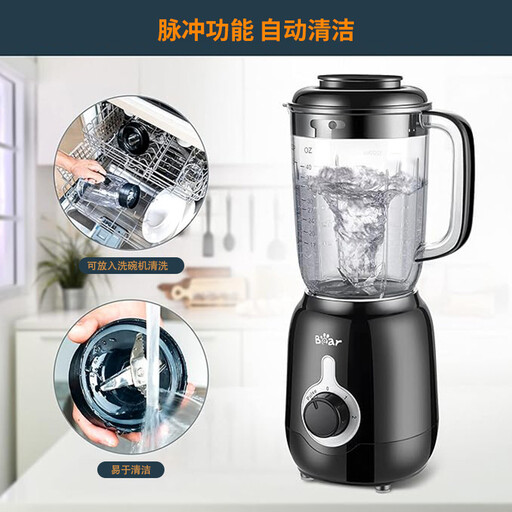
Bear Table Blender LLJ-B12K1, 1,2 l and 500 W

Bear Table Blender LLJ-B12K1

A jug blender for home use; the product description mentions smoothies and a 1,2 l jug.

The title lists 500 W, two speeds, a pulse function and four stainless steel blades.

View at Joybuy

Frequently asked questions

Do I need a high-powered blender to make a smoothie from fresh kiwi?

Not just to make a smoothie: according to the Consumers’ Association, a standard blender can make smoothies too. Choose based on your portion size and ingredients, and check the instructions if you’re using ice or frozen fruit.

How do I clean the blender after use?

Follow the manual for the specific model and check which parts can be removed and are dishwasher-safe. Bosch says this applies to parts of the MMB2111S; Tefal lists dishwasher-safe bottles for the BL19H4F0.

How long can I keep a fruit smoothie?

The Netherlands Nutrition Centre recommends keeping an opened fruit smoothie in the fridge for 1–2 days. This isn’t a guarantee for every homemade smoothie.

What are my rights if my blender bought online doesn’t work properly?

If a product is faulty, the seller is your point of contact for a solution in the Netherlands, according to the Dutch government. Online purchases from a business also usually come with a 14-day cooling-off period, although terms and exceptions may apply.

Which product safety rule applies to blenders in the Netherlands?

According to the Netherlands Food and Consumer Product Safety Authority, CE marking is compulsory for electrical products. A mention on a shop page doesn’t, by itself, verify the marking or compliance of a specific item.
