
Cook with limited worktop space
Wants to grind pepper at the table or while cooking, without leaving a large appliance on the worktop. Compares the mill’s dimensions to find one that fits.


If worktop space is limited, a compact manual mill is usually the best choice. An electric mill is worth considering if you want to grind with one hand and don’t mind the extra height and battery power. Compare the dimensions and grind settings of the exact model, and check the product information on food contact before you buy.
Wants to grind pepper at the table or while cooking, without leaving a large appliance on the worktop. Compares the mill’s dimensions to find one that fits.
Wants to grind pepper while cooking with the other hand, and weighs up the convenience against the size and battery power.
Switches between fine and coarse pepper, and looks for an adjustable grinding mechanism and guidance on what the mill can be used for.
Best for: limited space and grinding small amounts of pepper while cooking or at the table.
Trade-off: you turn the mill yourself. Check its diameter and how easy it is to handle, not just its height.
Best for: when one-handed operation matters more to you than keeping the mill as small as possible.
Trade-off: bear in mind that it needs batteries and takes up more space vertically.
| Buying consideration | What to look for | Who should consider this? |
|---|---|---|
| Storage space and footprint | Compare the mill’s height and diameter with the space where you plan to keep or store it. | I want the mill to fit in my limited worktop or cupboard space. Around 36% of consumers in these buying scenarios focus mainly on dimensions. |
| Using it while cooking | Check how it operates, its dimensions and whether the model needs batteries. | If my other hand is busy, one-handed grinding matters more to me than getting the smallest possible mill. Around 29% of consumers in these buying scenarios focus mainly on this convenience. |
| Grind setting and suitable contents | Check whether you can adjust the grind and which peppercorns or other contents are suitable. | I want to switch between fine and coarse grinds and know what the grinding mechanism is designed for. Around 21% of consumers in these buying scenarios are mainly looking for control over the grind. |
| Maintenance and running costs | Read the cleaning instructions and check whether the model needs batteries. | I want to know in advance how to maintain the mill and whether I’ll need batteries. Around 14% of consumers in these buying scenarios focus mainly on maintenance and running costs. |
The diameter, space needed to operate it, and room for refilling or storage also determine whether a mill will fit.
Measure the space available and compare it with the product dimensions. Don’t use the packaging dimensions as a substitute.
What a mill is designed to grind, and the requirements for the size of the grains, can vary by model.
Check the information and instructions for the exact mill before adding salt or other spices. WMF lists salt and spices as suitable for the Mini; Zassenhaus lists pepper, salt and certain dried herbs for the acrylic Berlin.
One-handed operation is convenient, but you’ll still need to consider the batteries and allow enough vertical storage space.
Check the battery requirements and dimensions of the exact model.
A manufacturer’s warranty on a part is separate from your statutory rights. The Dutch government states that there is no fixed statutory warranty period in the Netherlands.
Read the manufacturer’s warranty terms. If there’s a fault, contact the seller.
According to WMF, the manual Mini 0648199990 is designed for pepper, salt and spices.
The manual Bali Fonte is a compact mill designed for pepper. The blue cast-iron version reviewed is 8 cm high, according to Peugeot.
According to the manufacturer, the acrylic Berlin is 12 cm high and 5.3 cm in diameter.
The electric Battersea is an option if one-handed operation is important to you.
This selection features manual pepper mills for anyone who wants to grind pepper with a mill that fits the space available. Compare the dimensions and information for each version, and check the product information on food contact before choosing. According to the Netherlands Food and Consumer Product Safety Authority, articles intended to come into contact with food must comply with the Dutch Commodities Act Decree on Packaging and Consumer Articles, as well as the applicable European requirements.
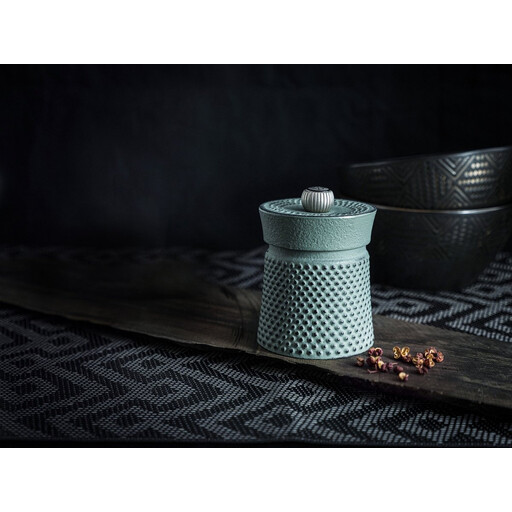 No image available
A manual mill for grinding pepper. Compare its stated height with your storage space.
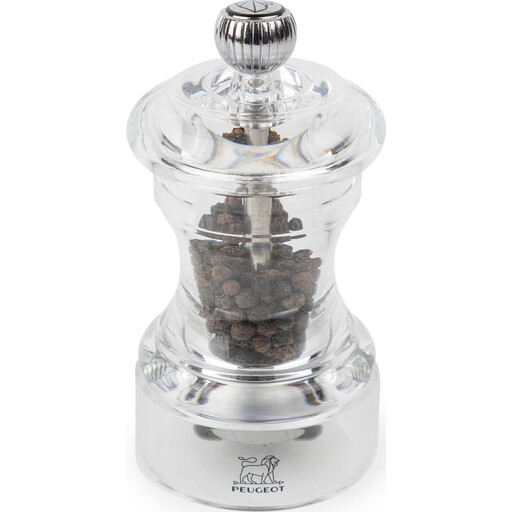 No image available
A manual pepper mill to compare if you’re looking for a version that takes up little storage space.
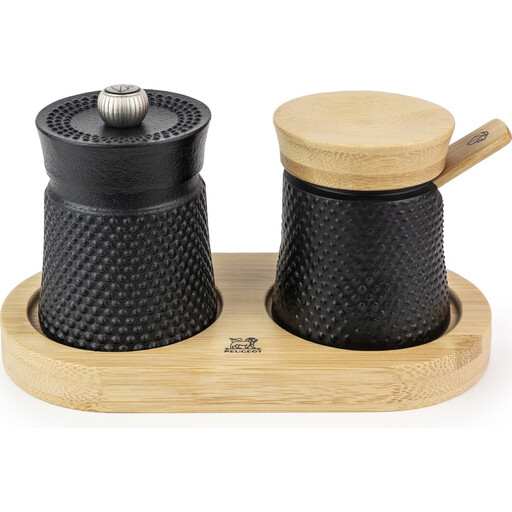 No image available
This set combines a manual pepper mill with a salt cellar. Check that both parts suit your needs.
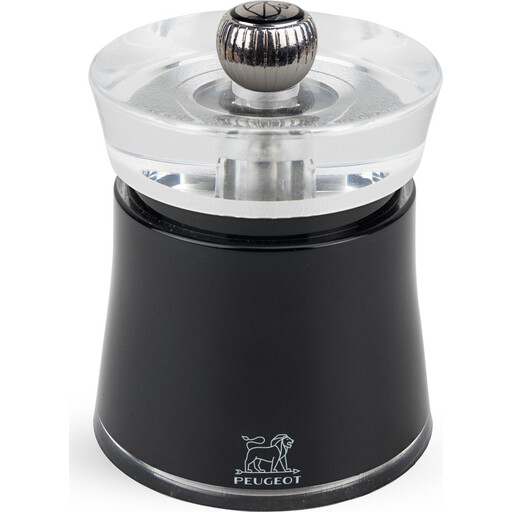 No image available
A manual version to compare if you’re looking for a compact pepper mill. Measure the space where you plan to use or store it.
 No image available
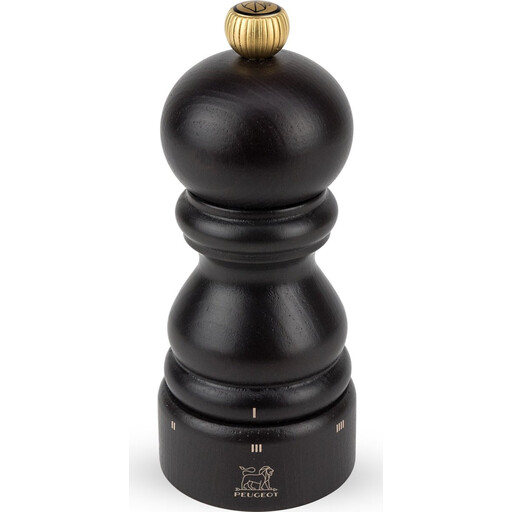
A manual mill to compare if you have room for its stated height of 12 cm.
Only if the information for the exact model says you can. WMF explicitly lists salt as suitable for the Mini, and Zassenhaus does so for the acrylic Berlin reviewed here. For other mills, check what the grinding mechanism is designed for and read the instructions.
Follow the instructions for your specific model. Cole & Mason recommends using a dry brush or soft, dry cloth on the grinding mechanism of its pepper mills. According to the product specifications, the WMF Mini is not dishwasher-safe.
When you buy from a business at a distance, you can usually change your mind within 14 days, according to the Dutch government. You also have a statutory guarantee that the product must be as it should be. The Netherlands has no fixed statutory warranty period, and you should contact the seller if there’s a fault. A manufacturer’s warranty is separate.
According to the Netherlands Food and Consumer Product Safety Authority, articles intended to come into contact with food must comply with the Dutch Commodities Act Decree on Packaging and Consumer Articles, as well as the applicable European requirements for food-contact materials. Check the product information for the specific mill.
A CE marking is required when the harmonised EU rules that apply to a product say it must have one. Check which requirements apply to the exact electric model. A CE logo is not an independent quality test.