
If you want to make a thick dip
You want a thick pepper dip for a get-together and don’t want to rely on adding lots of liquid. Consumentenbond points out that blenders may be less suitable for thick ingredients and small quantities.


For a small batch of thick pepper dip, a stick blender with a suitable chopper attachment or a compact food processor is a better choice than a large jug blender. For several servings that are liquid enough, a jug blender may be more practical. If you want to keep pieces of pepper or herbs in the dip, look for a chopping blade and pulse function. Check the usable capacity, included accessories and relevant product information for the model you choose.
You want a thick pepper dip for a get-together and don’t want to rely on adding lots of liquid. Consumentenbond points out that blenders may be less suitable for thick ingredients and small quantities.
You want to prepare several servings at once, choosing a bowl or jug based on both the quantity and the texture you’re after. Manufacturers sometimes list different capacities for the same bowl, such as for solid ingredients and liquids.
You want to chop peppers, herbs or other ingredients without puréeing everything until smooth. Look for a chopping blade and, if you want to control the texture yourself, a pulse function.
First, decide how much dip you want to make at once and how coarse or smooth it should be. Then choose an appliance with the right capacity and accessories for the job.
Best for: puréeing a smaller quantity, with minimal worktop space and washing-up.
Bear in mind: a very thick mixture can be difficult to process, and the chopper attachment has its own capacity.
Best for: several servings of smooth dip, provided the mixture is liquid enough to circulate.
Bear in mind: it may be less suitable for a small, thick batch. A jug blender generally takes up more space and creates more washing-up than a stick blender, according to Consumentenbond.
Best for: chopping or pulsing ingredients when you want to keep a coarser texture.
Bear in mind: extra bowls and accessories take up storage space and need cleaning.
| What to consider | What to look for | Who it matters to |
|---|---|---|
| Thick dip | Check whether the appliance is suitable for a small, thick batch and whether it comes with a chopper attachment. | I want to make a thick dip without adding lots of extra liquid. Consumers who prioritise thick dip account for around 40% of those choosing an appliance for this purpose. |
| Quantity | Check the usable capacity for both liquid and thicker preparations in the documentation for the exact model. | When I’m cooking for guests, I want to know whether everything will fit at once. Consumers who prioritise batch size account for around 30% of those choosing an appliance for this purpose. |
| Texture | Check whether the exact model has a chopping blade and pulse function if you want to keep some pieces in your dip. | I want to choose between a chunky texture and a smooth purée. Consumers who mainly want to control the texture account for around 20% of those choosing an appliance for this purpose. |
| Cleaning and storage | Check the cleaning instructions for each part and think about which accessories you’ll actually use. | After a get-together, I don’t want to wash up more parts than necessary. Consumers who prioritise easy cleaning and storage account for around 10% of those choosing an appliance for this purpose. |
Consumentenbond lists small or thick preparations as situations where a blender may be less suitable.
First, decide how much you’re making and how thick you want it. Then compare a stick blender with a suitable chopper attachment against a compact food processor.
For the Kenwood FDP31.360GY, the manufacturer lists a 2.1 l bowl and a 1.2 l capacity for liquids. These figures aren’t interchangeable.
Check the fill limits and instructions for the exact model and the preparation you want to make.
Consumentenbond distinguishes between stick blenders for puréeing and versions that come with a chopper attachment.
Before buying, check the full model code and the accessories included with that version.
MultiQuick stick blenders may suit you if you want to purée ingredients and, depending on the version, use a chopper attachment too.
According to Kenwood, the MultiPro Compact FDP31.360GY combines a food processor and a blender.
The MultiTalent 3 MCM3401M is a food processor option for chopping, mixing and pulsing.
The 5000 Series HR2685/00 is a stick blender option if you want to purée ingredients.
This selection includes stick blenders with chopping options and choppers for puréeing, chopping or preparing ingredients in batches for a dip. Check the parts included with the exact model and make sure its capacity suits your recipe.
 No image available
The product name describes a stick blender set with a chopper and whisk. Check which parts are included with this version.
 No image available
The product name lists two glass bowls, handy for preparing different quantities of ingredients.
The product name specifies 2 l and 0.6 l bowls and a power rating of 300 W.
 No image available
Suitable if you’re looking for a stick blender to purée ingredients for a dip. Check which accessories come with this version before buying.
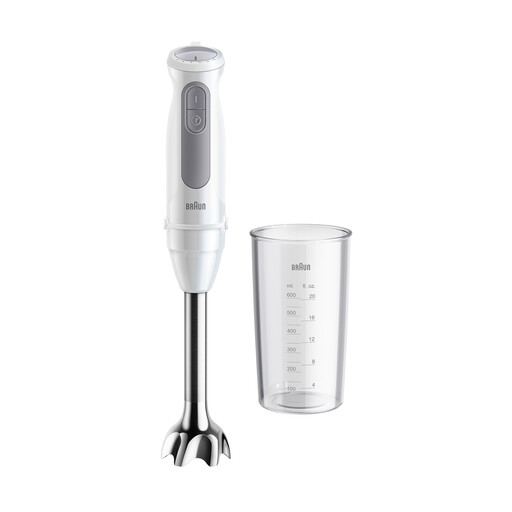 No image available
The product name identifies this as a stick blender. Check that this version suits the quantity you’re making and comes with the accessories you need.
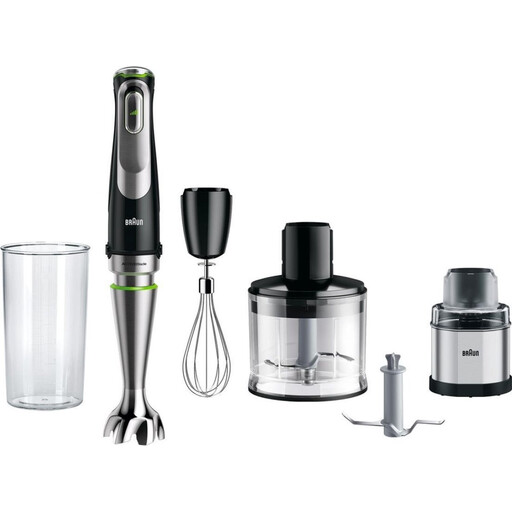 No image available
A good fit if you’re looking for a stick blender and also want to chop ingredients. Braun lists a 500 ml chopper attachment for this model; check the capacity of the set you choose.
Let hot ingredients cool slightly first. According to Consumentenbond, this allows steam to escape and helps prevent the appliance from overheating. Also follow the appliance’s temperature and filling instructions.
Voedingscentrum advises covering leftovers and putting them in the fridge within 2 hours of preparation. Keep your fridge at 4 °C and store leftovers in the fridge for no more than 2 days. Let hot food cool first, but don’t exceed the 2-hour limit.
Contact the seller. According to the Dutch government, the seller must provide a solution if there’s a problem under the legal guarantee. A manufacturer’s guarantee is separate and doesn’t replace this right.
According to the Netherlands Food and Consumer Product Safety Authority, CE marking is compulsory for electrical products placed on the market in the Netherlands. The electrical safety rules that apply also depend on the rated voltage. Parts intended to come into contact with food are also subject to Dutch and European rules on food contact materials. A statement on an online shop page doesn’t, by itself, prove that a specific model meets these requirements.
Not always. According to the Dutch government, in many cases you have 14 days to change your mind when buying online from a business, but there are exceptions. Check the seller’s information for your specific purchase.