
Vandaag of morgen in huis

Kwaliteit gegarandeerd

Welkomstaanbiedingen ontgrendelen: GRATIS bezorging | Tot 80% korting | Gratis 30 dagen JoyPlus-proefperiode
Download de app
A set of pens and markers may seem straightforward to choose: pick a colour and check how many pens are included. Yet many people end up buying a set that is unsuitable for their paper, writing purpose or frequency of use. A highlighter for a textbook, for example, works differently from an acrylic marker for glass or a brush pen for hand lettering.
As a Joybuy Product Recommendation Officer, I focus primarily on verifiable product information: ink type, nib shape, line width, surface, number of colours and care requirements. This helps prevent you from buying a marker that dries out quickly, bleeds through the paper or turns out to be unsuitable for your creative project.
A marker set with 50 colours sounds appealing, but more colours do not automatically mean the set is a better match for you. For everyday highlighting, four to eight carefully chosen highlighters are often enough. For drawing or colouring, a wider selection is more useful.
So check the following:
Water-based ink is commonly used in highlighters, fineliners and colouring pens. This ink is generally suitable for paper and, with some products, can be removed with water. That does not mean every mark will disappear completely from every type of fabric. Faber-Castell brush pens, for example, state that their ink is based on food colourings and is washable; follow the care instructions and treat stains as quickly as possible.
Alcohol markers dry quickly and are suitable for sketching and colour gradients, but they can bleed through thin paper. Acrylic markers are designed for surfaces such as wood, glass, ceramics or canvas, but often need to be activated first by shaking and pumping.
A round fibre tip is practical for consistent lines. A chisel tip usually offers two widths. A brush tip responds to the pressure of your hand, allowing you to create thin and thick lines.
Pay attention to the technical specification:
Choose a water-based marker for lots of paper-based tasks, school use and simple drawing projects. When choosing colouring pens for children, check whether the ink is washable. The product information remains the deciding factor: “washable” does not guarantee that every mark will disappear from every fabric.
Acrylic markers are more practical for non-porous or robust surfaces. According to the product specifications, the Faber-Castell Acrylic Marker Sets contain water-based acrylic ink and are suitable for paper, metal, ceramics, plastic, glass, textiles, stone, canvas and wood, among other surfaces. Test the marker on an inconspicuous area first, as adhesion and finish can vary depending on the material.
For highlighters, a chisel tip and two line widths are useful. According to the product information, STABILO BOSS ORIGINAL models have a 2 and 5 mm chisel tip. The STABILO swing cool uses a 1 and 4 mm tip, allowing you to underline text and highlight wider passages.
Fineliners are suitable for precise notes. The STABILO point 88 has a metal-clad tip and a line width of 0.4 mm. This makes it practical for diaries, charts, templates and drawings.
For children’s products, check the stated age recommendation, ventilated caps and any available quality information. Some sets list CE or EN 71 in their product details. Always check the warnings on the packaging as well. Small caps and parts are not suitable for young children.
Replace the cap firmly after use. Claims about how long pens can remain uncapped, such as “up to four hours” or “up to eight weeks”, are brand product specifications and not a guarantee for every situation. Temperature, storage conditions and usage all affect the product’s lifespan.
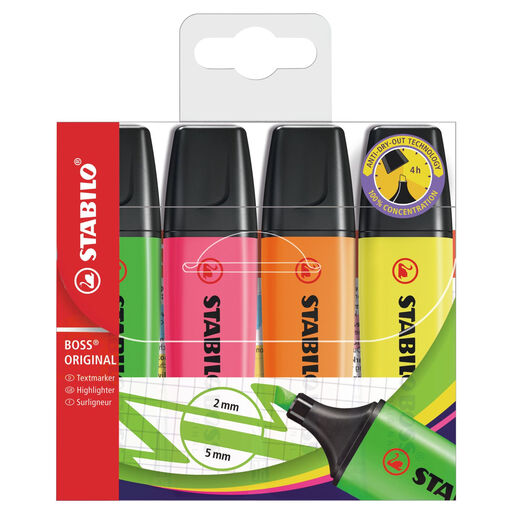
Why it suits this profile: This set contains four colours for diaries, schoolbooks and notes. The chisel tip provides lines from 2 to 5 mm.
You are not paying for a large number of colours that you may rarely use. The water-based ink and two line widths are clearly specified.
Set of 4, 2–5 mm chisel tip and fluorescent-coloured water-based ink.
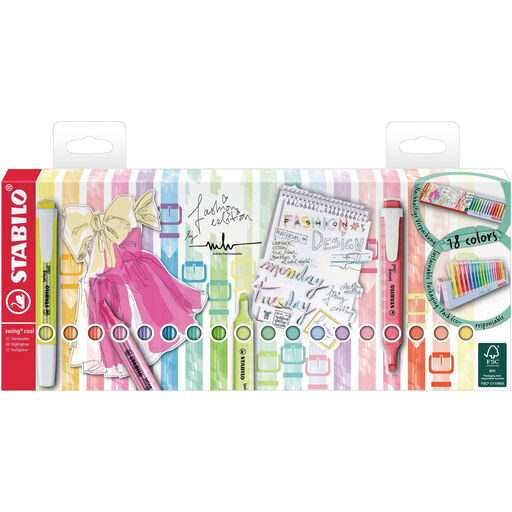
Why it suits this profile: For students, planners and office workers who want to combine neon and pastel highlighters in one desk set-up.
The set specifies the full number of colours, the water-based ink and the two line widths of 1 and 4 mm.
Desk set of 18, slim pocket model with clip and 1/4 mm tip for highlighting and underlining.

Why it suits this profile: For hobbyists and makers who want to work on multiple materials with metallic acrylic markers.
The suitable surfaces are described clearly. The marker also has an activation procedure and an ink-level indicator.
6 metallic colours, water-based acrylic ink and two tips measuring 1 and 3 mm.
We have compiled a complete, up-to-date list of products that fully meet these strict selection criteria and the applicable European safety regulations.
Choose a set with a stated minimum age, ventilated caps and clear information about the ink. Washable pens can be practical at home or school, but always check the washing instructions. Do not use markers with small caps with children below the recommended age.
Replace the cap immediately after use and check that it closes securely. Store the set away from direct sunlight and extreme heat. According to certain product specifications, fineliners and highlighters can remain uncapped for a while, but keeping them capped will generally extend their usable life.
Highlighters are designed to make text stand out, usually with a chisel tip. Fineliners have a fine tip for precise writing and drawing. Brush pens have a flexible tip that allows you to create thin and thick lines by varying the pressure. So choose the intended use first, then compare the colour, quantity and ink type.
