
Vandaag of morgen in huis

Kwaliteit gegarandeerd

Welkomstaanbiedingen ontgrendelen: GRATIS bezorging | Tot 80% korting | Gratis 30 dagen JoyPlus-proefperiode
Download de app
A set of pens and markers may seem straightforward to choose. However, it is easy to end up with the wrong product. For example, a pen set that appears to offer lots of colours in the product photo may mainly contain very similar shades. And a broad marker that seems suitable for everything will not necessarily work well for small details or thin paper.
As a Joybuy Product Recommendation Officer, I filter the most important product information according to how each item is used. This makes it easier to see which features are relevant for school, the office, journaling, drawing or crafts.
A set of 50 markers sounds appealing, but also check the range of colours. Lots of different shades are useful for colouring books. For notes, a set of 8 or 10 carefully selected colours may be more organised. Also check the colour coding on the caps and whether the set comes in a box or case.
A 0.4 mm fineliner is suitable for small lettering, diagrams and details. A 0.7 mm gel pen generally produces clearer writing for everyday use. For large areas of colour, a fibre-tip pen with a nib of around 1 to 3 mm is more practical. If you buy without making this distinction, you may end up using a broad nib for precise work or a fine nib for large areas.
Water-based ink is mainly intended for paper and card. Alcohol markers can bleed through thin paper and often require marker paper or a protective sheet. According to the product description, acrylic markers are designed for use on various surfaces, but adhesion and coverage can vary from one surface to another. Always test the marker on a scrap piece first.
Check the following before buying:
A metal-encased nib, as found on some STABILO pens, is useful when working with a ruler or stencil. With brush pens, the flexibility of the nib is particularly important for hand lettering and creating lines of varying width.
The ink determines how the pen behaves:
For children’s products, markings such as CE and EN 71 are useful points to check. CE is a conformity mark; it is not a general quality ranking. EN 71 refers to European safety requirements for toys. Also check the recommended minimum age and keep small parts away from children under 3 years old.
Close pens and markers securely after use. According to the product information, fineliners are best stored horizontally, while alcohol markers should be kept with their caps firmly closed. Direct sunlight and extreme temperatures can affect the ink. Washable ink can make it easier to clean hands or clothing, but always follow the instructions on the packaging and treat stains as quickly as possible.
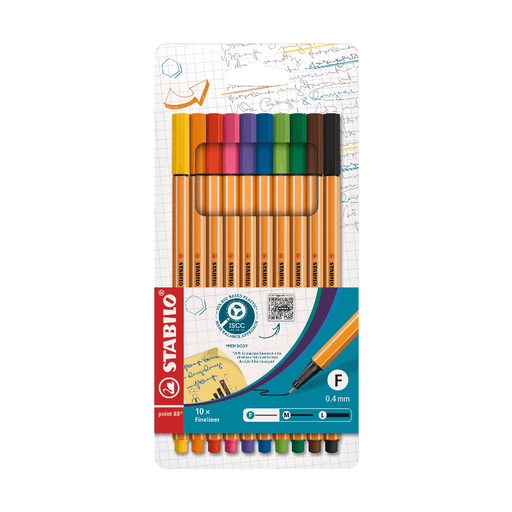
Why it suits this profile: A compact set for school pupils, students and anyone who wants to add colour to their notes without immediately buying a large collection.
The 0.4 mm nib makes the difference between adding colour and making text illegible. The set contains 10 different colours in resealable packaging.
Water-based ink, a metal nib and suitable for writing, drawing and working with a ruler or stencil.
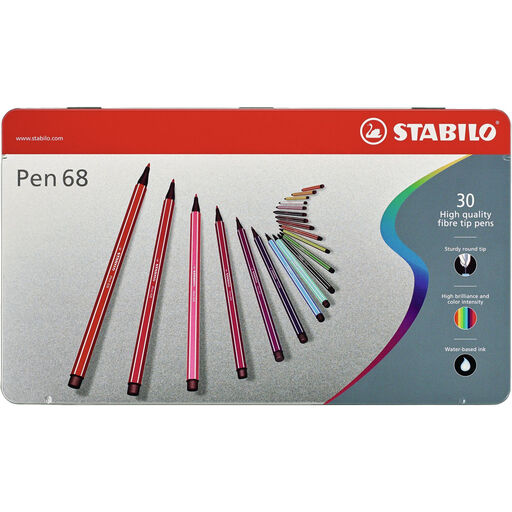
Why it suits this profile: For artists, journaling enthusiasts and creative users looking for a wide selection of colours and a robust fibre tip.
The approximately 1 mm nib is more versatile than an extra-broad marker. According to the product information, the water-based ink can be blended with water, so thicker paper is advisable.
30 assorted colours, a pressure-resistant nib and the option to blend colours with water according to the product description.

Why it suits this profile: Designed for sketches, illustrations and colouring projects that require both broad strokes and small details.
The combination of a flexible 1 to 5 mm brush tip and a 0.6 mm fineliner tip means you do not have to use one nib for every detail.
24 alcohol markers with two nib types; according to the product description, the ink is quick-drying and permanent once dry.

Why it suits this profile: For hobbyists who want to decorate wood, glass, ceramic, canvas or plastic as well as paper.
The product description explicitly lists multiple surfaces and two nib sizes. Activate the markers as instructed by shaking them and pumping the nib.
6 colours, water-based acrylic ink, an ink-level indicator and a 1 mm nib plus a 3 mm nib.
We have put together a complete, up-to-date list of products that fully meet these strict selection criteria and the applicable European safety regulations.
For journaling, fineliners and gel pens with a nib size of 0.4 to 0.7 mm are practical. A fineliner is useful for small borders and lettering. A gel pen is ideal for smooth writing and colour coding. Test dark or highly pigmented ink on the paper first to check whether it bleeds through.
Replace the cap immediately after use and store the set according to the product instructions. Fineliners generally remain usable for longer when stored horizontally. With capped markers, a secure seal is particularly important. Do not leave a pen uncapped for long periods, even if the manufacturer states that it has a longer open time.
A set of coloured pens is often practical when you need several colours at the same time. Individual pens are more convenient when only one colour has run out or when you are looking for a specific nib size. Do not compare only the number of items; also consider the ink type, nib, packaging and suitability for your paper or surface.
