
Vandaag of morgen in huis

Kwaliteit gegarandeerd

Welkomstaanbiedingen ontgrendelen: GRATIS bezorging | Tot 80% korting | Gratis 30 dagen JoyPlus-proefperiode
Download de app
A set of pens and markers might seem simple to choose, until you discover that not every pen is suitable for the same surface or purpose. A highlighter for your textbook works differently from an acrylic marker for glass. And a cheap set with lots of colours can be less practical if the tips dry out quickly or the ink isn't washable.
So don't just focus on colour and quantity. The tip shape, ink base and suitability for the surface determine whether your purchase matches how you'll use it.
A set of 20, 30 or 50 pens sounds appealing. Yet colours aren't the only thing that matters. For hand lettering, for example, you need a flexible brush pen. For large areas, a broader felt-tip pen is more practical. When highlighting in textbooks, two writing widths and a light ink colour are what you really need.
So check before you buy:
With washable pens, this usually means that, according to the product description, the ink can be removed from hands or most fabrics. That result depends on the fabric, the drying time and the washing method. So don't see it as a guarantee that every stain will disappear completely.
For example, the Faber-Castell felt-tip pens for children are described as washable from hands and skin. With the Brush Pen Set Black Edition, it's stated that the ink is based on food colourings and is washable. With both products, it's still wise to treat stains quickly and test on an inconspicuous area first.
Permanent markers aren't automatically suitable for every material. A marker for overhead transparencies or smooth plastic can have different properties from an alcohol marker for sketching. Acrylic markers, on the other hand, are intended for creative applications on surfaces including wood, glass, ceramic, metal and canvas, according to the product information.
So pay attention to the difference between:
Water-based ink is common with highlighters, many felt-tip pens and brush pens. This ink is generally suitable for paper and can be washable with certain models. The Faber-Castell Duo Felt-Tip Pens use water-based ink that, according to the product description, can be washed from most fabrics.
Alcohol markers dry quickly and are often intended for illustrations and sketches. The Faber-Castell Goldfaber Sketch Marker Set has alcohol-based ink, a brush tip of 1 to 5 mm and a fineliner tip of 0.6 mm. According to the product description, the ink is water-resistant and permanent once dry. So use these markers on suitable drawing paper and be aware of bleed-through.
Acrylic ink is a paint-like ink. The Faber-Castell Acrylic Marker Set Black Edition contains water-based, opaque acrylic ink. The marker must be shaken before use and activated by pressing the tip down. Always test on a scrap piece of the material first.
A chisel tip is suitable for both broad markings and thinner lines. The STABILO BOSS ORIGINAL has, according to the product data, a chisel tip with writing widths of 2 and 5 mm. The STABILO swing cool combines 1 and 4 mm, which is handy for underlining and highlighting.
A brush tip responds to the pressure of your hand. This lets you create thin and thick lines for hand lettering, outlines and small drawings. A medium fibre tip is more practical for regular colouring and writing, especially for children.
For children's products, certifications and age information are useful checkpoints. EN 71 refers to European safety standards for toys. A CE marking indicates that the manufacturer declares the product meets relevant European requirements. Also check the recommended minimum age and look out for small parts, ventilation holes in caps and advice not to ingest ink.
A certification doesn't mean a marker is suitable for every application. Always also consider the surface, ink type and tip.
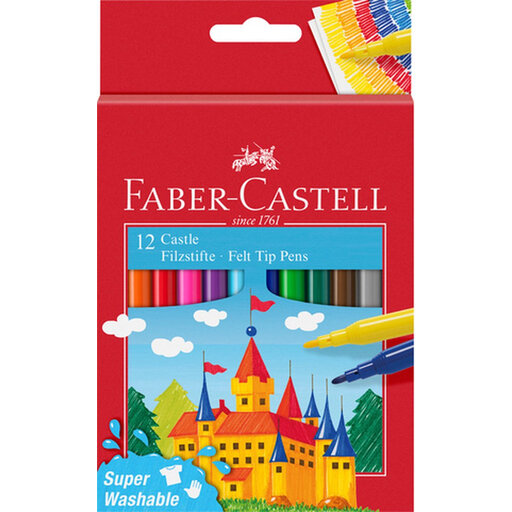
Why this fits the profile: A straightforward basic set for children and adults who mainly want to colour and draw on paper.
The count of 12 colours is clearly stated and the set is intended for paper, card and wood. So you don't buy a marker for the wrong surface.
Strong tip according to the product description, washable ink from hands and skin, and EN 71 certification.

Why this fits the profile: Aimed at artists and hobbyists who work with different line widths and colour areas.
The set specifies both a flexible brush tip and a fineliner tip of 0.6 mm. So you're not reliant on one universal tip.
24 colours, brush tip from 1 to 5 mm and alcohol-based ink that, according to the product description, is permanent once dry.

Why this fits the profile: For creative projects where you're not just working on paper, but also on surfaces like wood, glass, ceramic or canvas.
The suitable surfaces and the activation by shaking and pumping are clearly described. This prevents misuse of an ordinary felt-tip pen.
Six standard colours, opaque water-based acrylic ink, a tip of 1 and 3 mm and an ink level indicator.
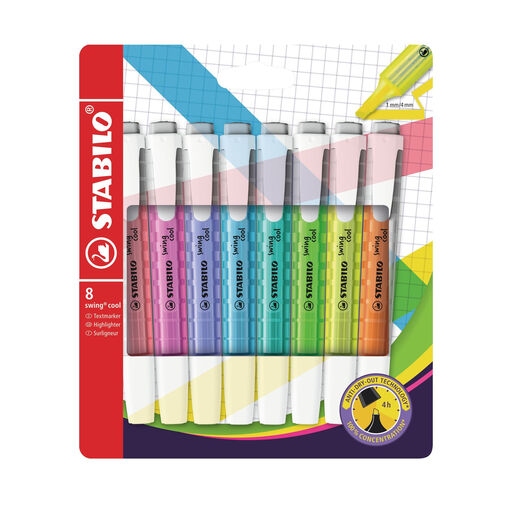
Why this fits the profile: Compact highlighters for diaries, textbooks, notes and everyday use on the go.
The set is specifically a highlighter and has two writing widths: 1 mm for underlining and 4 mm for highlighting.
Eight fluorescent colours, water-based ink, a clip and, according to STABILO, up to four hours' protection against drying out without the cap.
We've put together a full, up-to-date list of products that fully meet these strict selection criteria and current European safety regulations.
Look at the recommended minimum age, a sturdy tip, a ventilated cap and information about washability. The STABILO power has, according to the product description, a pressure-resistant medium tip and ink that can be washed from hands with water and soap. Faber-Castell also has sets with EN 71 or CE information. Always check the current packaging and usage instructions for each product.
Put the cap back on immediately after use and close it firmly. Store pens away from direct sunlight and extreme heat. Some models have a stated time during which they won't dry out without the cap, but treat this as a product specification and not a reason to leave the cap off routinely. Brush pens, highlighters and acrylic markers generally stay usable for longer when stored horizontally or according to the product instructions.
That depends on how often you use them and whether the set suits your application. A larger set isn't automatically better value if you mainly need a few colours. Look at the number of pens, the tip quality, the ink type and whether they're refillable. For daily highlighting, a compact set of highlighters may be enough; for drawing, a set with multiple tips and colour options can offer more versatility.
