
Retoucher at a hot desk
You want to edit photos with a pen and then put the tablet away or connect it to an available computer. With a screenless tablet, you look at the monitor as you draw, as Kieskeurig.nl explains.


A screenless pen tablet is a good fit if you want to work on your existing monitor and put the device away afterwards. A pen display makes more sense if you want to draw directly on the photo and have enough space and the right connections. If you’re using a shared computer, check whether you’re allowed to install drivers and use your preferred pen settings. Neither device replaces colour management when you need to assess a print accurately.
You want to edit photos with a pen and then put the tablet away or connect it to an available computer. With a screenless tablet, you look at the monitor as you draw, as Kieskeurig.nl explains.
You work on masks or local adjustments and want to use the pen directly on the image on screen. A pen display could suit you if you have room for an extra screen.
You want to assess retouches using a suitable monitor and printer workflow. Adobe describes monitor profiling, lighting conditions and paper as parts of colour management; pen input alone won’t determine how a print looks.
Choose this if: you want to work on your existing monitor and clear the desk when you’re finished.
Bear in mind: you look at the monitor while using the tablet; connections and settings vary by model.
Choose this if: you’d rather work directly on the image when making selections and masks.
Bear in mind: you’ll need space and suitable display and power connections. XPPen lists different connection options and possible additional requirements for the Artist 12 (2nd Gen).
For photo retouching at a shared desk, the available space, your preference for pen input and the computers you use are the main factors in deciding which option will work best.
| What to consider | What should you check? | Who is this important for? |
|---|---|---|
| Clearing your workspace | Compare the overall dimensions with the active area and decide whether you want to work on your existing monitor. | If I share a desk, I want to be able to put the tablet away after retouching rather than set up an extra screen. Around 36% of consumers prioritise a workspace that’s easy to clear. |
| Pen input | Check which buttons or other controls the exact model offers and whether its workflow suits your retouching. | When working on masks and local adjustments, I want the pen to feel comfortable to use rather than choosing a tablet based on pressure levels alone. Around 29% of consumers prioritise pen control for detailed retouching. |
| Colour before printing | Check your monitor profile and, where available, use soft proofing with suitable profiles. | When assessing prints, I don’t want to assume that a tablet will automatically make my colours accurate. Around 21% of consumers give top priority to assessing the finished print. |
| Switching between computers | Check the operating system and ports on each computer, and whether you’re allowed to install drivers. | When I work on different shared computers, I want to know in advance whether the connection and settings will work on each one. Around 14% of consumers prioritise switching between computers. |
Pen input helps you control edits, but it doesn’t determine on its own how a photo will look on paper. Your screen profile and viewing conditions also play a part.
Choose a pen tablet based on its controls and where you’ll use it. Assess print colour separately, using a suitable monitor profile and soft proofing.
A pen display needs a video signal and enough power; the connection method depends on the computer and model.
Compare the ports on the shared computer with the manual, and check which cables and power supply are included with the version you’re considering.
Depending on the connection method, you may need a suitable extra cable or power supply.
The name alone doesn’t tell you which generation or controls you’ll get. An older Wacom specification lists the PTH660 and Pro Pen 2; the 2025 Intuos Pro version is called PTK670K0B and lists the Pro Pen 3.
Before buying, check the full model number, pen and controls of the version on offer.
The Intuos Pro Medium PTK670K0B is a screenless pen tablet for image editing.
The Inspiroy 2 M is a screenless pen tablet with a scroller and programmable keys.
The Artist 12 (2nd Gen) is a pen display; the Deco Pro (Gen 2) is a separate range of screenless pen tablets.
The Pen Tablet Medium is a screenless pen tablet; a separate Bundle version is also available.
These product picks are pen tablets for retouching on your existing monitor, without adding a pen display to your shared desk.
 No image available
Ideal for retouching on your existing monitor with a wired pen tablet.
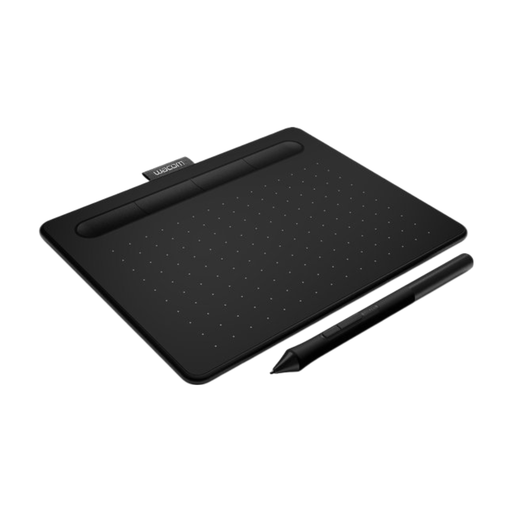
Active area: 216 × 135 mm. Wired USB connection; the product name lists 4,096 pressure levels.
 No image available
A pen tablet for retouching photos on your existing monitor. Check the full model number and controls of the generation on offer.
Size option: Medium.
 No image available
A good fit for pen work at a shared workspace if you’re looking for a compact size.
Size option: S. The product name lists Black.
 No image available
A small size option for working with a pen on your existing monitor.
Size option: Small.
No image available
A good fit for pen work on your existing monitor if you’re looking for the Small S version.
Size option: Small S.
No. A pen is an input device and doesn’t set print colours on its own. Adobe lists monitor profiling, controlled lighting conditions and soft proofing with suitable profiles as parts of the assessment; soft proofing still depends on your monitor and viewing conditions.
Not without checking the computer, cable and model. The XPPen Artist 12 (2nd Gen) manual describes different connection methods; a suitable USB-C cable is sold separately, and extra power may be needed in some situations. Also check whether you’re allowed to install the driver.
Compare what’s included with the exact version against your workspace: the cables and power supply you need may vary for a pen display. Quick Keys aren’t included with the standard Xencelabs Pen Tablet Medium; check whether you’re choosing the Pen Tablet Medium or the Bundle.
According to ACM ConsuWijzer, online consumer purchases often come with a 14-day cooling-off period from delivery, although exceptions may apply depending on the circumstances. If the product develops a fault sooner than you could reasonably expect with normal use, the seller is responsible for providing an appropriate solution under the statutory guarantee. In the Netherlands, there is no fixed general two-year limit for this.