
Making a single galette
You mainly want to know whether the pastry and pears will fit on the baking tray, and whether you can select the setting specified in your recipe.


If the holiday cottage already has an oven or a combi microwave with an oven function, first check whether its baking tray and settings suit your recipe; you may not need an extra appliance. If there isn’t a suitable oven, only choose a freestanding model if your bake will fit on the tray and you can position and connect the oven safely in line with the instructions. A compact model takes up less space, but you may need to bake in several batches.
You mainly want to know whether the pastry and pears will fit on the baking tray, and whether you can select the setting specified in your recipe.
You may be looking for a separate oven, but alongside its external dimensions, you’ll also need to allow the clearance specified in the instructions for your chosen model.
You want enough tray space for several small galettes or a larger batch, without overlooking the space needed for a bigger oven.
First check whether you can use the oven in the holiday cottage. Then compare the tray size and space needed for the appliance before looking at extra features.
When: if the cottage already has an oven or a combi microwave with an oven function, and its tray and settings suit your recipe.
Trade-off: you won’t need to find space for another appliance, but check which oven functions and accessories are available.
When: if there isn’t a suitable oven and you want to bake small galettes on a tray that fits.
Trade-off: compact external dimensions don’t automatically mean there’s enough room for baking or ventilation.
When: if you want to bake a larger galette or several portions at once, and have enough space to position it.
Trade-off: consider the usable baking tray and energy use, as well as the extra space the appliance takes up.
Rutger Bakt’s pear galette recipe uses six pastry circles, each about 12 cm across. So measure the usable baking tray: the oven’s capacity in litres doesn’t tell you how many bakes will fit on it at once.
| What to consider | What should you check? | Who is this important for? |
|---|---|---|
| Will the galette fit on the tray? | Measure the usable baking tray and compare it with your recipe and the number of bakes you want to prepare at once. | If I don’t want to bake in several batches, I’ll first check how many pastry circles will fit on the tray. Around 33% of consumers focus mainly on baking tray size and portion size. |
| Will the oven fit in the space? | Measure the space available, including the ventilation clearance specified in the instructions. Also check the socket and which appliances will be running at the same time. Brandweer Nederland advises plugging high-power appliances directly into a socket. | In a small holiday cottage, I want to know whether the oven will fit with the required clearance and can be connected to the available power supply. Around 27% of consumers put safe positioning and connection first. |
| Are the baking settings suitable for the recipe? | Compare the required temperature, oven setting and baking time with the model’s available settings and timer. | If I want to follow the baking time and temperature in my recipe, I’ll look for suitable settings and a timer that matches. Around 20% of consumers give baking controls their highest priority. |
| Is an extra oven worthwhile? | First check which oven functions and accessories are already available. Then compare how often you expect to use it and, where possible, the energy used per bake. | If the cottage already has a suitable oven, I don’t want to add a second appliance that I’ll hardly use. Around 20% of consumers focus mainly on whether an extra oven is worthwhile and how much they’ll use it. |
The usable baking tray determines whether your galette will fit and how many small bakes you can prepare at once.
Measure the tray and compare it with the dimensions and number of galettes in your recipe.
If the tray is too small, you may need to bake in several batches or find a separate tray that fits.
A freestanding oven may need extra space to release heat. The clearance specified in one model’s instructions won’t necessarily apply to another.
Measure the space, including the ventilation clearance specified in the instructions for the model you choose.
If there isn’t room for the required clearance, you may need to find somewhere else to position it.
The stated power rating alone doesn’t tell you how much energy one bake will use.
Only compare energy-use figures when they’re measured on the same basis, and choose a size that suits how you plan to use it.
The OV207B is a 20-litre freestanding oven with convection, separate top and bottom heat settings, and a baking tray included.
The TEO2101B is a 21-litre freestanding oven with three shelf positions and a baking tray included.
The OV-3622 is a 19-litre freestanding convection oven with top and bottom heating and a baking tray included.
The TO 2058 is a 42-litre freestanding baking and toast oven with convection and independently selectable top and bottom heat.
The 112701 is a 10-litre freestanding oven with top and bottom heating and a baking tray included.
These Joybuy products are freestanding ovens for baking, from compact models to larger options. Before choosing, check that the baking tray or tin will fit and that you can position the oven with the required clearance.
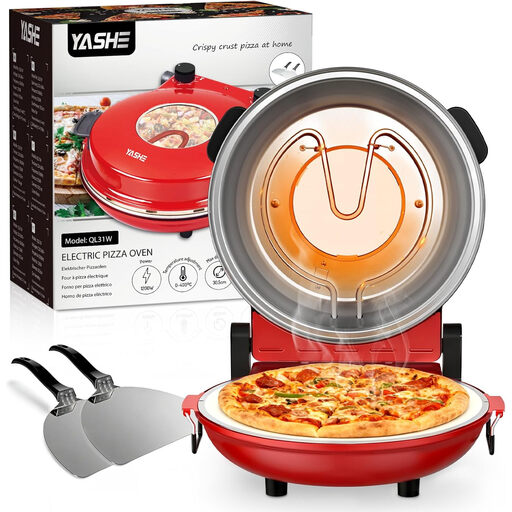 Image unavailable
An option if you want to use top and bottom heat; check that the ceramic stone suits the shape of your bake and the way your recipe is made.
The product name specifies a 30 cm ceramic stone, 1200 W, top and bottom heat, a built-in timer and a viewing window.
 Image unavailable
A larger oven to consider if you’re looking for more baking space. Measure the space available and allow for the required ventilation clearance.
The product name specifies a capacity of 35 litres, a thermometer and a four-level baking rack.
 Image unavailable
A freestanding oven to consider if you’re looking for a larger capacity. Check that its external dimensions and required clearance will fit in the holiday cottage.
The product name specifies a capacity of 45 litres, 2000 W and a white finish.
 Image unavailable
A model to consider if you’re looking for a mini oven. Measure your baking tin and check that the settings and timer suit your recipe.
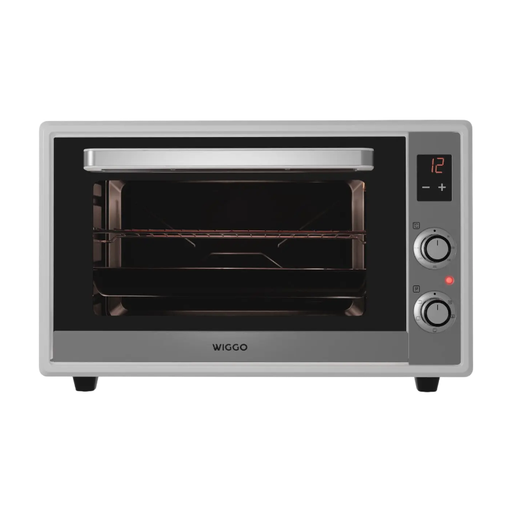 Image unavailable
This larger freestanding oven needs plenty of space. Measure the area available before considering this size.
The product name specifies 65 litres and 2000 W. The stated dimensions are 60 × 49 × 40 cm and the weight is 14 kg.
You’ll need an oven or a combi microwave with an oven function to bake. If you’re using an appliance in the holiday cottage, check specifically that it has an oven function.
Follow the settings in your own recipe. The Rutger Bakt recipe we consulted recommends preheating the oven to 200 °C for small pear galettes and baking them on a baking-paper-lined tray for 25–35 minutes. This isn’t a universal setting for other recipes or ovens.
Follow the instructions for the exact model and keep the ventilation openings clear. The Tomado TEO2101B instructions specify 10 cm of clearance on all sides and say to unplug the appliance and let it cool before cleaning.
Check who the seller is and how servicing is handled. According to the Dutch government, consumers’ rights when a product is faulty are separate from any manufacturer’s guarantee.
No. The stated power rating alone doesn’t tell you how much energy a baking session will use. Where possible, compare energy-use figures on the same basis and consider the energy used per bake.