
Less fat per snack
You want to take peanut snacks with you alongside your lunch and are mainly choosing based on their composition. Compare nutritional values on the same basis, and distinguish between a low-fat composition and a smaller portion.


If you’re looking for peanut snacks with less fat, compare the nutrition information per 100 g: a smaller portion doesn’t change the product’s composition. For a ‘low fat’ claim, the European Commission sets a limit of 3 g of fat per 100 g for solid foods. ‘Reduced fat’ is a different claim, so check the exact wording and basis for comparison on the packaging.
You want to take peanut snacks with you alongside your lunch and are mainly choosing based on their composition. Compare nutritional values on the same basis, and distinguish between a low-fat composition and a smaller portion.
You’d rather take a measured amount with you than eat from a large bag while you’re out. Portion size, individual bags and resealability all affect how convenient they are to use.
You look beyond total fat to saturated fat, energy and salt. Advice about unsalted nuts doesn’t necessarily apply to coated peanut snacks.
Compare nutritional values per 100 g. For solid foods, the European Commission sets a limit of 3 g of fat per 100 g for a ‘low fat’ claim.
| What to consider | What to look for when buying | Who is this important for? |
|---|---|---|
| Fat content and claim | Compare fat per 100 g and check whether the claim says ‘low fat’ or ‘reduced fat’. | If I want less fat in the product itself, I compare the values per 100 g and check the exact wording of the claim. Around 36% of consumers prioritise the product’s composition. |
| Portion and portability | Check the weight of each bag and whether a larger pack can be resealed. | For my lunch, I want to take an amount that I can limit in advance. Around 29% of consumers prioritise portion size and ease of taking the product with them. |
| Nutritional values | As well as total fat, check energy, saturated fat and salt, all per 100 g. | I want to compare several nutritional values before making a choice. Around 21% of consumers prioritise the overall nutritional composition. |
| Flavour and size | Choose a flavour and bag size that suit how you’ll use the product; don’t take them as proof of a lower fat content. | If flavour and a convenient size for my lunch are the deciding factors, I still check the nutritional values separately. Around 14% of consumers prioritise flavour and size. |
The pack size doesn’t change the nutritional value per 100 g. The Duyvis Provencale 20-pack lists 35 g of fat per 100 g, while the European Commission sets a limit of 3 g per 100 g for a ‘low fat’ claim on solid foods.
Check the nutritional value per 100 g first, then decide how much you want to take with you.
Energy, saturated fat and salt are listed separately in the nutrition information and tell you something different from the total fat content.
Compare these values per 100 g, then work them out for the portion you plan to take with you.
Peanut snacks are coated products. The Voedingscentrum recommends unsalted nuts, but that doesn’t make them equivalent to peanut snacks.
Assess the specific peanut snack by checking its ingredients and nutritional values on the packaging.
These product examples can help you compare flavour, packaging and nutritional values; a brand name alone doesn’t tell you whether a variant is low in fat.
The range includes Provencale, Cocktail, Poesta and Oriental, among other varieties.
AH Borrelnoten cocktail is an own-brand variant in a resealable 250 g pack.
The range includes Cocktail, Provençal and Shanghai-style varieties in different bag sizes.
Lidl lists borrelnoten on its range page; here, ‘borrelnoten’ refers to the product category.
ALDI sells TRADER JOE'S peanut snacks in a 300 g pack, with flavours including bacon and cheese, Poesta and paprika.
PLUS Borrelnoten Mild is a 300 g own-brand variant with a seasoned, crunchy coating.
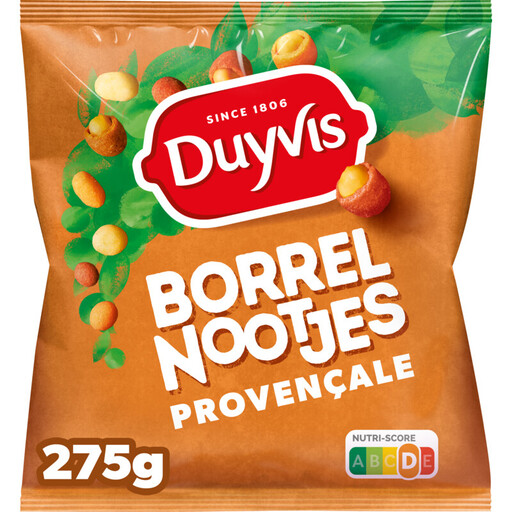
This Joybuy pick is a Duyvis Provencale variant. Use the nutritional value per 100 g to decide whether it suits your aim of eating less fat.
 No image available
This variant isn’t low in fat; compare its composition per 100 g if you’re looking for less fat in the product itself.
The product information lists 35 g of fat per 100 g. For solid foods, the European Commission sets a limit of 3 g of fat per 100 g for a ‘low fat’ claim.
For solid foods, the European Commission sets a limit of 3 g of fat per 100 g. So compare the composition per 100 g, rather than looking only at the amount in a small bag.
Multiply the fat per 100 g shown on the label by the weight of your portion, then divide by 100. Use the nutritional values for the specific pack; the portion size on the label may not match the amount you eat.
Follow the instructions on the packaging for your product. AH Borrelnoten cocktail should be closed securely after use and stored somewhere cool, dark and dry. For the Duyvis Provencale 20-pack, it’s recommended that you store an opened bag in a light- and airtight container.
The AH Cocktail, PLUS Mild and Duyvis Provencale variants we looked at contain peanuts, so they aren’t suitable if you need to avoid peanuts. If you have other allergies, check the ingredients and warnings on the specific packaging too.
The AH, PLUS and Duyvis product pages we looked at warn that young children can choke on peanuts or nuts. Follow the warning on the packaging for the specific variant.