Who is this choice relevant to?

Snackers who watch their portions

You want to keep eating peanuts while keeping an eye on the energy in the amount you serve yourself. Weighing your portion and checking the nutritional values per 100 g help you compare varieties on a like-for-like basis.

Those looking for less fat

You’re looking for a lower fat content and want to distinguish between an absolute claim, a comparison with another product and a description of how it’s prepared, such as oven-roasted.

Those looking for unsalted peanuts

You want an unsalted variety and also check the ingredients. Unsalted, by itself, tells you nothing about the fat or energy content.

What should you look for when buying?

Peanuts with a reduced-fat claim

Choose these when: you’re specifically looking for a lower fat content. Check the claim on the exact pack and find out what it’s being compared with.

Consider: a claim on a snack mix doesn’t automatically apply to plain peanuts. Albert Heijn described a historical mix that was compared with peanuts in a crispy coating.

Unsalted peanuts with a weighed portion

Choose these when: you want an unsalted variety and, above all, want to keep track of how much you eat.

Consider: unsalted doesn’t automatically mean low in fat or energy. Check the nutritional values and ingredients for the variety, too.

Oven-roasted peanuts

Choose these when: it matters to you that no oil or fat is added during roasting. Duyvis describes this method for Oven Baked Original.

Consider: the AH label information for Duyvis Original still lists 50 g of fat and 606 kcal per 100 g, plus 1.4 g of salt.

What to consider What should you check? Who is this important to?
Identifying a lower fat content Check the fat per 100 g, the exact variety and, for a percentage claim, what it’s being compared with. For solid foods, the European Commission sets a maximum of 3 g of fat per 100 g for the ‘low fat’ claim. I’m mainly looking for a verifiably lower fat content and want to know what the comparison is based on. Around 34% of consumers put reduced fat at the top of their list.
Energy in your own portion Compare kcal per 100 g and calculate this for the same weighed amount; serving sizes can differ between manufacturers. I want to assess the energy in my own snack portion, rather than simply comparing two different serving sizes on packs. Around 33% of consumers give energy and portion size their highest priority.
Unsalted and ingredients Check the salt per 100 g and the ingredients list. Also check whether oil, sugar or a flavour coating is listed. If I mainly want an unsalted snack, I also compare the ingredients without assuming this means less energy. Around 20% of consumers put an unsalted recipe first.
Pack size and storage Compare the net weight and unit price for the exact variety. Follow the storage advice and reseal the pack after use. I want a pack size that suits how I use the product and that I can store properly once opened. Around 13% of consumers give pack size and value for money their highest priority.

Common buying mistakes

  • Confusing oven-roasted with low fat

    A description of how a product is prepared doesn’t tell you how much fat the finished product contains. For solid foods, the European Commission sets a maximum of 3 g of fat per 100 g for the ‘low fat’ claim. The Duyvis Original variety described by Albert Heijn lists 50 g per 100 g.

    Check the total fat per 100 g and consider the preparation method as a separate feature.

  • Comparing products with different serving sizes

    A 25 g serving on one label and a 30 g serving on another aren’t a like-for-like basis for a direct comparison. Albert Heijn lists 25 g for AH Unsalted Peanuts; the AH product information for Duyvis Original lists 30 g.

    Compare per 100 g first, then calculate the values for both varieties using the same amount.

  • Applying a snack mix claim to plain peanuts

    The comparison and product category determine what a claim refers to. The historical Duyvis Japanese snack mix described by Albert Heijn was a mix containing rice crackers and was compared with peanuts in a crispy coating.

    Check the claim for the exact variety and keep snack mixes, coated peanuts and plain peanuts separate.

  • Treating a large pack as one snack portion

    The net weight of a bag is the pack size; it isn’t automatically the amount you’ll want to eat at one time.

    Divide it into portions yourself and reseal the pack after use, following the storage advice.

Brands and varieties to consider

Duyvis

Relevant for roasted and seasoned snack peanuts; the Original variety reviewed has a savoury flavour.

  • Duyvis describes Oven Baked Original as being roasted without added oil or fat.
  • The preparation method doesn’t prove that the finished product is low in fat. For the Original variety described, Albert Heijn lists 50 g of fat and 606 kcal per 100 g.

Albert Heijn

The AH Unsalted Peanuts reviewed are a reference for an unsalted variety; the product page describes a 300 g pack.

  • For this variety, Albert Heijn lists a 25 g serving and provides nutritional values on the product page.
  • Unsalted doesn’t mean low in fat: the product page lists 51 g of fat and 620 kcal per 100 g for this variety.

Jumbo

The Dutch category overview lists unsalted peanuts in various pack sizes, as well as a separate Dry Roasted variety.

  • The pack sizes listed can help you choose a pack that suits how you use the product.
  • Category names don’t prove that a variety contains less fat or energy. Check the label for the exact product.

PLUS

The unsalted variety reviewed comes in a 250 g bag.

  • PLUS product information provides the ingredients and nutritional values for this specific variety.
  • For the 250 g variety, PLUS lists 50 g of fat and 625 kcal per 100 g. These values don’t automatically apply to other pack sizes or varieties.

ALDI

The Dutch product description from ALDI is for Trader Joe’s 250 g roasted, unsalted peanuts.

  • The product description makes this variety relevant if you’re looking for roasted, unsalted peanuts.
  • The description doesn’t substantiate a reduction in fat or an effect on weight management.

Lidl

The Dutch product range page lists unsalted peanuts as a product category.

  • The category shows that unsalted peanuts are included in the product range.
  • The category name isn’t nutritional evidence that the product contains less fat or energy. Check the details for the exact variety.

Peanuts at Joybuy

This selection of Joybuy products includes unsalted peanuts, roasted peanuts and peanuts in their shells. For each exact variety, compare the nutritional values, ingredients and portion size that suit your needs.
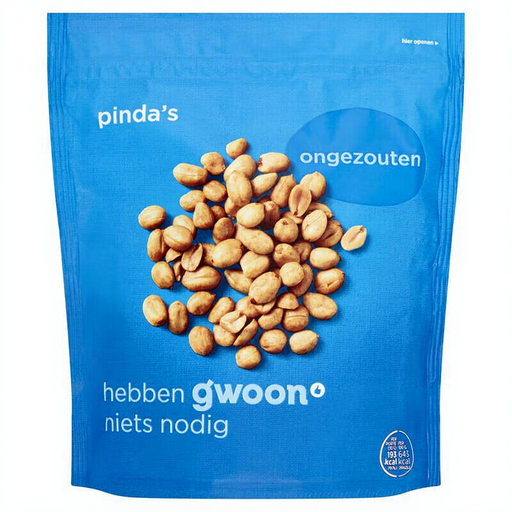
g’woon unsalted peanuts, 250 g

g’woon unsalted peanuts, 250 g

An option if you’re looking for unsalted peanuts in a 250 g pack.

The product information lists 99% peanuts and sunflower oil. Check the nutritional values and information about possible traces of cashew nuts for this variety.

View at Joybuy
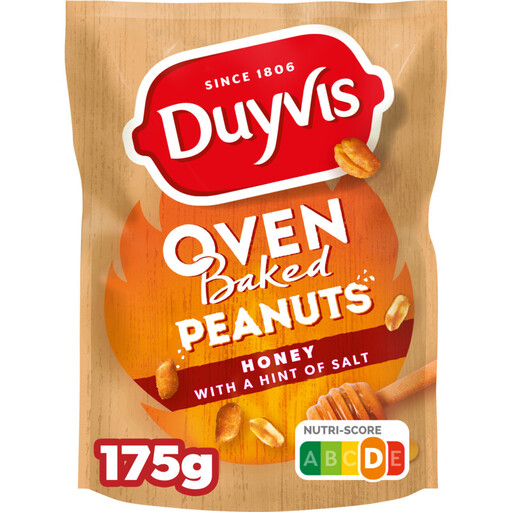
Duyvis Honey & Lightly Salted Oven-Roasted Peanuts

Duyvis Honey & Lightly Salted Oven-Roasted Peanuts

An oven-roasted variety with a honey flavour and a light sprinkling of salt, as stated in the product name.

Before comparing this exact variety with plain peanuts, check its nutritional values and ingredients, including honey, sugar, sunflower oil and salt.

View at Joybuy
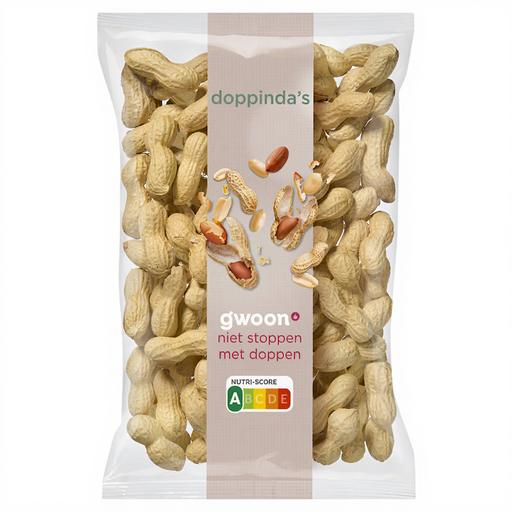
g’woon peanuts in their shells, 500 g

g’woon peanuts in their shells, 500 g

An option if you specifically want peanuts in their shells.

The product name states that the pack contains 500 g. Refer to the product information for nutritional values and possible traces of nuts.

View at Joybuy
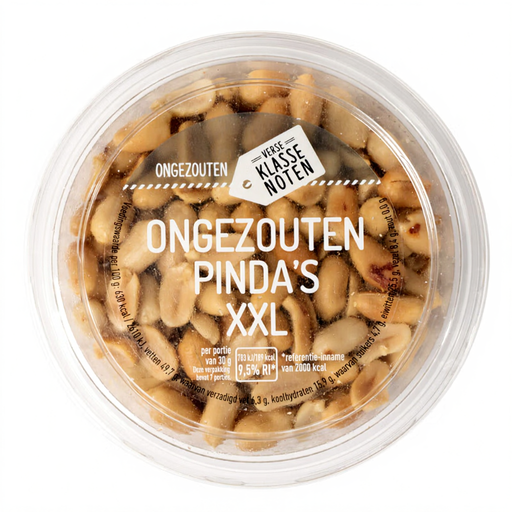
Verse Extra Large roasted peanuts, 210 g

Verse Extra Large roasted peanuts, 210 g

A roasted variety in a 210 g pack, according to the product name.

The available product information contains conflicting allergen details. Carefully check the pack and current product information before buying.

View at Joybuy

Frequently asked questions

When can a pack of peanuts be labelled ‘low fat’?

For solid foods, the European Commission sets a maximum of 3 g of fat per 100 g for the ‘low fat’ claim. This is an absolute limit, not just a comparison with another product.

Is the serving size on the pack personal weight-loss advice?

No. Treat the stated serving size as product information, not personal weight-loss advice. For example, Albert Heijn lists 25 g for AH Unsalted Peanuts, while the product information for Duyvis Original gives a 30 g serving. Choose the amount you want to assess and compare the energy on the same basis.

What allergen information should I check on packaged peanuts?

Check the allergen information on the pack for the exact variety. According to the Netherlands Food and Consumer Product Safety Authority, allergen information must appear on the label of prepacked foods. Also read the information about possible traces of other nuts.

Are whole peanuts automatically suitable for young children?

No. The AH, PLUS and Duyvis labels reviewed warn that young children may choke on peanuts. General snack information is therefore not advice on whether peanuts are suitable for young children.

Does the recall warning apply to all salted peanuts from Albert Heijn?

No. Albert Heijn’s warning of 20 May 2026 concerns AH Extra Large Salted Peanuts in a tub with a best-before date of 04-11-2026. Do not eat this specific product; Albert Heijn says you can return it to a shop for a refund. The warning does not include products with other best-before dates in this recall.
