What should you look for in peanuts to enjoy in front of the TV?
First decide what matters most to you: fat content, how much you eat, salt, flavour or pack size.
| What to consider |
What should you check? |
Who does this matter most to? |
| Proven lower total fat |
Compare the fat per 100 g for the exact variety and check what it is being compared with. |
If I want to eat less fat, I want to compare the fat content of the variety I choose. Around 33% of consumers put a proven reduction in fat first. |
| The portion you eat |
Weigh the amount you plan to eat and calculate the nutritional values using the label. |
I want to decide in advance how many peanuts to have while watching; for around 27% of consumers, keeping portions in check is the main requirement. |
| Less salt |
Check the salt per 100 g and make sure the exact variety is salted or unsalted. |
If salt matters more to me than a fat claim, I look for a suitable unsalted variety. Around 20% of consumers put limiting salt first. |
| Flavour and preparation |
Check the product type and the ingredients in the flavour you’ve chosen. |
I want a flavour or preparation method that suits my preferences, without assuming that it means less fat. For around 13% of consumers, preserving flavour matters most. |
| Pack size |
Compare the net weight with the amount you want to eat and store. |
I want a pack that suits how I use it and the storage space I have. Around 7% of consumers prioritise pack size. |
Peanuts at Joybuy
These peanut snacks offer options for assessing portion size, salt content or preparation method; the features listed do not, on their own, demonstrate a reduction in fat.
 Image unavailable
g'woon unsalted peanuts, 250 g
An unsalted variety for weighing out the portion you choose; unsalted does not mean low fat.
Per 100 g: 50 g of fat and 0.02 g of salt. The ingredients are 99% peanuts and sunflower oil. May contain cashew nuts.
View at Joybuy
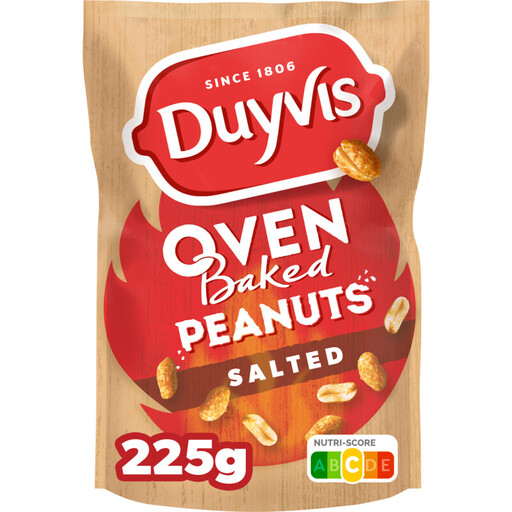 Image unavailable
Duyvis roasted peanuts, 225 g
A savoury roasted peanut snack; check the salt content if you’re looking to limit it.
The product information lists 50 g of fat and 1.4 g of salt per 100 g.
View at Joybuy
 Image unavailable
G'woon peanuts in shells, 500 g
For anyone who likes to shell their own peanuts and decide how much to eat.
The product information lists 49 g of fat and 0.12 g of salt per 100 g. The ingredients list names peanuts.
View at Joybuy
 Image unavailable
Verse extra-large roasted peanuts, 210 g
An unsalted roasted variety to compare if you’re also keeping an eye on salt.
The product information lists 50 g of fat and 0.02 g of salt per 100 g. The ingredients are 100% peanuts.
View at Joybuy
Frequently asked questions about peanuts to enjoy in front of the TV
When can a peanut snack be called ‘low fat’?
For solid foods, the limit is 3 g of fat per 100 g. This is the condition for the claim set by the European Commission; ‘unsalted’ or ‘oven-baked’ does not, on its own, prove that a peanut snack meets this requirement.
How can I stop a small pack becoming my whole portion?
Compare the pack weight with the amount you want to eat, and weigh that amount out separately if needed. Duyvis also sells a 60 g pack, for example, while the Netherlands Nutrition Centre’s general reference amount for unsalted peanuts is 25 g.
Does peanut have to be clearly identified as an allergen on the label?
Yes. Peanut is an allergen, and the Netherlands Food and Consumer Product Safety Authority (NVWA) requires allergens to be clearly distinguishable in the ingredients list. Check the current packaging for allergen information about the variety you’ve chosen.
Which recall warning applies to AH peanuts?
Albert Heijn’s warning concerns AH Extra Large Salted Peanuts in a tub with a best-before date of 04-11-2026, because it may contain metal fragments. Do not eat the specific pack mentioned; this warning does not automatically apply to other AH peanuts.
How should I store opened salted peanuts?
The Netherlands Nutrition Centre’s general advice is to keep them in a kitchen cupboard for six months or in the freezer for one year. Quality may deteriorate; check for rancidity, a chewy texture or mould, and follow the storage instructions on the packaging too.


