What should you look for when buying?
First compare the total fat on the same basis, then decide on your portion and consider salt, flavour and pack size as separate choices.
| What to consider |
What should you check? |
Who should pay particular attention? |
| Verified lower total fat |
Compare the total fat per 100 grams and check which product is used as the basis for the claim. |
If I want to eat less fat, I want to compare the labels rather than rely on a product name; around 31% of consumers rank a verified fat reduction as their top buying priority. |
| Amount in your bowl |
Weigh your portion and use the nutritional values for that exact variant. |
For my TV snack bowl, I want to decide the amount myself, regardless of the pack size; around 25% of consumers give portion control top priority. |
| Choosing unsalted |
Check that the specific variant is labelled unsalted; assess the fat content separately. |
If salt is my main consideration, I look for an unsalted variant without assuming that means less fat; around 19% of consumers put unsalted first. |
| Flavour and preparation |
Check whether the peanuts are plain, roasted or coated, and read the ingredients. |
For my snack, I mainly want a flavour and preparation method I enjoy, while considering nutritional values separately; around 13% of consumers prioritise flavour and preparation. |
| Pack size |
Compare the pack contents with the amount you plan to use. |
I want to buy an amount that suits me, rather than simply choosing a larger bag; around 12% of consumers rank pack value as their top buying priority. |
Brands to compare
The product ranges mentioned can help you compare preparation methods, salt content and packaging. These features don’t, on their own, prove that a product has a lower fat content.
Duyvis
Duyvis describes various preparation methods and types of snacks, including Oven Baked Peanuts Original.
- The manufacturer describes the Original variant as roasted without added oil or fat.
- That preparation feature doesn’t prove a lower total fat content. The historical claim for Japanese Party Mix referred to peanuts in a crunchy coating and isn’t a comparison with all plain peanuts.
Albert Heijn
Albert Heijn lists unsalted peanuts in various pack sizes.
- Its own search page lists unsalted variants in 250- and 500-gram packs.
- The product listings confirm the variants and pack sizes, not a lower fat content across the own-brand range as a whole.
Jumbo
Jumbo lists unsalted and dry-roasted peanuts, among other options.
- The product and category pages list unsalted packs of 250 and 500 grams, as well as a 200-gram dry-roasted variant.
- The names and pack-size differences don’t support a claim of lower total fat.
Lidl
Lidl lists a 285-gram unsalted peanut variant.
- The product page describes the variant as unsalted and says it’s available in stores only.
- This product information applies to the variant specified and says nothing about a lower fat content across all Lidl peanuts.
Aldi
Aldi lists 250-gram packs of Trader Joe’s roasted, unsalted peanuts.
- The product page lists the peanuts as roasted and unsalted.
- Trader Joe’s is the product brand name shown on the page; roasted and unsalted don’t prove a lower fat content.
PLUS
PLUS lists unsalted peanuts in a 250-gram pack.
- The product page confirms the variant and pack size.
- PLUS advises checking the packaging because product information can change; unsalted doesn’t prove lower fat.
Peanuts at Joybuy
These products include snack peanuts in unsalted, roasted and flavoured varieties. Compare the total fat on the pack; flavour, salt and preparation method don’t tell you this on their own.
 Image unavailable
g’woon unsalted peanuts, 250 g
An unsalted option if that’s important to you; unsalted doesn’t automatically mean lower in fat.
The product description lists 99% peanuts and sunflower oil.
View at Joybuy
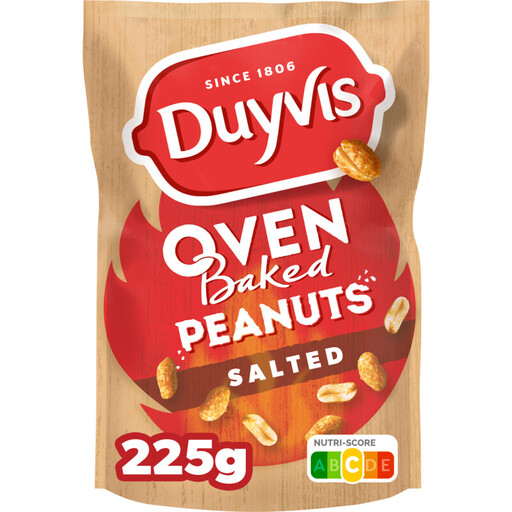 Image unavailable
Duyvis roasted peanuts, 225 g
A ready-to-eat roasted snack; check the label if fat content is your main buying criterion.
The product description mentions a savoury flavour and peanuts that are ready to eat as a snack.
View at Joybuy
 Image unavailable
Duyvis Honey & Lightly Salted Oven-Roasted Peanuts
A sweet and savoury option if you enjoy honey and salt; that flavour choice doesn’t indicate lower fat.
The title lists 175 g and the description mentions 5–6 servings. The product information lists wheat and gluten and says it may contain other nuts.
View at Joybuy
 Image unavailable
g’woon peanuts in shell, 500 g
A snack option in the shell for anyone who likes to shell their own peanuts; bear the shells in mind when serving.
The pack contains 500 g. The nutritional values shown aren’t linked to a specific weight, so they can’t be used for a comparison per 100 grams.
View at Joybuy
 Image unavailable
Verse Extra Large roasted peanuts, 210 g
A roasted option if you’re looking for peanuts with no added salt; check the label for total fat per 100 grams.
The product information lists 100% peanuts and no added salt.
View at Joybuy
Frequently asked questions
Are oven-roasted peanuts automatically low-fat?
No. Duyvis describes Oven Baked Peanuts Original as roasted without added fat, but that doesn’t tell you how much total fat the peanuts contain. For the general category of dry-roasted peanuts, the Netherlands Nutrition Centre gives 11.8 grams of fat per 25-gram serving; this isn’t an exact nutritional value for this Duyvis product.
What’s the difference between low-fat and reduced fat?
According to the Netherlands Nutrition Centre, the low-fat claim for solid foods means no more than 3 grams of fat per 100 grams. Don’t treat a comparative claim such as reduced fat as a synonym: check the product packaging to see which product and feature are being used for comparison.
How do I work out the amount of fat in my snack bowl?
Use the nutritional values on your pack: grams of fat per 100 grams × the weight of your portion ÷ 100. Compare different products on the same basis; for its example of dry-roasted peanuts, the Netherlands Nutrition Centre uses a 25-gram serving.
What allergen information should I check before buying?
Check the allergen information on the label of pre-packed peanuts. The Netherlands Food and Consumer Product Safety Authority says this information must appear on the label; since 2026, the NVWA has also been checking the new rules for warnings about unintended cross-contamination.
Does Albert Heijn’s warning apply to all peanuts?
No. Albert Heijn’s warning concerns AH Extra Large Salted Peanuts in a tub with a best-before date of 04-11-2026 due to possible metal fragments. Don’t eat the product with that date; the warning doesn’t automatically apply to other AH peanuts or products with different best-before dates.


